
ARCAM, originally called A&R Cambridge, got its start back in 1976, when a couple of engineering students at the University of Cambridge built an integrated amp called the A&R Cambridge A60. From there, the company built its reputation almost entirely on two-channel stereo gear, picking up plenty of awards over the decades for a sound that's always leaned natural and musical rather than clinical. ARCAM actually has a longer AV pedigree than you might expect too. Back in 1995 they built the Xeta 1, which they call the world's first audiophile AV amp, and when Harman Group acquired the company in 2017, ARCAM continued to build out its multichannel lineup alongside that stereo focus. Harman also owns JBL and Revel, two more brands we're big fans of, so pairing ARCAM's sound with Harman's engineering resources has worked out well.
In 2023, ARCAM gave its two-channel gear a whole refreshed look and called it Radia. The Radia series represented a sweeping update across ARCAM's HiFi lineup, with major changes to the aesthetic, a reimagined user interface and dedicated app, and a series of engineering advancements aimed at pushing sonic performance to a new level. ARCAM has carried that same approach through everything since.
Now, for the first time, Radia is making its way into full home theater gear with four new products: the AVA15, AVA25, and AVA35 AV amplifiers, plus the AVP45 AV processor. These replace the AVR11, AVR21, AVR31, and AV41 lineup that came out back in 2020, and among several significant changes, one of the biggest jumps from that generation to this one is amplification. The old lineup topped out at seven built-in amplified channels. This new one bumps that up to nine across the board.
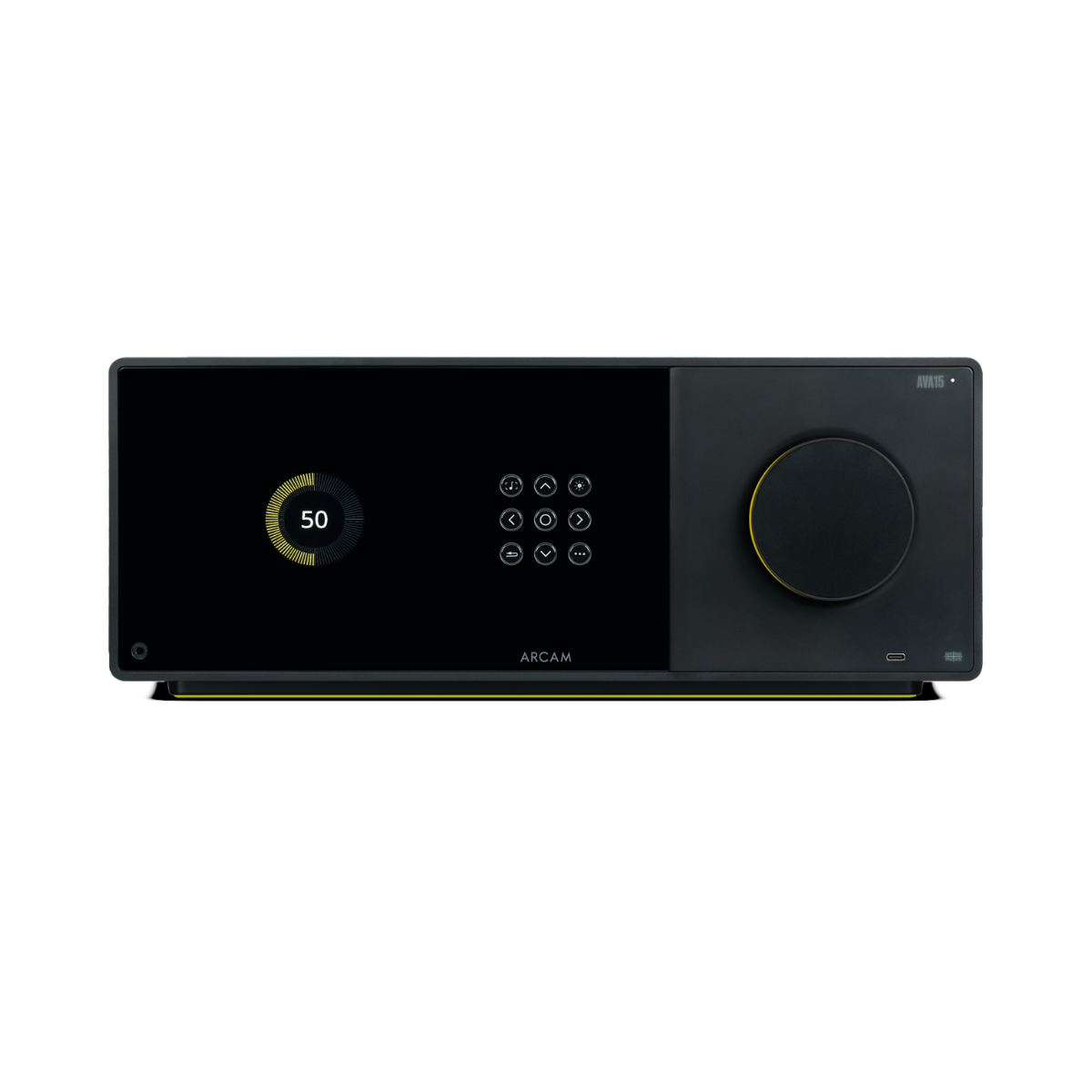
Arcam Radia AVA15 9-channel Class D Home Theater Receiver
$4,499.95
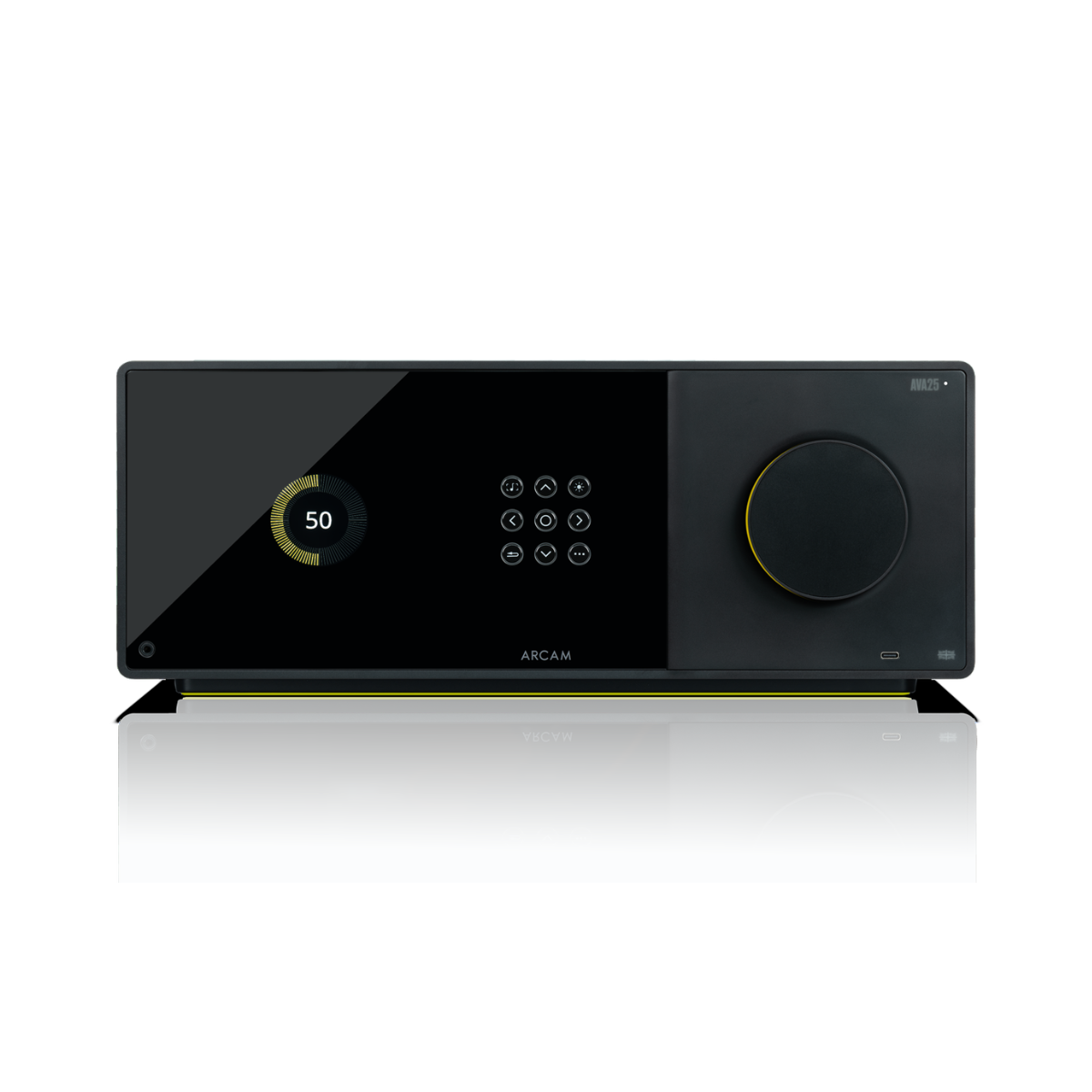
Arcam Radia AVA25 9-channel Class A/B Home Theater Receiver
$5,499.95
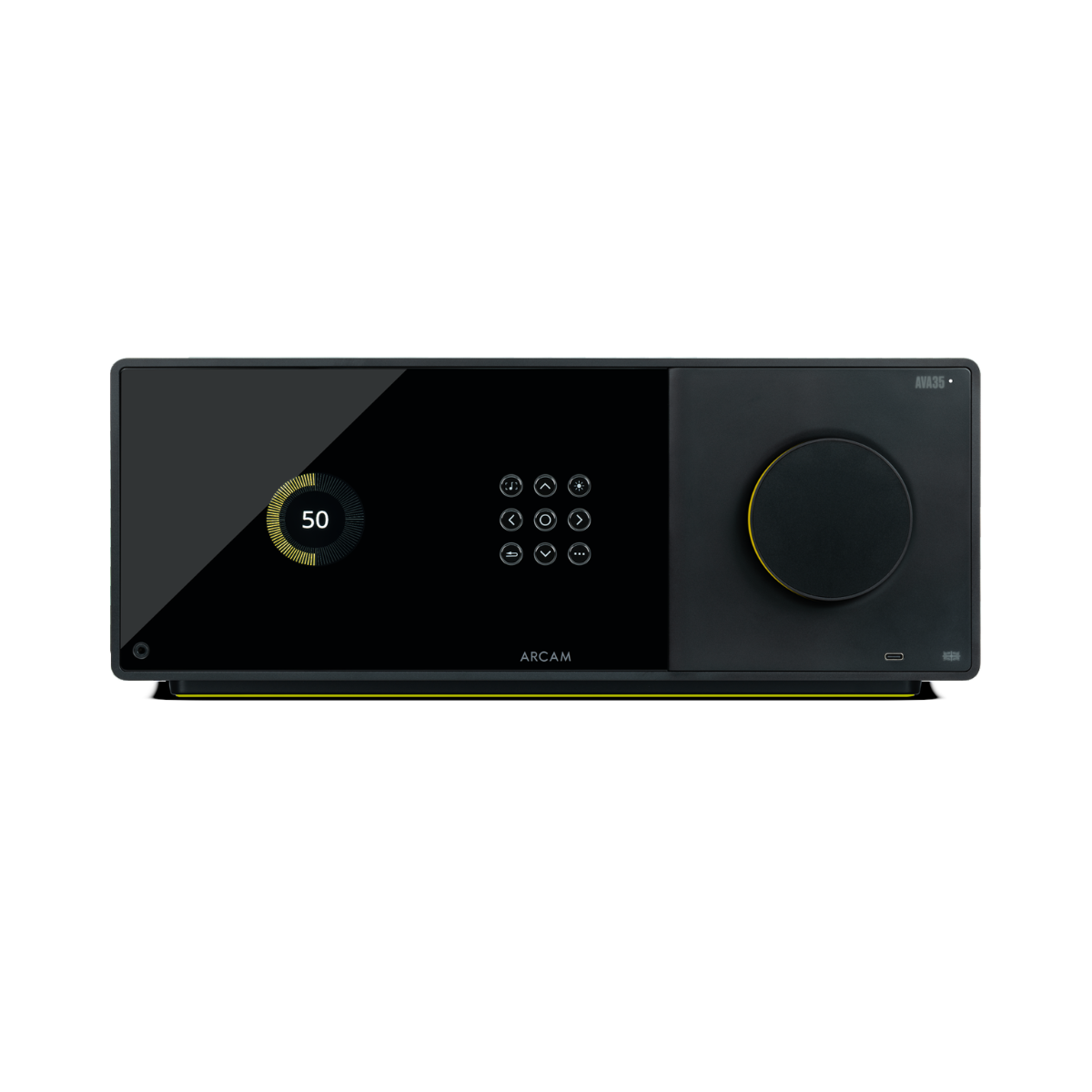
Arcam Radia AVA35 9-channel Class G Home Theater Receiver
$6,999.95
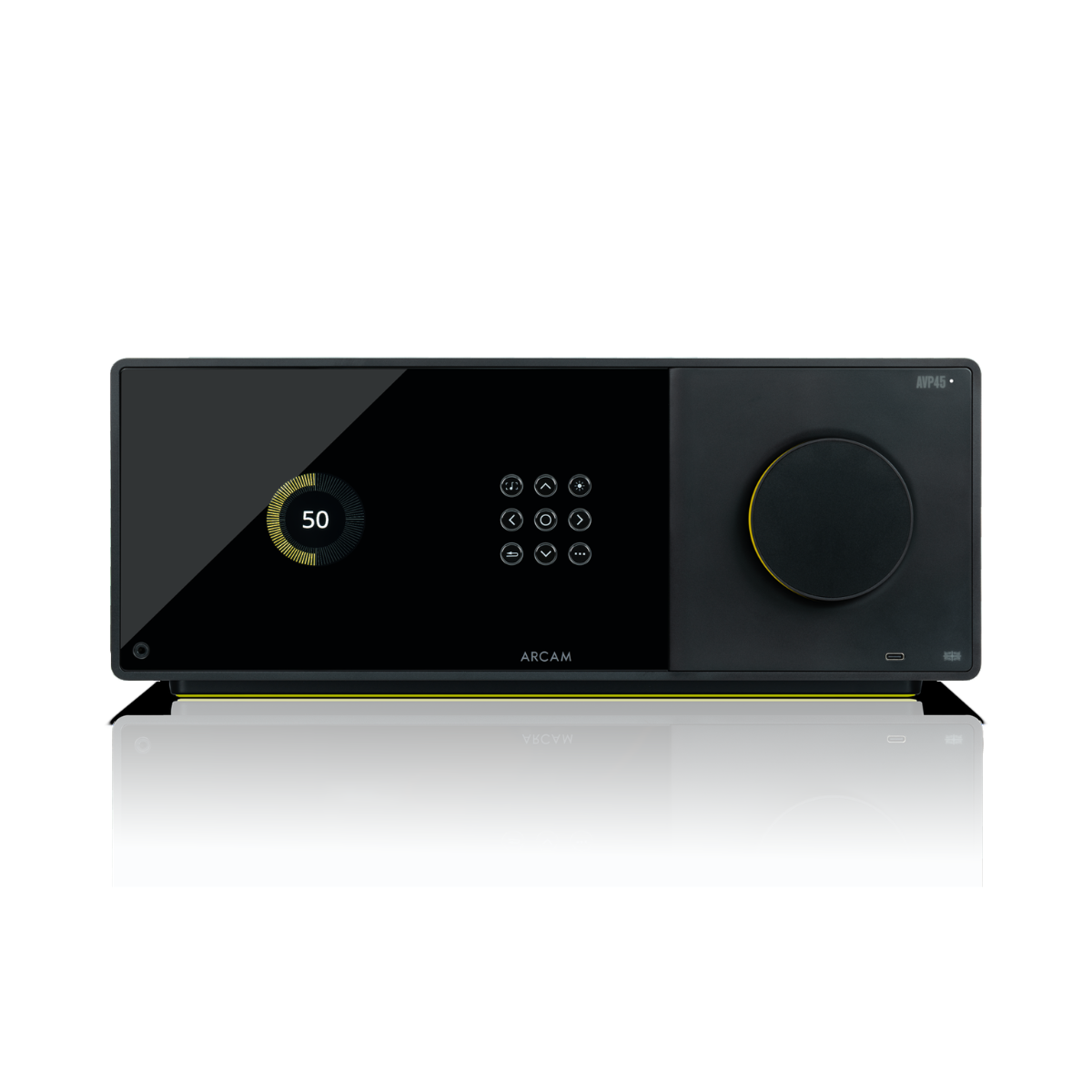
Arcam Radia AVP45 16-Channel Surround Sound Processor
$5,999.95
All four models carry the same look as the rest of the Radia lineup: black casework, a thin yellow ring around the volume knob, and the same 6.5 inch color display found on ARCAM's two-channel gear. There's also a rear panel cowl that overhangs the back of the chassis just enough to hide cables and antennas without adding any bulk, a detail carried straight over from the stereo amps.
These feel built to last, too. The AVA25 comes in at over 47 pounds, and the AVA35 tips the scales at over 50, which is a lot of amplifier packed into that chassis.
Every model in this lineup runs Dirac Live Room Correction, which is one of the best room correction platforms out there. It measures your room with a microphone, then corrects both the frequency response and the timing of what's actually reaching your seat. It does take a little setup, but we have a detailed guide on how to use it that walks you through the whole process and makes it easy for anyone to do.
Beyond that baseline, there are two paid upgrades, and both are new options ARCAM is offering for the first time with this lineup.
Dirac Live Bass Control treats every subwoofer and speaker in your system as one cohesive low end instead of correcting each one on its own. It aligns the timing and phase between your subs and your main speakers so the bass blends in seamlessly instead of feeling disconnected, and it cuts down on the boomy, uneven bass you get from seat to seat.
Dirac Live Active Room Treatment (ART) is the other upgrade, and these are ARCAM's first products to offer it. ART uses your speakers to fight back against room reflections in real time, kind of like noise cancellation for room acoustics, targeting the stubborn 20 to 150 hertz range where most bass problems live. It's genuinely impressive technology, but it earns its keep most in rooms that fight you acoustically: open floor plans, hard reflective surfaces, oddly shaped rooms, that kind of thing. In a room that's already fairly well behaved, it's still worthwhile, just a more incremental improvement. Worth knowing if you have subwoofers: ART needs Bass Control running alongside it to deliver its full benefit, so it's less of an either-or between the two and more of a package deal. You either add Bass Control on its own, or you get both together.
Between the two, you get tighter, cleaner bass and a much bigger sweet spot that isn't limited to just one chair in the room.
On subwoofers specifically, all four models come with one dedicated subwoofer preamp output as standard. The AVA35 and AVP45 are the exception. Their Matrix Channel Assignment lets you reassign additional channels to add more subs if your room calls for it, though every channel you hand over to a sub is one less channel available for speakers. Run 4 independent subs on one of those and you're still left with 12 channels for everything else, plenty for a full 7.1.4 layout. For most rooms this won't matter at all, but it's a fair tradeoff to know about if you're planning a bigger install.
On the DAC side, the AVA15 and AVA25 use ESS's Hyperstream IV DAC platform, while the AVA35 and AVP45 step up to the more advanced Hyperstream IV DAC Pro, the same chip ARCAM uses in its five-star SA45 streaming amplifier. That's a serious DAC for gear at this price point, and it's a big part of why these sound as musical as they do even before you factor in the amplifier stage.
On the video side, you get HDMI 2.1a with seven inputs and two outputs for the main zone, support for 8K at 60Hz or 4K at 120Hz, HDR10+, Dolby Vision, HLG, Variable Refresh Rate, and Auto Low Latency Mode for gaming. The AVA25, AVA35, and AVP45 add a third HDMI output with dedicated Zone 2 functionality that the AVA15 doesn't have. On the digital audio side, you get 2 coaxial and 2 optical digital inputs plus 3 pairs of analog RCA inputs across the board.
Streaming is fully covered too: AirPlay, Google Cast, Spotify Connect, Tidal Connect, Qobuz Connect, and Roon Ready certification are all here, controlled through the slick Radia app alongside internet radio and podcasts. And yes, there's Bluetooth, real two-way Bluetooth 5.4 with Snapdragon Sound and Auracast, so you can stream to these from your phone or send audio out to a pair of Bluetooth headphones for a late night listening session without waking anyone up.
One naming note worth mentioning: none of these four have a built-in AM or FM tuner, which is why ARCAM is calling them AVA, for AV Amplifier, instead of the AVR name from the last generation. Keep that in mind if a tuner is a must-have for you.
The AVA15 processes up to 12 channels total, with 9 of those powered directly onboard using Class D amplification rated at 85 watts per channel with two channels driven at 8 ohms. On its own, those 9 channels cover a 7.1.2 setup, or a 5.1.4 setup if you'd rather prioritize height channels over surrounds. Want to go further? Adding an external amplifier opens the door to something like a 9.1.2 layout, using the AVA15's full 12 channel ceiling.
Format support here covers Dolby Atmos and DTS:X, but skips IMAX Enhanced and Auro-3D, which ARCAM reserves for the step-up models.
Move up to the AVA25 and the processing ceiling jumps from 12 channels to 16, while the 9 built-in amplified channels switch from Class D to Class AB, now rated at 120 watts per channel with two channels driven at 8 ohms. It also steps up to a substantial toroidal linear power supply, which gives it more stable, consistent power under demand, especially useful in bigger rooms or with less efficient speakers that pull more current.
It's worth explaining what that switch to Class AB actually means. Class D, which the AVA15 uses, works by switching the output transistors fully on and off at very high speed to reconstruct the waveform. It's efficient and runs cool, but it's fundamentally a digital, switching process. Class AB drops that switching approach and goes back to a continuous analog design, where the output transistors stay partially active rather than snapping on and off. That avoids the crossover distortion you'd get from a less refined design, and that distinction matters more than it might sound like it should.
The fine detail that makes music and movies feel real usually lives in the quiet passages, not the loud ones, and that's exactly where crossover distortion tends to show up first. Class AB handles that without the excessive heat and power draw of running full Class A all the time. It's the same basic approach that's been the backbone of high-end audio amplification for decades, and it's a big part of why ARCAM says the AVA25 carries more of that classic two-channel realism into a multichannel system.
Just like the AVA15, those 9 onboard channels cover a 7.1.2 or 5.1.4 setup on their own, but that 16 channel ceiling gives you a lot more room to grow from there with extra height or surround speakers once you bring in external amplification. The AVA25 also picks up IMAX Enhanced and Auro-3D support, plus that dedicated Zone 2 HDMI output for a second room.
The AVA35 keeps that same 16 channel ceiling as the AVA25, but adds Matrix Channel Assignment across all 16 channels, and this is where it genuinely pulls ahead of the AVA25 rather than just adding more power. On the AVA25, positions like the extra height pairs and front wides are fixed, they do that one job and nothing else. On the AVA35, any of those 16 channels can be reassigned to whatever role your room actually needs. Don't want front wides? Turn those 2 preamp channels into a second and third subwoofer instead, running something like a 9.3.4 layout with all three subs blended together through Bass Control. Want to go the other direction and free up every onboard amp channel for surrounds and height speakers, running your main left, center, and right off a separate external amp entirely? That's on the table too.
Its 9 built-in channels step up again to Class G, ARCAM's signature amplifier topology, now rated at 145 watts per channel with two channels driven at 8 ohms. Think of it like a hybrid car engine. Instead of running off one single power supply all the time, Class G uses two. The first, lower power supply handles most normal listening levels and runs in pure Class A, the same distortion-free mode you'd find in the most exotic, inefficient amplifiers, and it stays in that mode for the vast majority of actual listening, since most music doesn't demand peak power most of the time. When a movie explosion or a musical peak calls for more, a second, higher voltage supply kicks in automatically, kind of like a turbo kicking in when you floor the accelerator, and modern circuitry handles that handoff fast enough that there's no lag or glitch to ever notice. ARCAM calls the circuit that manages that handoff a lifter circuit, designed specifically to ease into that extra headroom smoothly rather than switching abruptly, which is where cheaper Class G or Class H designs tend to introduce artifacts.
The result is an amplifier that sounds as pure and detailed as Class A during normal listening, without running hot or wasting power the way true Class A always does, while still having full power on tap the moment a movie or a song actually calls for it. On its own it covers the same 7.1.2 or 5.1.4 base as the other two, but that channel flexibility is really what separates it from the AVA25, not just the extra headroom.
The AVP45 is a different kind of product entirely. It's a 16 channel processor with zero built-in amplification, every single channel gets a balanced XLR output, and it's built for people who want to choose their own power amps rather than have them baked into the chassis. It carries the full format list, Dolby Atmos, DTS:X, IMAX Enhanced, and Auro-3D, plus Matrix Channel Assignment across all 16 channels and its own Zone 2 output.
ARCAM built two new power amplifiers to go with it. The PA9 is a nine channel Class G amp, and the PA4 is a compact four channel Class D amp for filling in height or surround duty. Pair the two together and you've got 13 channels of amplification to work with, or scale up further as your system grows, since the AVP45's 16 channel ceiling leaves room for configurations most people will never need, up to something like 9.1.6 if you really want to go all out.
If this is your first step into a real Dirac corrected, Atmos capable home theater system, the AVA15 gives you everything you need without paying for headroom you don't need yet. If you want more format support, more current, and more room to grow, the AVA25 is the move. If you want the most power and the most flexibility while keeping everything in one box, that's the AVA35. And if you're building a true separates system from scratch, where you want to choose your own amplification and expand it independently down the line, the AVP45 paired with a PA9 or PA4 is exactly what it's designed for.
We got our hands on early units ahead of launch and ran all four through the same reference system: JBL HDI-3800 towers up front for left and right, an HDI-4500 center, HDI-1600s handling sides and surrounds, two HDI-1200 subwoofers, and four SCL-8 in-ceiling speakers for Atmos and height duties, a full 7.2.4 setup. We put it through Top Gun Maverick, Dune, and a handful of other reference scenes, plus plenty of two-channel and Atmos music, and honestly, we were amazed at how great everything sounded. Dialogue was clear, the ceiling channels blended right into the overhead mix instead of sitting on top of it, and once Dirac finished calibrating, the two subs were tight and controlled. Atmos music tracks sounded just as good as the movies did, with real height and space to them.
Moving up the lineup, that improvement was easy to hear step by step. The AVA15 already sounded great on its own, the AVA25's Class AB stage brought a noticeably richer, more natural texture on top of that, and the AVA35's Class G took it further still. Across every single one of these, that classic ARCAM sound came through: natural, musical, and genuinely enjoyable to listen to, not just technically impressive. The AVA35 was the clear standout for us, especially on music, with real depth and texture that carried right over into the movie soundtracks too.
All three share the same 9 built-in amplified channels and similar streaming, HDMI, and Dirac Live features, but each steps up in amplifier class and channel count. The AVA15 uses Class D amplification and processes up to 12 channels. The AVA25 moves to Class AB, adds a toroidal linear power supply, and processes up to 16 channels. The AVA35 uses Class G, ARCAM's flagship amplifier topology, and adds Matrix Channel Assignment across all 16 channels for full speaker flexibility.
No. The AVA15 supports Dolby Atmos and DTS:X only. IMAX Enhanced and Auro-3D are reserved for the AVA25, AVA35, and AVP45.
It's a feature on the AVA35 and AVP45 that lets any of the 16 processing channels be reassigned to any speaker role, including extra subwoofers, height channels, or front wide channels. The AVA15 and AVA25 only allow reassignment among Front, Surround Back, and Height positions.
Yes, all four models include a full Dirac Live Room Correction license standard, not a limited or trial version. Dirac Live Bass Control and Dirac Live Active Room Treatment (ART) are available as separate paid upgrades.
Bass Control optimizes multiple subwoofers as one blended system rather than correcting each independently. ART goes further, using the system's speakers to actively counteract room reflections and resonances, primarily in the 20 to 150Hz range. If you have subwoofers, ART needs Bass Control alongside it to deliver its full benefit.
No. The AVP45 is a 16 channel processor with balanced XLR outputs on every channel and no built-in amplification. It's designed to pair with ARCAM's PA9 (9 channel Class G) or PA4 (4 channel Class D) power amplifiers.
Contact our experts via chat, phone, or email, visit one of our showrooms, or use our FREE Home Theater Design Tool.
We're a trusted seller since 1978, and we offer Free Shipping, Lifetime Expert Support, and our Price Guarantee on everything we carry.
You'll be among the first to know about product launches, exclusive online deals, and the hottest audio trends.