













Yamaha R200A
Couldn't load pickup availability
Free Shipping On All Orders, No Minimums.
We offer free 2-day shipping on most products within the continental US.
Weekdays - Orders placed by 2pm EST ship same day. Orders placed after 2pm EST will ship the following business day.
Weekends - Orders placed on Saturday and Sunday will ship Monday.
Orders requiring motor freight delivery may take more than two business days. Once your order has shipped, you'll receive a shipping confirmation email with a tracking number for easy tracking.
Orders for Open Box products ship with free ground shipping within the continental United States.
Orders that contain items that are currently backordered, special order, or out of stock will ship complete once all items are in-stock unless otherwise requested.
If you need it faster, you will have the option of choosing a quicker shipping option when you checkout on the website.
At this time, we do not ship internationally and orders to Hawaii and Alaska may incur an additional shipping charge. Please contact us at 888.899.8776 or email support@audioadvice.com to confirm.
Rerouting and Address Changes
We cannot make ANY address changes once an order is placed. If you are unable to accept delivery of your package as ordered, we will need to cancel your order, return the package to sender and have you replace your order through our website.
Keep the Box
We suggest you keep the shipping box or boxes for at least 30 days. It is actually a great idea to keep boxes for audio products for the life of the product. Having the box and all packing will increase the trade-in value should you decide to move up and they are handy to have should you ever need to send the unit in for repair.
How To Receive a Motor Freight Order
The trucking company will contact you to schedule a convenient time to deliver the order. Please note that you must be present for delivery.
Visually inspect the box to make sure you see no signs of damage. If you notice any damage at all, take some pictures with your phone and make a note of them on the delivery receipt the driver will ask you to sign. If it is obvious that the product is damaged, please refuse the order and contact us immediately at 888.899.8776 or email support@audioadvice.com.
Open your box as soon as possible and inspect the product for damage and contact us if you find anything wrong.
FedEx Freight Service Comparison
| Feature / Service | Scheduled Curbside Delivery | White Glove Delivery |
|---|---|---|
| Scheduled delivery appointment | ✔ | ✔ |
| Delivery location | Ground level only (garage, front door, loading dock) | Room of choice, any floor |
| Delivery team | 1 person | 2 people |
| Placement inside home/business | ✘ | ✔ |
| Upstairs / downstairs delivery | ✘ | ✔ |
| Unpacking | ✘ | ✔ (upon request) |
| Packaging removal | ✘ | ✔ (upon request) |
| Assembly / installation | ✘ | ✘ |
| Old item removal | ✘ | ✘ |
At Audio Advice, we pride ourselves on customer satisfaction. We'll bend over backward to make sure you're 100% satisfied and we won't accept anything less. We offer 30-day hassle-free returns and personalized service from real, live people.
If an item doesn't meet your expectations, you may return or exchange it in its original condition and packaging within 30 days for a full refund, minus shipping fees. Items shipped back in like new condition through standard shipping carriers will incur a minimum $15 return shipping fee. If the items were initially shipped through free scheduled delivery via motor freight (commonly referred to as LTL), returning them will result in return shipping fees starting at $150. These items include but are not limited to, oversized items such as TVs, certain subwoofers, floorstanding speakers, furniture, and most items weighing over 75 pounds. Return fees will also apply for exchanges. We want to treat your system as if it is our own and want you to be completely satisfied with your purchase.
Please see the instructions below. We only accept returns for any product purchased directly from our website. If merchandise is not returned in its original condition or is missing packaging, manuals, accessories or other parts, or the resale value of the product has been impaired, a partial refund will be given and calculated on a case-by-case basis.
Non-Returnable Items
The following items cannot be returned or cancelled:
- Special/Custom Order Items
- Gift Cards
- In-ear headphones cannot be returned once the packaging has been opened due to personal hygiene reasons. Please contact our customer care team if you'd like help choosing.
-
Turntables With a Broken Stylus: All turntables ship out with the stylus intact. If you return a turntable or phono cartridge with a broken or missing stylus you will be subject to a return fee. Please be careful when setting up your turntable and contact us with any questions.
Is It Easy To Return An Item?
Yes, simply give us a call at 888.899.8776 or you can email our support team at support@audioadvice.com. Many times our team of experts can help figure out why the product might not be working like you expected and get things fixed over the phone, so don’t be surprised if we ask a few questions, we love troubleshooting!
If our tech help can not make you happy, we will email over a return shipping label with a Return Number.
Hopefully, you saved all of the original item’s box and packaging inserts. You will want to pack back up your return or exchange in the same way it came out of the original box. Once you have everything packaged correctly, tape the box on the top and bottom to assure it stays together. If Audio Advice shipped the item to you inside a second box, it's a good idea to use that same extra box to help prevent damage on its way back to us. To avoid it accidentally coming back to you, use a magic marker to cross out the old shipping label or just tear it off.
The return shipping label we send you will have our address on it, just make sure you take the box to the right shipper (UPS, FEDEX, or USPS) as per the label.
If you are close to one of our stores, please let us know if it is more convenient for you to return it to us directly. You will still need to get a return number by contacting us and shipping and/or restocking charges may apply.
When Will I See My Refund?
It usually takes around 7-14 days for the refund to show up on the payment method you used. We do inspect all returns for damage and accuracy of the item inside the box before issuing a refund. Some items may be subject to shipping and restocking fees.
Can I Exchange My Purchase For Something Different?
Sometimes those big speakers just don’t fit in the room or you might have bought a small subwoofer and later found out you’d love a bigger one. If you would like to make an exchange within 30 days of receiving your item, just give us a call at 888.899.8776 or email support@audioadvice.com and we will help work out the details. Additional shipping charges and return costs may apply.
How Do I Cancel An Order?
If the item has already shipped out or is a special order item, it is not possible to cancel the order. Please contact us at 888.899.8776 or email support@audioadvice.com to start the return process.
What If I Find Shipping Damage?
We need to know right away about any shipping damage. Please contact us at 888.899.8776 or email support@audioadvice.com within 48 hours of your delivery so we can get the ball rolling on making things right. It’s very helpful to take some pictures and email them to us if possible.
Can I Refuse A Shipment?
You can, but unless the item is damaged, shipping and restocking fees will be deducted from your refund. If your item arrives damaged and you are lucky enough to be there, snap some quick pics and refuse the order. Then contact us so we can get a replacement on the way.
What Happens If My Order Is Defective?
This is actually pretty rare, most consumer electronics work fine out of the box 99.9% of the time. We’d like for you to contact us first by calling 888.899.8776 or email support@audioadvice.com so we can help get to the bottom of things. If your item is indeed defective during the first 30 days, we can usually exchange it for a new, replacement unit.
What About Service After 30 Days?
Audio Advice has a great relationship with all of our brands and can help you with warranty service by the brand after our 30-day guarantee period. Even after the warranty expires, we can arrange for service by the brand on products purchased from Audio Advice. Just call 888.899.8776 or email support@audioadvice.com.
How Do You Determine A Restocking Fee?
You may not believe it, but sometimes we receive items back that were put in the box with zero packaging and are completely destroyed or are missing many of the pieces that came with the item. We also track serial numbers and will get back different serial numbers. We’ve even seen different items than what we shipped out be returned. However, it’s very important to package your return properly so that nothing goes missing or gets damaged in shipping, which will result in a restocking fee or even no refund at all. If a product is opened and the market value of the product is reduced, then a restocking fee may be applied to the cost of restocking and the reduced market value of the product. The bottom line is if you treat us fairly, we will do the same.
Audio Advice strives to provide industry-leading support and service while also maintaining the lowest prices available on products for our customers. We work hard with our vendors to bring our customers the best products at each price point. As a part of that process, we work with our vendors to provide the lowest pricing in our stores and on our website.
Our prices should always be the same as any other authorized dealer, including big-box retailers and major online retailers.
If you believe that you have found a lower advertised price from a legitimate authorized seller, call us and let us know so we can make sure we can correct any inadvertent error on our side. As a matter of policy, we update our prices automatically if a vendor changes its authorized pricing policies, so we generally have the best prices all the time. Increasingly, there are knock-off copies of products online, usually sold by non-authorized dealers.
Please be sure that the item meets the following conditions:
- The item is brand new, in stock, and available for purchase
- The item has the identical model number, color, etc as the item on our site.
- The seller is an authorized dealer
As always, our goal is to provide a terrific customer experience, including industry low prices. We appreciate your support.
Overview
The High Notes

A Much More Complete $300 Receiver

Built for a Simple Hi-Fi System

Classic Yamaha Value
Yamaha has replaced one of its most popular entry-level stereo receivers with the new Yamaha R200A, and on paper, this is much more than a cosmetic update.
At $299.95, the R200A comes in at essentially the same price as the outgoing R-S202 while adding several features that were noticeably missing before. There is now a dedicated moving-magnet phono input, a subwoofer output, proper binding posts, Bluetooth 5.3 with Multipoint, a redesigned chassis, and a choice of black or silver finishes.
After spending some time with the R200A, what stands out is how complete it feels for the price. This is still a very simple stereo receiver. There is no Wi-Fi platform, HDMI, or large menu system to learn. Instead, Yamaha has focused on the things someone building a straightforward two-channel system is most likely to use.
If you want to connect a turntable, pair your phone over Bluetooth, add a CD player, power a pair of passive speakers, and eventually add a subwoofer, the R200A covers almost everything you need in one affordable component.

Who Is the Yamaha R200A For?
The R200A makes the most sense in two situations.
The first is someone putting together a first real stereo system. Pair it with a turntable and a good pair of bookshelf or floorstanding speakers, and you have a simple system that can handle vinyl, Bluetooth streaming, CDs, radio, and other analog sources without requiring several separate boxes.
The second is a bedroom, office, basement, garage, or secondary listening system. If you already have a larger main system but want something simple somewhere else in the house, the R200A gives you enough power and connectivity to build a legitimate passive-speaker system without spending a lot of money.
It is exactly the kind of product that makes sense for someone who wants to step into hi-fi without immediately needing to understand streamers, DACs, separate phono stages, and multiple components.
A Completely New Look for Yamaha's Entry-Level Receiver
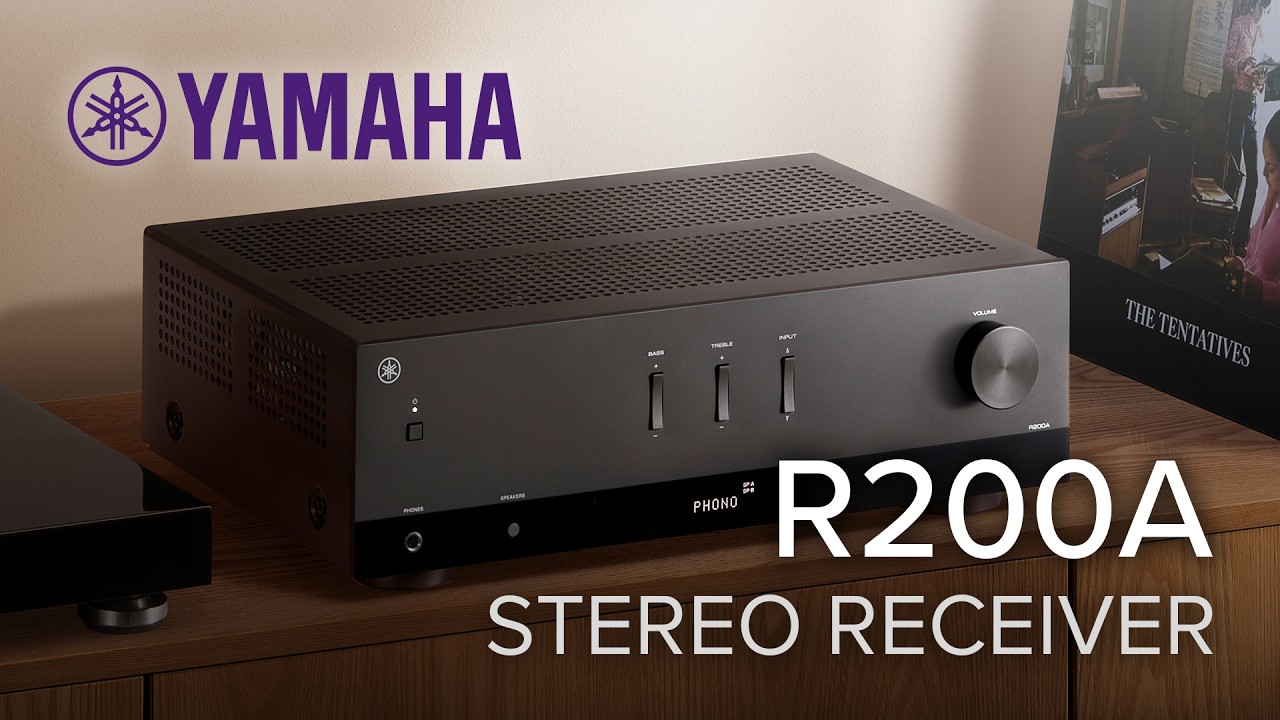
The R200A looks considerably more modern than the R-S202 it replaces.
The large Yamaha wordmark on the old receiver is gone, with the Tuning Fork logo now sitting in the upper-left corner. Yamaha also cleaned up the control layout. The front panel uses a power button, slim vertical controls for bass, treble, and input selection, a streamlined display, and a large volume knob on the right.
It feels less like an inexpensive receiver that happens to be part of Yamaha's lineup and more visually connected to the company's newer hi-fi components.
The controls are also one of the areas where the R200A surprised us in person. At this price, you expect some compromises in the way knobs, buttons, and the chassis itself feel. The R200A still clearly belongs in the affordable category, but it doesn't feel cheap.
Yamaha is also offering the receiver in both black and silver, whereas the R-S202 was sold in black. The silver version is especially interesting if you're pairing it with a turntable, older hi-fi components, or a room where traditional black electronics feel a little heavy. It gives the R200A more of that classic Yamaha hi-fi look.

What's New Inside the R200A?
The redesign is not limited to the front panel. Yamaha has revised the internal layout and uses optimized hi-fi circuitry with streamlined signal paths designed to reduce noise and interference. There is also an anti-vibration center beam running through the chassis to reduce structural flex and vibration.
The center beam is intended to help improve low-frequency performance and stereo imaging, while the internal materials and thermal design help with heat dissipation and long-term stability.
Those are unusually serious construction details to see emphasized on a $300 receiver. And after handling and listening to it, the overall impression is that Yamaha didn't simply take the R-S202 and bolt a few extra connections onto the back.
A Built-In Phono Input Makes the R200A Much Better for Vinyl
For anyone building a stereo around vinyl, this may be the most important change. The R-S202 did not include a phono preamplifier. If your turntable didn't have one built in, you needed to buy a separate phono stage and connect it between the turntable and receiver.
The R200A now includes a dedicated moving-magnet phono input and ground connection. That means many popular entry-level turntables can connect directly to the receiver, and it also makes the R200A much easier to pair with vintage turntables that don't have their own phono electronics.
For someone buying a receiver specifically to start listening to records, that's a meaningful improvement because it simplifies the system and removes another component from the shopping list.
Dedicated Subwoofer Output
Yamaha has also added a dedicated subwoofer output, which makes it much easier to expand the system later.
You could start with a pair of bookshelf speakers and the R200A, then add a powered subwoofer when you want deeper bass. Instead of worrying about whether your subwoofer accepts speaker-level inputs, you can simply run an RCA cable from the receiver's subwoofer output.

Binding Posts Replace the R-S202's Spring Clips
Another small change that makes the R200A feel like a more serious piece of hi-fi gear is the move from spring-clip speaker connections to binding posts. That gives you a more secure connection and makes the receiver easier to use with different speaker-wire terminations.
The R200A still provides Speaker A and Speaker B outputs, so you can connect two pairs of passive speakers. You could run four speakers in the same room, switch between two pairs, or put the second pair in another space.
There is one important distinction here. This is not a true independent multi-zone receiver. Both pairs share the same amplifier and source. So, think of Speaker A/B as a flexible way to connect and switch between two pairs, or play both when your speaker impedance and setup allow it, rather than two independently controlled audio zones.
Bluetooth 5.3 With Multipoint
Bluetooth has also been upgraded to version 5.3 with Multipoint. Multipoint allows two Bluetooth devices to remain paired to the receiver at the same time. In a shared system, that can be surprisingly useful. Two people can keep their phones connected without repeatedly removing one device and pairing the other.
For a simple living-room or secondary system, Bluetooth also keeps setup incredibly easy. Pair your phone, open whatever music service you already use, and start playing.
What the Yamaha R200A Does Not Have
Understanding what isn't included is just as important. The R200A is a traditional stereo receiver, not a network streaming amplifier. There is no Wi-Fi, Ethernet, AirPlay 2, MusicCast, Spotify Connect, or other built-in network streaming platform. Wireless music streaming is handled through Bluetooth. There are also no HDMI, optical, or coaxial digital audio inputs. The USB connection on the rear panel is for firmware updates only.
You get three analog RCA inputs in addition to the phono input, along with one analog RCA output. If you're primarily building a music system around vinyl, Bluetooth, CD playback, and analog sources, the simplicity is part of the appeal.
If your goal is to connect a TV over HDMI, stream directly from Spotify or Apple Music over Wi-Fi, use AirPlay 2, or build the receiver into a networked whole-home audio system, this probably isn't the Yamaha receiver you want.
Something like Yamaha's R-N600A makes more sense if network streaming and digital connectivity are priorities.

Three Analog Inputs Plus Phono
Outside of the phono stage, the R200A has three standard stereo RCA inputs. They're labeled CD, Line 1, and Line 2, giving you enough room for a CD player, external streamer, DAC with analog output, cassette deck, or another traditional source.
You also get an analog RCA output, a front headphone jack, AM and FM antenna connections, and the dedicated subwoofer output. That gives the R200A a fairly traditional connection layout, but that's also part of what makes it easy to understand.
AM/FM Radio Is Still Here
This is still technically a stereo receiver, so Yamaha has retained a built-in AM/FM tuner. You can store up to 40 station presets, with station control available from either the receiver or the included remote. That may not be the headline feature, but for a garage, office, workshop, kitchen, or secondary room, traditional radio can still be useful.
A New Remote
Yamaha has also redesigned the remote. Rather than forcing most controls onto the front of the receiver, the remote gives you access to direct source selection, volume, tone controls, balance, Speaker A/B switching, tuner controls, sleep functions, and display settings.
Combined with the cleaner front panel, it helps keep the R200A visually simple while still giving you access to the controls you'd expect from a traditional stereo receiver.
How Much Power Does the Yamaha R200A Have?
Yamaha rates the R200A at 100 watts per channel into 8 ohms, measured from 40Hz to 20kHz at 0.2% total harmonic distortion. Yamaha also publishes dynamic power ratings of 125 watts into 8 ohms, 150 watts into 6 ohms, 165 watts into 4 ohms, and 180 watts into 2 ohms.
The important part is understanding how that 100-watt number is measured. Yamaha's rating begins at 40Hz rather than the more common 20Hz used in some full-bandwidth amplifier measurements. That means you shouldn't automatically compare the R200A's 100-watt specification with another amplifier's 100-watt rating unless the test conditions are the same.
If Yamaha rated the amplifier continuously from 20Hz to 20kHz, we would expect that number to be lower, probably somewhere closer to around 60 watts per channel. Yamaha does not publish that exact full-band figure, so that number is our estimate rather than an official specification.
Even if the real-world full-band output lands in that neighborhood, that's still very good power for a $300 receiver. For reasonably sensitive bookshelf speakers or smaller floorstanding speakers in a bedroom, office, den, basement, or typical living room, the R200A should have plenty of output. If you're trying to fill a very large room with inefficient or difficult-to-drive speakers, that's where it makes sense to move farther up Yamaha's lineup.
How Does the Yamaha R200A Sound?
This was probably the biggest surprise for us. The R200A sounds really good for the money.
The overall presentation has the clean, natural, balanced character we tend to associate with Yamaha's traditional stereo gear. It isn't trying to sound exaggerated or artificially impressive. Voices are clear, instruments remain well separated, and the receiver maintains a composed presentation without sounding sterile.
The biggest compliment we can give it is that it sounds like a proper Yamaha stereo component, not like something that was designed solely to hit the lowest possible price. The build quality supports that impression too. For $300, the controls, chassis, and overall construction feel more substantial than we expected. They clearly put some effort into the internal construction, chassis rigidity, and circuit layout, and after listening to the receiver, that effort seems worthwhile.
More Than 70 Years of Yamaha Hi-Fi
There is also something to be said for the history behind the product.
Yamaha has been developing hi-fi equipment for more than 70 years, with products ranging from classic integrated amplifiers like the CA-1000 to speakers such as the NS-1000M and later technologies like YPAO room correction.
The R200A isn't the smallest option, and it isn't loaded with every modern streaming feature, but you're getting a straightforward stereo receiver from a company that has been building this type of component for decades. After hearing the R200A, some of that experience comes through.

Yamaha R200A vs. R-S202: What Changed?
The R200A brings several meaningful upgrades over the R-S202, including a new cosmetic design, phono input, subwoofer output, upgraded build quality, Bluetooth Multipoint, binding-post speaker terminals, and black or silver finish options.
| Feature | Yamaha R200A | Yamaha R-S202 |
|---|---|---|
| MM Phono Input | Yes | No |
| Dedicated Subwoofer Output | Yes | No dedicated RCA sub out |
| Speaker Connections | Binding posts | Spring clips |
| Bluetooth Multipoint | Yes | No |
| Speaker A/B | Yes | Yes |
| AM/FM Tuner | Yes | Yes |
| Color Options | Black or silver | Black |
| Chassis | Redesigned with center reinforcement | Previous design |
| Network Streaming | No | No |
This makes the R200A a much more complete receiver for building a system from scratch. But if you already own an R-S202 and you're happy with it, I wouldn't replace it simply because a new model exists.
The reasons to upgrade are pretty specific. If you want a built-in phono stage, dedicated subwoofer connection, better speaker terminals, Bluetooth Multipoint, the new design, or the refinements Yamaha has made to the construction and sound, the R200A gives you those things. Otherwise, your R-S202 can keep doing what it has always done.
Should You Buy the Yamaha R200A?
If you're looking for an affordable stereo receiver for a turntable, Bluetooth, CD player, and a good pair of passive speakers, the Yamaha R200A makes a lot of sense.
It doesn't try to be an AV receiver or an all-in-one network streamer. Instead, Yamaha has taken the traditional entry-level stereo receiver and fixed most of the things that made the R-S202 feel limited.
You now have a phono stage for vinyl, a proper subwoofer output, better speaker connections, Bluetooth Multipoint, A/B speaker outputs, and a chassis that feels more substantial than we expected at this price.
And that simplicity gives the R200A a long life in a system. You could buy it as the center of your first stereo today, then eventually move it into a bedroom, office, basement, or garage if you upgrade your main system later.
At $300, that's exactly the kind of product we want an entry-level stereo receiver to be.
Final Thoughts
The Yamaha R200A doesn't reinvent what a stereo receiver is. That's actually part of why we like it. For $300, Yamaha has built a straightforward two-channel receiver with the connections most people actually need for a simple hi-fi system. Add a turntable, CD player, phone, pair of speakers, and eventually a subwoofer, and you have a system that can cover a lot of listening without becoming complicated.
We’re Here to Help!
If you have further questions, contact our experts via chat, phone, or email. Or simply visit one of our world-class showrooms to experience speakers, projectors, TVs, and everything in between for yourself before you make a purchase!
If you’re planning your home theater or media room, check out our Home Theater Design page, where we have everything Home Theater related, including our FREE Home Theater Design Tool.
When you buy from Audio Advice, you’re buying from a trusted seller since 1978. We offer Free Shipping, Lifetime Expert Support, and our Price Guarantee. We look forward to serving you!
Frequently Asked Questions
Does the Yamaha R200A have a phono input?
Can you connect a subwoofer to the Yamaha R200A?
Does the Yamaha R200A have Wi-Fi?
Does the Yamaha R200A support AirPlay 2?
Does the Yamaha R200A have HDMI?
How many speakers can the Yamaha R200A power?
How powerful is the Yamaha R200A?
What is the difference between the Yamaha R200A and R-S202?
Details & Specs
Power behind every detail
Designed to bring out the best in your speakers, this receiver delivers 100W x 2 channel (8Ω) of clean, dynamic power for a rich, accurate listening experience.
More ways to play
Versatile connection options let you effortlessly enjoy music from vinyl, radio, CDs, or Bluetooth, all from one receiver.
Expandable home audio
Take your sound further with a dedicated subwoofer output, making it easy to get deeper, more powerful bass whenever you’re ready.
Set, save, and listen
Enjoy quick access to 40 preset AM/FM radio stations, making your favorite music, news, and talk shows just a tap away.
Stream seamlessly
Easily switch between two streaming audio sources with Bluetooth Multipoint, allowing you to pair and stay connected to two devices at once.
Turntable-ready
Get authentic vinyl sound with a dedicated phono input, bringing your favorite records to life from vintage classics to the latest hits.
Built solid to sound pure
Precise imaging and an immersive soundstage across every music genre, with an anti-vibration center beam and optimized Hi-Fi circuitry.
Flexible speaker setup
Power up to four speakers in a single room or enjoy music across two separate spaces with A/B speaker selection for uninterrupted audio from room to room.
Multiple ways to control
Designed for everyday ease, you can control your receiver directly or with the included remote.
Simple setup in minutes
Set up is fast and straight forward with the easy-to-follow Quick Guide.
| Model | Yamaha R200A |
|---|---|
| Amplification | |
| Channels | 2-Channels with subwoofer output |
| Rated Power (8Ω, 40 Hz to 20 kHz, 0.2% THD) | 100 W + 100 W |
| High Dynamic Power per Channel (8/6/4/2 ohms) | 125/150/165/180 W |
| Frequency Response | 20 Hz–20 kHz ±0.5 dB 10 Hz–100 kHz ±3 dB |
| Total Harmonic Distortion (CD to Sp Out, 20 Hz–20 kHz) | ≤ 0.2% |
| Signal-to-Noise Ratio (CD) | ≥ 100 dB |
| Input Sensitivity (CD) | 500 mV / 47 kΩ |
| Connectivity | |
| Phono Input | Yes, (1) |
| Headphone Output | Yes, (1) |
| Subwoofer Output | Yes, (1) |
| Analog RCA Inputs | Yes, (3) |
| USB | 1 - Firmware updates only |
| AM/FM Tuner | AM/FM with 40 presets |
| Bluetooth | Yes (Ver. 5.3, Multipoint) |
| General | |
| FM 50dB Quieting Sensitivity (IHF, 1 kHz, 100% Mod., Mono) | 3 µV (20.8 dBf) |
| FM Signal-to-Noise Ratio (Mono/Stereo) | 65 dB / 64 dB |
| A/B Speaker Support | Yes |
| Standby Power Consumption | ≤0.3 W |
| Auto Power Standby | Yes |
| Dimensions (Unit) | 17.13 W x 5.39 H x 12.91 D in. (435 W x 137 H x 328 D mm) |
| Dimensions (Package) | 20 W x 7.95 H x 15.24 D in. (508 W x 202 H x 387 D mm) |
| Weight (Unit) | 16 lbs. (7.3 kg) |
| Weight (Package) | 18.96 lbs. (8.6 kg) |
| What’s Inside the Box | R200A Stereo Receiver, Remote Control, AAA Batteries, AM Antenna, FM Antenna, Quick Guide, Safety Guide |


