
JBL Summit Series Overview

JBL Summit Series Overview video cover
Play

At Audio Advice, we see a lot of equipment come through our doors, but there is one name that carries a weight like no other: JBL. For nearly 80 years, JBL has been the common thread in the world’s most significant musical milestones. Whether it was powering the Grateful Dead’s legendary "Wall of Sound"—a massive 28,000-watt, 600-speaker behemoth that changed live sound forever—or ensuring that every seat in Nashville’s historic Ryman Auditorium receives the same crystalline "you-are-there" experience, JBL has remained the gold standard for dynamic, lifelike sound.

The subject of today’s overview is the new JBL Summit Series. For years, the "Summit" name was reserved for JBL’s ultra-high-end legacy flagships: the K2 S9900 and the mighty Everest DD67000. We are happy to report that JBL has recently expanded the line with three new additions: the Ama, Pumori, and Makalu. These new models are far easier to fit into an average listening room but have that same dedication to live sound we loved in the Everest and K2. You will still need some physical help; however, even though they are not super huge, they are built like tanks and weigh far more than you would expect. More on this later.

JBL Summit Series Speakers

To understand the design goals behind the Summit Series, you first have to understand the philosophy of JBL’s special projects. In 1974, when the Grateful Dead debuted the Wall of Sound, they weren't just looking for volume; they were looking for a way to deliver high-fidelity, distortion-free sound across a half-mile radius. They achieved this using massive towers of JBL drivers, each instrument and voice assigned its own dedicated stack. That same obsession with effortless dynamics and scale is what led the technical staff at the Ryman Auditorium to choose JBL line arrays to ensure that artists sound their best from every single seat in the house.

The Summit Series is the residential version of that same massive professional power. JBL’s engineers in Northridge, California, were challenged to take that same "Wall of Sound" impact and shrink it down into a package that could fit into a high-end listening room.

This was especially challenging with the new Summit Series models. JBL has long been known for high-performance speakers with very high sensitivity ratings. Traditionally, to get that high sensitivity, they gave up some ultimate low-end extension. Their Northridge team made the decision with the new models to go for deep bass extension, but doing that in a smaller, more living room-friendly cabinet meant they had to give up some of that high sensitivity. Their team has gone to great lengths to achieve that bass extension while maintaining the ability to let you hear all of those tiny dynamic changes.

The result is a series that focuses on speed, clarity, deep bass, and most importantly, preserving those all-important micro-dynamics at all volume levels. We feel this is one big characteristic that has always set JBL apart in delivering that "you-are-there" sense of realism. It’s their ability to reveal tiny changes in volume that gives you the feel of a live performance.

We love the way these provide that JBL sound—which used to only be attainable with a huge cabinet—in three models that can fit into most spaces while remaining incredibly beautiful. Plus, you get bass extension like we have never seen before from JBL. The only tradeoff is that you can no longer plan to run these on a small tube amp. These need lots of current and plenty of power. They are all 4-ohm loads, which is good news for most power amps, as many high-performance amplifiers on the market double their power at 4 ohms.

We will first dive into the tech each of the models share, then get into the individual models afterward.

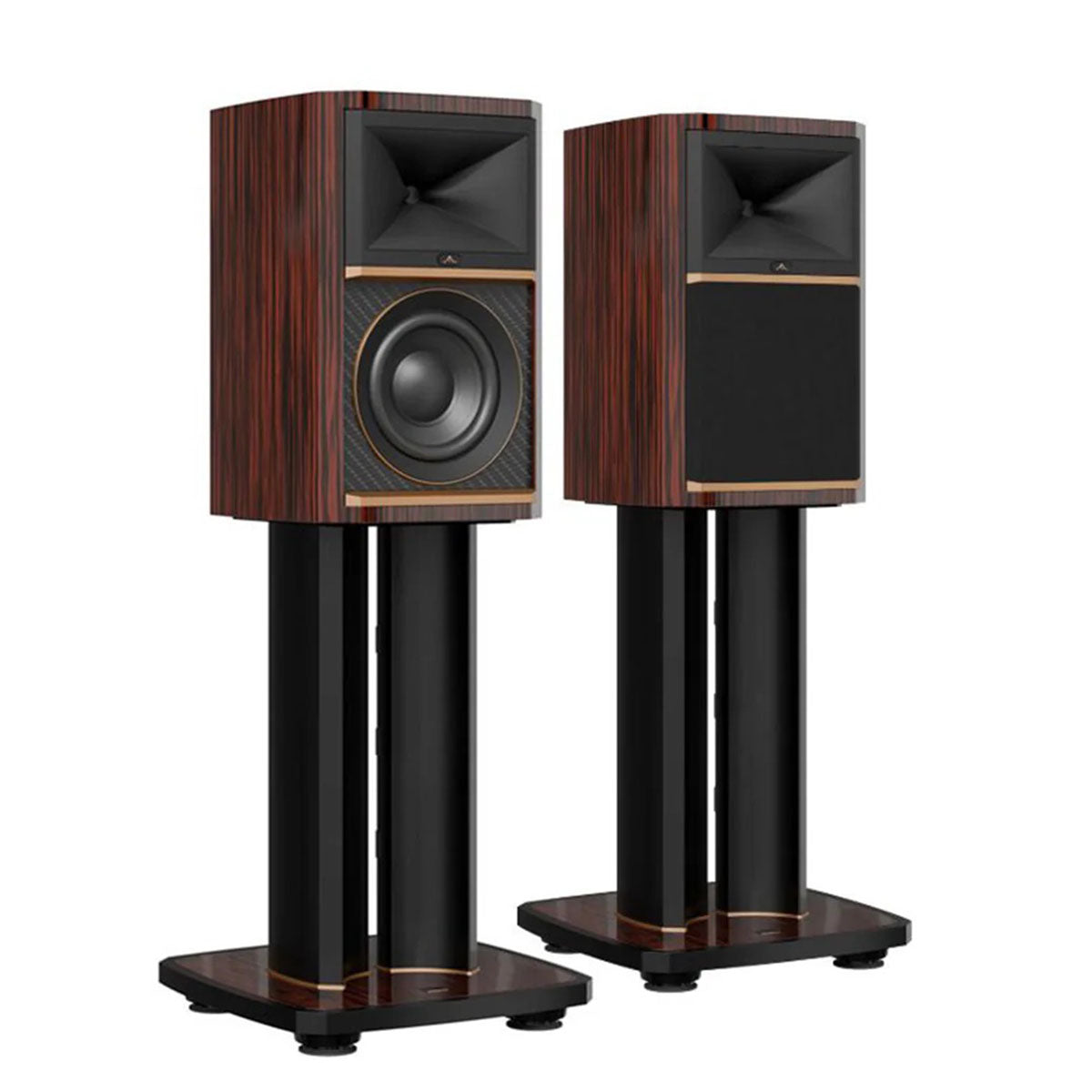
JBL Summit Ama speaker pair
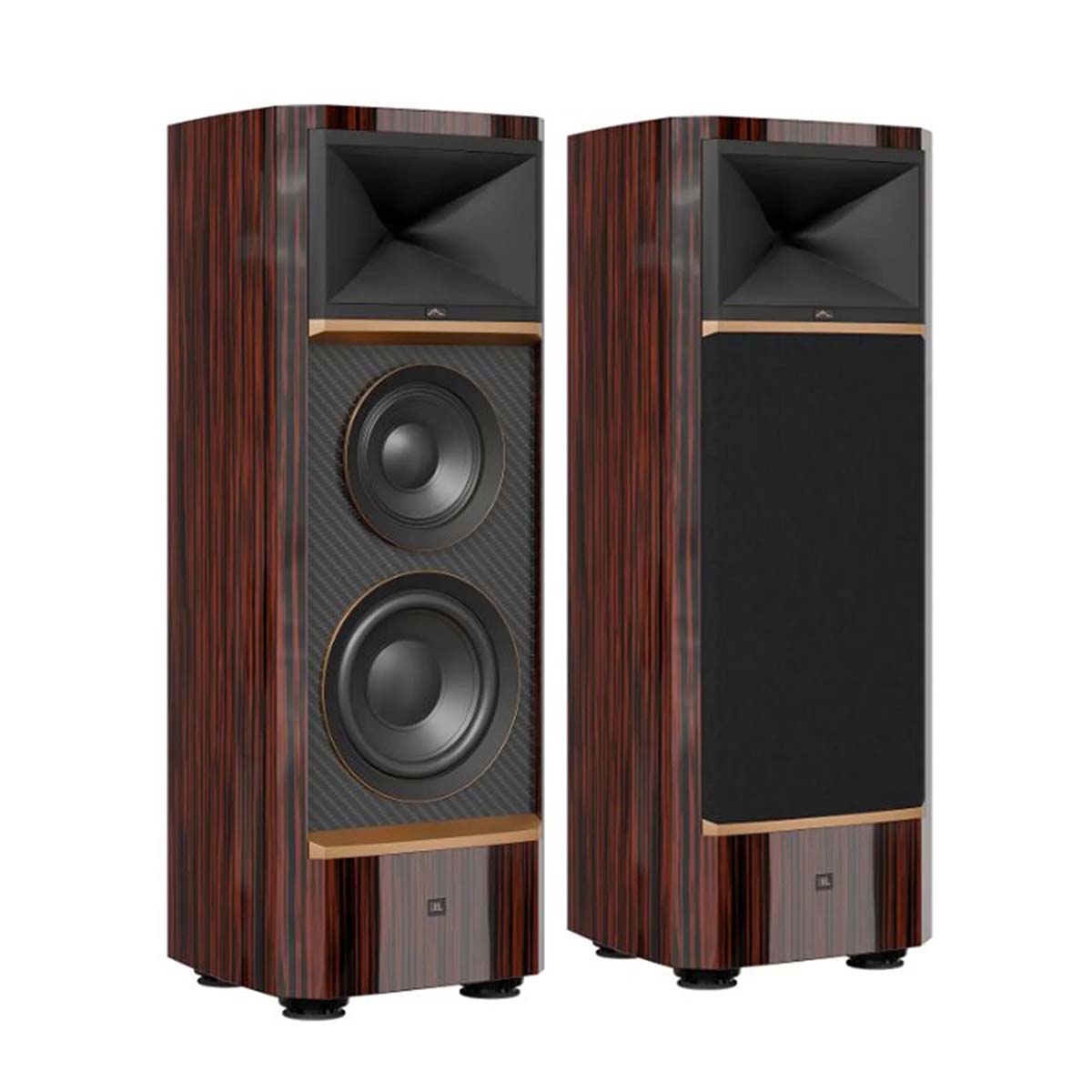
JBL Summit Pumori speaker pair
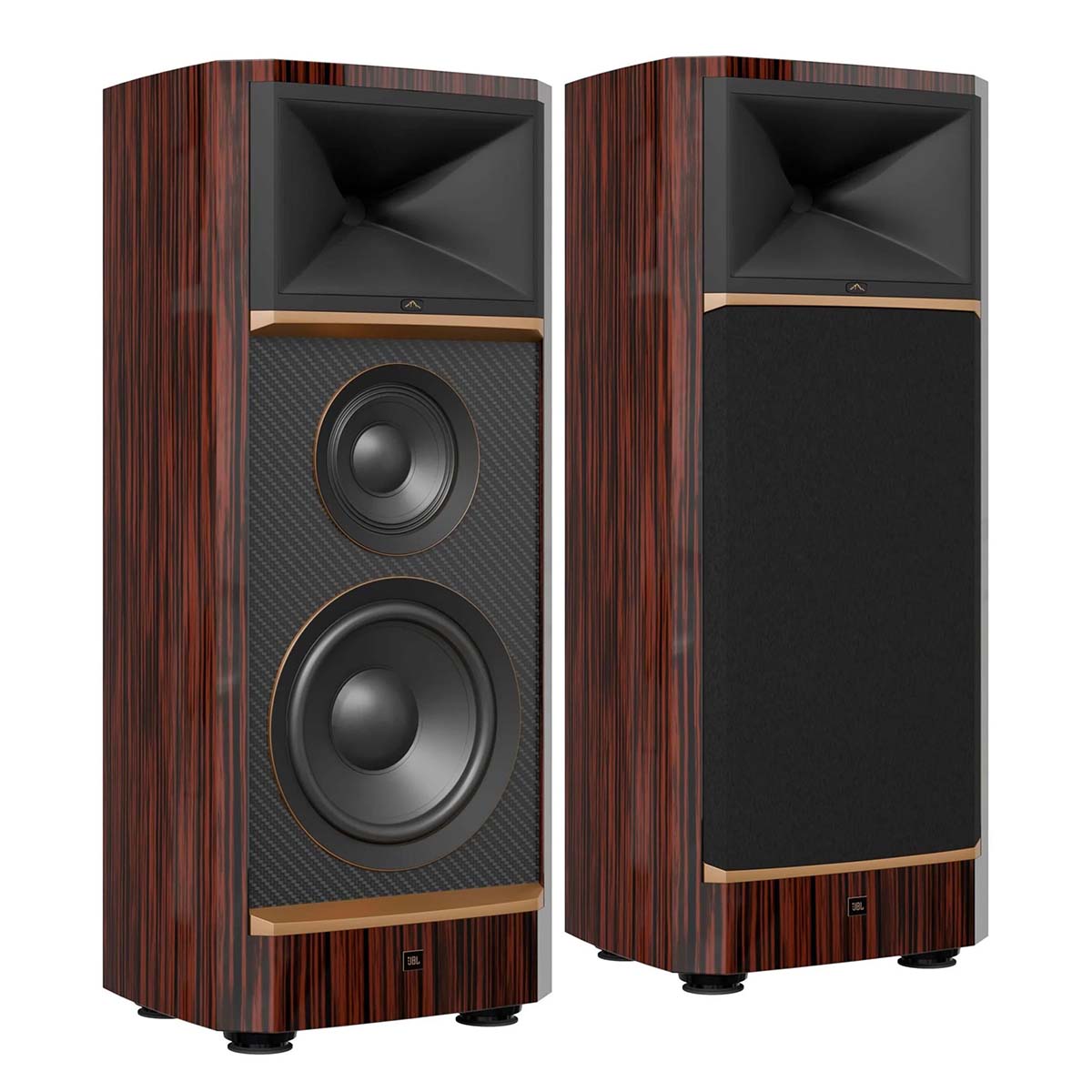
JBL Summit Makalu speaker pair

New D2 Drivers

For years, JBL has used its patented D2 compression drivers in its high-performance speakers. These models receive brand-new versions: the D2815K in the Ama and Pumori, and the massive 3-inch D2830K in the flagship Makalu. They use a new Teonex® dual-diaphragm design that pushes the limits of speed and tonal purity.

Many audiophiles look at a compression driver with its large horn and think of PA system sound. In some cases that may be true, but with JBL, it is just the opposite. Compression drivers exist because a typical dome tweeter moves very little air. A compression-chamber design, like the D2, is roughly ten times more efficient than a standard tweeter. This JBL technology requires roughly ten times less power to achieve the same sound pressure level (SPL).

For the listener, this translates to lightning-fast transients and zero "shoutiness" or distortion, even when you're cranking it up to concert levels. It allows you to hear all the subtle harmonics of a violin or the sharp crack of a snare drum with a precision that standard tweeters have a hard time keeping up with. Plus, you can easily pick out all those micro-dynamics found in live music.

The D2 driver is paired with a uniquely shaped Sonoglass® High-Definition Imaging (HDI™) horn.


Sonoglass

Sonoglass is a proprietary, high-density fiberglass-based thermoset composite. Unlike standard injection-molded plastic, which is hollow or uniform in structure, Sonoglass is created by mixing glass fibers into a resin and molding it under extreme pressure. If you were to look at a cross-section under a microscope, you’d see a "hair-like" internal structure. These random glass fibers are woven throughout the material, creating an internal matrix that is incredibly good at dissipating energy.

When you couple a horn with a compression driver, you ideally do not want the horn to add any sonic character of its own, which is very difficult to do with wood or plastic. The "honky" or nasal horn sound some people complain about is really the sound of the horn itself vibrating, which is just not present with Sonoglass.

Another advantage of a horn is the control it gives the designer over the directivity of high frequencies. The Sonoglass material is easy to mold into a precise shape that enables the horn to have better control of the directivity of the higher frequencies. In most rooms, the sound you hear is a mix of the direct sound from the speaker and the early reflections bouncing off your side walls and ceiling. If a speaker sprays sound everywhere, those reflections arrive at your ear slightly out of time, which blurs the imaging. JBL’s HDI horn is engineered to control exactly where the sound goes. This means you will hear more of what is coming from the speaker than what is reflected off your walls. The end result is pinpoint imaging and a sound that is super sweet and nuanced—exactly the opposite of what many people expect from a basic horn design.


New HC4 Drivers

For the low and mid frequencies, JBL engineers developed an entirely new cone material called Hybrid Carbon Cellulose Composite (HC4). It’s a three-layer sandwich: front and rear layers of a custom carbon-fiber and pure-pulp blend, with a core of closed-cell foam. In speaker design, you want a cone that is both incredibly stiff and extremely light. This sandwich construction provides the perfect balance. The carbon-pulp surfaces give us the stiffness while the foam core keeps the mass low. This means the woofer can deliver extremely high output while keeping distortion very low.

Inside these new HC4 drivers, JBL has deployed a new Dual Voice Coil configuration. By using two voice coils in a single magnetic gap, they have effectively doubled the surface area available for heat dissipation. While the improved heat dissipation is great, JBL’s design provides far more linearity. In a typical speaker, the voice coil can behave differently as it moves forward versus backward, especially at high volumes when it is really moving. This asymmetry creates even-order harmonic distortion. JBL’s Differential Drive uses opposed dual voice coils in two separate magnetic gaps. Because the coils are wound in opposite directions and sit in opposite magnetic fields, they act like a "push-pull" system. This cancels out non-linearities, resulting in a woofer that tracks the incoming signal perfectly. You get bass you can feel that is also cleaner and more detailed, even when you are pushing the system.

JBL Summit Ama speaker 3/4 front view
JBL Summit Ama speaker 3/4 back view

New Cabinet Design

The engineering inside a Summit Series cabinet is as impressive as the drivers themselves. Each enclosure is constructed with offset internal bracing and a curved wall that is internally damped. Unlike a typical box speaker, the soft-curved walls are designed to eliminate internal standing waves and push resonances far outside of the audible frequency range.

The baffle is finished with a unique carbon-fiber trim that reinforces the high-pressure area around the D2 driver, while the rest of the cabinet is available in either a high-gloss piano black with Summit Platinum accents or a rich, high-gloss ebony wood veneer with Summit Gold detailing. We especially love the look of the ebony wood finish.

Another great addition is the new feet. JBL worked with one of our favorite companies, IsoAcoustics, to design the feet for the cabinets and, in the case of the Ama, the stands. We’ve put IsoAcoustics feet on previous JBL and other speaker brands and noticed a significant improvement; it is fantastic to have them now included as standard.


New MultiCap™ Crossover

One of the biggest upgrades in the Summit Series is the MultiCap™ crossover network. While many speakers use one or two large capacitors to filter frequencies, JBL has replaced them with a massive array of smaller capacitors wired in parallel.

Large capacitors are "slow." They have higher resistance and can store and release energy with a slight delay, which blurs the signal. By using multiple small caps, JBL dramatically lowers that resistance. Furthermore, in all of the new Summit models (as well as the Everest and K2), JBL uses DC biasing on the caps. They are kept constantly charged by a small circuit using a 9-volt battery. We’ve seen this same tech in a handful of other high-end speakers, and it works to keep the dielectric inside the capacitors at an optimal condition, eliminating distortion. This new crossover design was one of the critical factors that allowed the new Summits to still sound "alive" at low volume levels. Many speakers don’t tend to wake up until you crank them up, but JBL has always been known for sounding dynamic at any level. We were really happy to hear for ourselves that this is still the case with these new models.


New Internal Wiring

JBL has upgraded the internal wiring to Ohno-Continuous-Cast (OCC) Long-Crystal Oxygen-Free Silver-Plated Copper. OCC wire is cast in a way that creates a single, continuous crystal structure over long distances. By silver-plating this ultra-pure copper, JBL ensures that the signal reaches the drivers with zero "skin effect" losses or graininess. This isn't hocus pocus; it is a real-world improvement confirmed by their engineers. We love this attention to detail in both the wiring and crossovers, as it impacts the final sound in ways you can hear even if you never see the components. Even the dual binding posts are wrapped in carbon fiber and rhodium-plated, ensuring every link in your signal chain is of the highest possible quality.

JBL Summit Ama

Summit Ama

The Ama is named after Ama Dablam, a peak in the Himalayas often called the "Mother's Necklace." This is a 2-way reference stand-mount loudspeaker. It pairs an 8-inch HC4 woofer with the 1.5-inch D2815K compression driver and includes a matching dual-leg, mass-loaded damped floorstand.

While they appear small, the Ama itself is 55 pounds, and with the stands, you are over 100 pounds. The -6dB downpoint is 34Hz—which is extremely good for something this small—and they are only -10dB down at 25Hz. A couple of people on our team had fun with these at home and both declared they were by far the best stand-mount speakers they had ever heard. The sound is highly detailed with a sense of power you don’t usually get from something so small.

Don’t plan on running these with a small tube amp, though. With a sensitivity of only 84dB, they need quite a bit of power to really show off. As we talked about earlier, the sensitivity was the tradeoff for achieving incredible deep bass.

JBL Summit Pumori speakers

Summit Pumori

The Pumori is named after the "Daughter of Everest." This is a 3-way floorstanding model that adds a dedicated 8-inch mid-bass driver to a 10-inch HC4 woofer. It shares the same D2815K compression driver found in the Ama.

These are not super large at about 42” tall, 15.5” wide, and 17.5” deep, but they weigh in at 106 pounds! The larger cabinet and 10” woofer enable them to be only -6dB down at 30Hz and -10dB down at 25Hz, which is awesome for a medium-sized floorstander.

These move up to 87dB in sensitivity, though we still recommend a high-quality power amp. We’ve had these set up in the showroom and everyone has been very impressed. They have a sense of openness and effortless sound that is hard to beat. Even at very low volume levels, they sounded alive. What will really surprise you, however, is their bass impact. You would swear there is a super-fast subwoofer in the room; the deep bass is lightning quick with tons of detail.

JBL Summit Makalu speakers

Summit Makalu

The Makalu is named after the world's fifth-highest peak, sitting just 12 miles southeast of Everest. This is the absolute flagship of the new series—a massive 3-way floorstander featuring a 12-inch woofer and an 8-inch midrange. It steps up to the larger 3-inch D2830K compression driver for even greater scale and effortless dynamics.

The Makalu is only slightly larger than the Pumori at 43.4” tall, 18.3” wide, and 15.5” deep, but it weighs almost 50% more at about 153 pounds! Sensitivity sits at 88dB. With the larger driver and cabinet, the bass reaches much deeper: these are down -6dB at 23Hz and -10dB at 20Hz. We set these up after the Pumori, and they had everything we liked about that model but with even more authority. The deep bass reach and speed are simply amazing. The midrange is even more open to our ears, and we loved the taller soundstage they present. If you want to get to concert levels in your living room, just add a great high-power amp and these will make you feel like you are hearing your favorite band live!

Final Thoughts

At the end of the day, the JBL Summit Series represents everything we love about high-end audio. It’s that rare combination of world-class engineering and a raw, emotional soul that just makes you want to keep listening. While the move to a lower sensitivity means you’ll need to be sure you have plenty of power on board, the reward is a level of bass authority and "you-are-there" realism that is practically unheard of in a cabinet this size. Whether you choose the Ama, the Pumori, or the flagship Makalu, you aren't just buying a speaker—you’re bringing home a piece of the Northridge legacy. If you’ve ever wanted that massive, effortless concert sound without needing a huge room to house it, along with the ability to hear tiny detail changes at very low listening levels, the Summit Series is exactly what you’ve been waiting for.