











Wharfedale Heritage Center
Couldn't load pickup availability
Free Shipping On All Orders, No Minimums.
We offer free 2-day shipping on most products within the continental US.
Weekdays - Orders placed by 2pm EST ship same day. Orders placed after 2pm EST will ship the following business day.
Weekends - Orders placed on Saturday and Sunday will ship Monday.
Orders requiring motor freight delivery may take more than two business days. Once your order has shipped, you'll receive a shipping confirmation email with a tracking number for easy tracking.
Orders for Open Box products ship with free ground shipping within the continental United States.
Orders that contain items that are currently backordered, special order, or out of stock will ship complete once all items are in-stock unless otherwise requested.
If you need it faster, you will have the option of choosing a quicker shipping option when you checkout on the website.
At this time, we do not ship internationally and orders to Hawaii and Alaska may incur an additional shipping charge. Please contact us at 888.899.8776 or email support@audioadvice.com to confirm.
Rerouting and Address Changes
We cannot make ANY address changes once an order is placed. If you are unable to accept delivery of your package as ordered, we will need to cancel your order, return the package to sender and have you replace your order through our website.
Keep the Box
We suggest you keep the shipping box or boxes for at least 30 days. It is actually a great idea to keep boxes for audio products for the life of the product. Having the box and all packing will increase the trade-in value should you decide to move up and they are handy to have should you ever need to send the unit in for repair.
How To Receive a Motor Freight Order
The trucking company will contact you to schedule a convenient time to deliver the order. Please note that you must be present for delivery.
Visually inspect the box to make sure you see no signs of damage. If you notice any damage at all, take some pictures with your phone and make a note of them on the delivery receipt the driver will ask you to sign. If it is obvious that the product is damaged, please refuse the order and contact us immediately at 888.899.8776 or email support@audioadvice.com.
Open your box as soon as possible and inspect the product for damage and contact us if you find anything wrong.
FedEx Freight Service Comparison
| Feature / Service | Scheduled Curbside Delivery | White Glove Delivery |
|---|---|---|
| Scheduled delivery appointment | ✔ | ✔ |
| Delivery location | Ground level only (garage, front door, loading dock) | Room of choice, any floor |
| Delivery team | 1 person | 2 people |
| Placement inside home/business | ✘ | ✔ |
| Upstairs / downstairs delivery | ✘ | ✔ |
| Unpacking | ✘ | ✔ (upon request) |
| Packaging removal | ✘ | ✔ (upon request) |
| Assembly / installation | ✘ | ✘ |
| Old item removal | ✘ | ✘ |
At Audio Advice, we pride ourselves on customer satisfaction. We'll bend over backward to make sure you're 100% satisfied and we won't accept anything less. We offer 30-day hassle-free returns and personalized service from real, live people.
If an item doesn't meet your expectations, you may return or exchange it in its original condition and packaging within 30 days for a full refund, minus shipping fees. Items shipped back in like new condition through standard shipping carriers will incur a minimum $15 return shipping fee. If the items were initially shipped through free scheduled delivery via motor freight (commonly referred to as LTL), returning them will result in return shipping fees starting at $150. These items include but are not limited to, oversized items such as TVs, certain subwoofers, floorstanding speakers, furniture, and most items weighing over 75 pounds. Return fees will also apply for exchanges. We want to treat your system as if it is our own and want you to be completely satisfied with your purchase.
Please see the instructions below. We only accept returns for any product purchased directly from our website. If merchandise is not returned in its original condition or is missing packaging, manuals, accessories or other parts, or the resale value of the product has been impaired, a partial refund will be given and calculated on a case-by-case basis.
Non-Returnable Items
The following items cannot be returned or cancelled:
- Special/Custom Order Items
- Gift Cards
- In-ear headphones cannot be returned once the packaging has been opened due to personal hygiene reasons. Please contact our customer care team if you'd like help choosing.
-
Turntables With a Broken Stylus: All turntables ship out with the stylus intact. If you return a turntable or phono cartridge with a broken or missing stylus you will be subject to a return fee. Please be careful when setting up your turntable and contact us with any questions.
Is It Easy To Return An Item?
Yes, simply give us a call at 888.899.8776 or you can email our support team at support@audioadvice.com. Many times our team of experts can help figure out why the product might not be working like you expected and get things fixed over the phone, so don’t be surprised if we ask a few questions, we love troubleshooting!
If our tech help can not make you happy, we will email over a return shipping label with a Return Number.
Hopefully, you saved all of the original item’s box and packaging inserts. You will want to pack back up your return or exchange in the same way it came out of the original box. Once you have everything packaged correctly, tape the box on the top and bottom to assure it stays together. If Audio Advice shipped the item to you inside a second box, it's a good idea to use that same extra box to help prevent damage on its way back to us. To avoid it accidentally coming back to you, use a magic marker to cross out the old shipping label or just tear it off.
The return shipping label we send you will have our address on it, just make sure you take the box to the right shipper (UPS, FEDEX, or USPS) as per the label.
If you are close to one of our stores, please let us know if it is more convenient for you to return it to us directly. You will still need to get a return number by contacting us and shipping and/or restocking charges may apply.
When Will I See My Refund?
It usually takes around 7-14 days for the refund to show up on the payment method you used. We do inspect all returns for damage and accuracy of the item inside the box before issuing a refund. Some items may be subject to shipping and restocking fees.
Can I Exchange My Purchase For Something Different?
Sometimes those big speakers just don’t fit in the room or you might have bought a small subwoofer and later found out you’d love a bigger one. If you would like to make an exchange within 30 days of receiving your item, just give us a call at 888.899.8776 or email support@audioadvice.com and we will help work out the details. Additional shipping charges and return costs may apply.
How Do I Cancel An Order?
If the item has already shipped out or is a special order item, it is not possible to cancel the order. Please contact us at 888.899.8776 or email support@audioadvice.com to start the return process.
What If I Find Shipping Damage?
We need to know right away about any shipping damage. Please contact us at 888.899.8776 or email support@audioadvice.com within 48 hours of your delivery so we can get the ball rolling on making things right. It’s very helpful to take some pictures and email them to us if possible.
Can I Refuse A Shipment?
You can, but unless the item is damaged, shipping and restocking fees will be deducted from your refund. If your item arrives damaged and you are lucky enough to be there, snap some quick pics and refuse the order. Then contact us so we can get a replacement on the way.
What Happens If My Order Is Defective?
This is actually pretty rare, most consumer electronics work fine out of the box 99.9% of the time. We’d like for you to contact us first by calling 888.899.8776 or email support@audioadvice.com so we can help get to the bottom of things. If your item is indeed defective during the first 30 days, we can usually exchange it for a new, replacement unit.
What About Service After 30 Days?
Audio Advice has a great relationship with all of our brands and can help you with warranty service by the brand after our 30-day guarantee period. Even after the warranty expires, we can arrange for service by the brand on products purchased from Audio Advice. Just call 888.899.8776 or email support@audioadvice.com.
How Do You Determine A Restocking Fee?
You may not believe it, but sometimes we receive items back that were put in the box with zero packaging and are completely destroyed or are missing many of the pieces that came with the item. We also track serial numbers and will get back different serial numbers. We’ve even seen different items than what we shipped out be returned. However, it’s very important to package your return properly so that nothing goes missing or gets damaged in shipping, which will result in a restocking fee or even no refund at all. If a product is opened and the market value of the product is reduced, then a restocking fee may be applied to the cost of restocking and the reduced market value of the product. The bottom line is if you treat us fairly, we will do the same.
Audio Advice strives to provide industry-leading support and service while also maintaining the lowest prices available on products for our customers. We work hard with our vendors to bring our customers the best products at each price point. As a part of that process, we work with our vendors to provide the lowest pricing in our stores and on our website.
Our prices should always be the same as any other authorized dealer, including big-box retailers and major online retailers.
If you believe that you have found a lower advertised price from a legitimate authorized seller, call us and let us know so we can make sure we can correct any inadvertent error on our side. As a matter of policy, we update our prices automatically if a vendor changes its authorized pricing policies, so we generally have the best prices all the time. Increasingly, there are knock-off copies of products online, usually sold by non-authorized dealers.
Please be sure that the item meets the following conditions:
- The item is brand new, in stock, and available for purchase
- The item has the identical model number, color, etc as the item on our site.
- The seller is an authorized dealer
As always, our goal is to provide a terrific customer experience, including industry low prices. We appreciate your support.
Overview
The High Notes

Three-Way Driver Array

Tonally Matched to the Heritage Line

Built to Match, Inside and Out
A while back, Audio Advice was doing a live stream with Wharfedale covering the Heritage lineup, and someone in the chat asked why there was no center channel for the series. It turned out a lot of people had been wondering the same thing, because the question kept coming up for the rest of the stream. Wharfedale took notice, and the result is the Heritage Centre, the first dedicated center channel in the Heritage lineup.
We've had it in our lab paired with the Super Lintons for the past few weeks. Here's everything you need to know, including why adding a center channel to any two-channel system running movies is one of the more significant upgrades you can make.

Why Running Two-Channel for Movies Is Holding You Back
A lot of people run two-channel setups for movies, and honestly it makes sense. A good pair of stereo speakers will outperform most soundbars by a wide margin, so why add more complexity to the system? The problem is that film audio isn't mixed for two channels, and the gap between what you're hearing and what the mix was actually designed to deliver is bigger than most people realize.
The center channel in a properly mixed film carries somewhere around 60 to 70 percent of the total audio information, primarily dialogue, voiceovers, and the anchor of nearly every scene. When you play that back through a stereo system, your receiver takes that center channel information and folds it into the left and right speakers through a process called downmixing. The result is that the center channel track gets mixed down to mono, which in theory should work reasonably well, but only if you're sitting perfectly centered between your two speakers and they're perfectly centered on your TV. In practice that's a one-person sweet spot at best.
You've probably noticed the symptoms without necessarily connecting them to the cause. Dialogue that feels slightly loose or detached from the image. Lines of conversation getting buried when a music cue or sound effect hits at the same time. And if you're sitting even a little off to one side, voices start drifting toward whichever speaker is closer. Over a two-hour movie that adds up, and it's the kind of thing that's hard to put your finger on but makes you feel like you're working harder than you should be to follow what's happening on screen.
A dedicated center channel takes all of that off the table. It puts dialogue exactly where it belongs, locked directly below or above your screen, stable and clear regardless of where anyone in the room is sitting.
One important note before you go any further: adding a center channel requires an AV receiver. If you're currently running a two-channel integrated amplifier, you'll need to factor that into your plans. It's a worthwhile step, but it's not a small one. We have a full guide on how to set up a center channel properly, covering integration with your existing system, receiver configuration, and crossover settings, linked at the bottom of this article.

Where the Heritage Centre Came From
Wharfedale's Heritage series has been one of the more quietly dominant speaker lines in specialty audio over the last several years. The Linton relaunched in 2019 after an extended absence and immediately found a devoted audience. The Super Linton followed, along with the Denton models at various sizes and the UK-built Dovedale and Aston at the higher end of the range. What ties all of them together is real wood veneers, cloth grilles, and a warm musical character that doesn't give up detail to get there. They look like furniture in the best possible way, which is a big part of why people keep gravitating toward them.
As the Heritage series grew, more people started using these speakers as their primary audio for TV and movies, running the Lintons or Super Lintons through a receiver and watching films through a system that was never really designed with that use case in mind. The consistent problem was that there was no center channel that belonged in that system, nothing that matched the veneer options, the driver approach, or the tonal character. The choices were to run without a center entirely, which as we just covered is a real compromise for movie watching, or to add something that looked visually mismatched and sounded like it came from a different design philosophy. Neither option was great, and that frustration came up constantly in comments, forums, and during that live stream, which is what finally pushed this over the line.
How the Heritage Centre Is Built
The Heritage Centre is a three-way design, which is worth calling out specifically because a lot of center channels cut corners and go two-way to keep the cabinet small and the price down. A two-way center channel means your tweeter or woofer, depending on the design, is handling frequencies that really should belong to a dedicated midrange driver, and that's a problem because the midrange is where voices live. A three-way design like this one has a dedicated driver for that range, and that makes a concrete difference in dialogue clarity and separation, particularly when the mix gets busy. There are some excellent two-way center channels on the market, but they tend to live at significantly higher price points to get there.
The driver layout is two 6.5-inch woven Kevlar woofers on the outside, a 2-inch soft-dome midrange in the center, and a 1-inch soft-dome tweeter just below it. The Kevlar cones and dome materials mirror exactly what Wharfedale uses in the Linton and Super Linton, which is not an accident. The crossover points are at 900Hz and 2.7kHz, keeping that midrange driver right in the sweet spot for vocals. The cabinet is rear-ported with internal bracing and reaches down to 47Hz at -6dB, which for a center channel is a really solid low-end extension. It's what keeps the speaker from collapsing or sounding thin when a movie scene gets loud and dynamic.


Placement Tip
Because the Heritage Centre is rear-ported, placement matters. Try to leave at least six inches between the back of the cabinet and the wall, and avoid placing it inside an enclosed media console where the port is blocked. A cramped placement will choke the low end and introduce some cabinet coloration that the speaker wasn't designed to have. It doesn't need a lot of space, but it does need some.
Peter Comeau's Role
Every Heritage model goes through Peter Comeau, Wharfedale's Director of Acoustic Design, and the Heritage Centre is no different. Comeau has been responsible for the character of the entire Heritage line, which means this isn't a center channel designed to approximate the sound of the Linton and Denton. It was designed specifically to be tonally indistinguishable from that family. The crossover was engineered for this specific driver array in this specific cabinet. The voicing matches the Linton and Super Linton, so dialogue sits forward and clear without getting harsh up top, and there's enough body in the lower midrange that voices sound full and natural rather than thin. The goal was a center channel that disappears into a Heritage system and does its job without calling attention to itself.
How It Performs
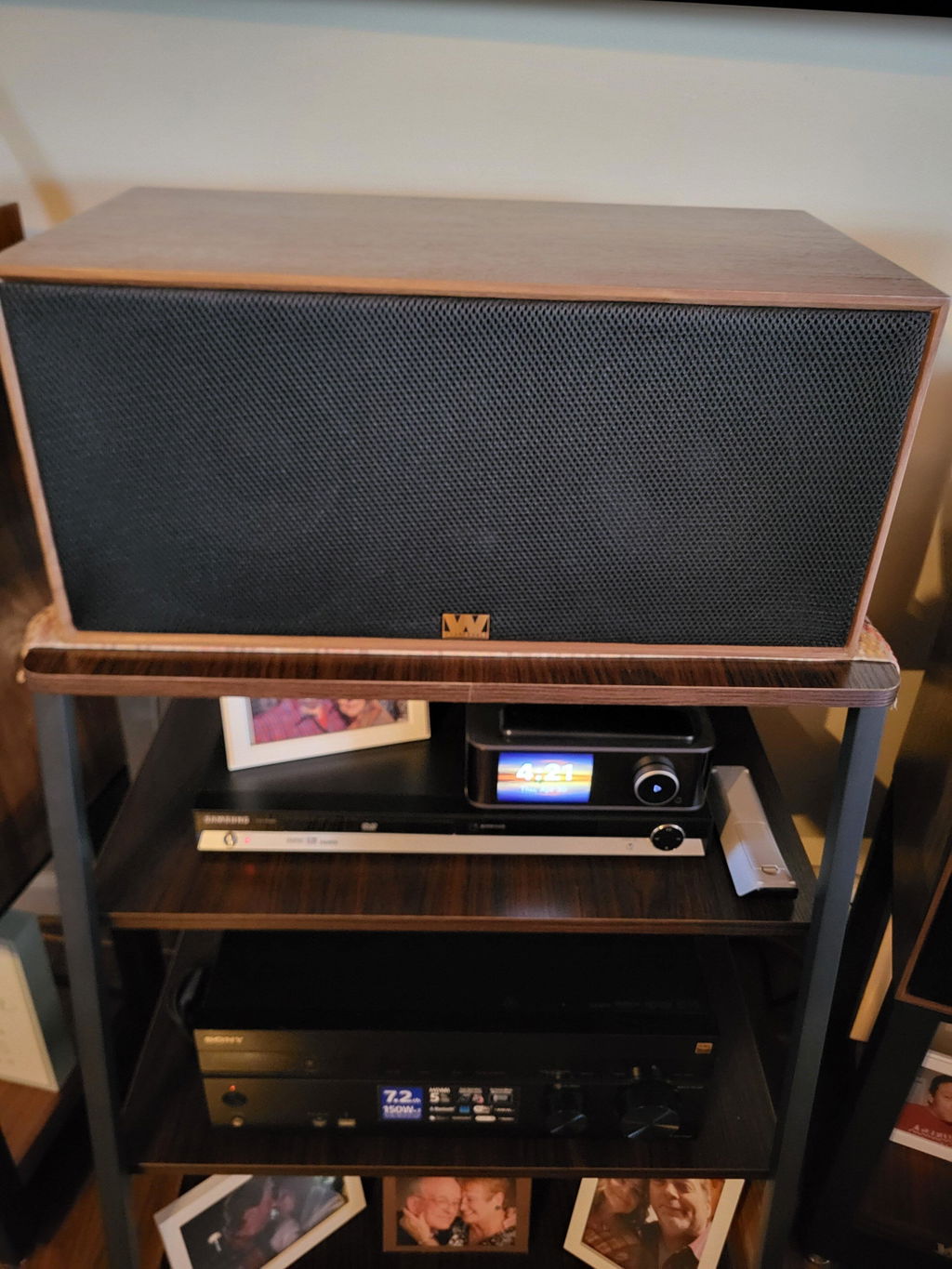
We ran the Heritage Centre in our lab with the Super Lintons handling left and right through a mid-range AV receiver. The improvement in soundstage stability compared to running the Super Lintons in stereo downmix mode was immediate and obvious. Dialogue locked to the screen. Action sequences that previously had a slightly diffuse, spread-out quality became spatially coherent and easier to follow.
The midrange performance is where this speaker makes its strongest case. The 2-inch soft-dome is doing exactly the job it was designed for. Voices have texture and presence and stay intelligible at volume levels where a two-way center would start to compress and lose definition. We pushed it through some demanding sequences and didn't run into congestion or smearing at similar volumes.
The tonal match with the Super Lintons across the front soundstage is as close as you could reasonably hope for from a center channel. Audio panning from center to left or right moves through a coherent, continuous soundstage. You don't hear a different-sounding speaker taking over in the middle. That handoff is smooth, and it's what makes the whole front stage feel like a unified system rather than a collection of individual speakers.
Who Should Buy the Heritage Centre
If you own Lintons, Super Lintons, Dentons, or any other Heritage speaker and you're watching movies through a two-channel setup, this is the most direct upgrade available to you right now. There is no other center channel that was designed from the ground up to match this lineup, acoustically or aesthetically. If you're planning a Heritage-based home theater from scratch, build the center channel into your budget from day one. And if you've been on the fence about whether a center channel makes enough of a difference to justify the addition, the answer is yes, particularly if movies and TV are a significant part of how you use your system.

Audio Advice Take
The Heritage Centre fills a gap that Heritage series owners have been asking about for years. It's tonally matched, visually matched, and built to the same standard as the rest of the lineup. If you're running Heritage speakers for movies and you don't have a center channel yet, this is the one to get. Have questions about whether it's the right fit for your system? Reach out to our team at audioadvice.com and we're happy to help you put it together.We’re Here to Help!
If you have further questions, contact our experts via chat, phone, or email. Or simply visit one of our world-class showrooms to experience speakers, projectors, TVs, and everything in between for yourself before you make a purchase!
If you’re planning your home theater or media room, check out our Home Theater Design page, where we have everything Home Theater related, including our FREE Home Theater Design Tool.
When you buy from Audio Advice, you’re buying from a trusted seller since 1978. We offer Free Shipping, Lifetime Expert Support, and our Price Guarantee. We look forward to serving you!
Frequently Asked Questions
Do I need a center channel if I already have Wharfedale Lintons?
Will the Heritage Centre match my Lintons or Super Lintons?
What AV receiver do I need to use the Heritage Centre?
Can I place the Heritage Centre inside a media console?
What crossover setting should I use for the Heritage Centre?
Is the Heritage Centre good for music as well as movies?

Details & Specs
Heritage-Correct Aesthetics and Build
Unmistakably part of the Heritage family in looks, styling, substance and performance, the Heritage Center is available in the same options of real-wood veneer finishes: Black Oak, Mahogany or Walnut. The matching black front baffle, vintage-style cloth grille, and subtle yet iconic gold Wharfedale badges make this centre speaker blend seamlessly into any LINTON or DENTON system.
Purpose-Built Driver Array
At its core, the Heritage Center features a carefully considered driver configuration: twin 6.5” woven Kevlar woofers that flank a 2” soft-dome midrange and a 1” soft-dome tweeter. This layout mirrors the driver complement and tonal balance of the Heritage series, ensuring coherent dialogue delivery and uniform dispersion characteristics and tonal consistency across the front soundstage. This design guarantees the clarity and weight required for movie soundtracks while retaining musicality for multi-channel music playback.
Peter Comeau’s Center of Attention
The Heritage Center is not a retrofit – it is a fully bespoke model designed under the guidance of Peter Comeau, Director of Acoustic Design for Wharfedale and the master behind all Wharfedale Heritage models. Through typically precise and considered crossover engineering, driver matching, and enclosure tuning, it provides natural tonality and superior vocal intelligibility without colouration. It is voiced to deliver expressive, focused, and fatigue-free dialogue – even at high volumes.
Built to Heritage Standards
The cabinet, while compact, is built to the same standards as the LINTON and DENTON loudspeakers. Braced internally to suppress resonances and fitted with a rear-firing bass reflex port, it delivers low-end support that adds depth and presence to vocal material without bloating or overhang. This gives the speaker authority and scale, even in large rooms or dynamic film scenes.
Ready for Multi-Channel Expansion
As two-channel systems evolve into 3.1 or 5.1 home theatres or beyond, the Heritage Center fills the vital role of dialogue anchor and linchpin. Unlike generic centre speakers, it offers a perfect – and only correct - acoustic and aesthetic match for Wharfedale Heritage set-up. Any modern-retro setup brings the styling, appeal, and living-room-friendly style guide to home theatre setups without compromising aesthetics or sound.
Key Features
Set and Matched — The Driver configuration: 2x 6.5" Kevlar woofers, 2" soft dome midrange, 1" soft dome tweeter and acoustic tuning perfectly complements the Wharfedale Linton and Denton models.
True Heritage Style — The Heritage Center comes in the same wood veneer finishes of Black Oak, Mahogany or Walnut to match the Heritage line.
Demanded and Delivered — Initiated out of end-customer demand and, as with all Heritage models, the Heritage Center is a project led by Wharfedale’s Director of Acoustic Design, Peter Comeau.
| Model | Wharfedale Heritage Center |
|---|---|
| General Description | 3-Way Vented-box/Center |
| Design Philosophy and Core Technology | |
| Enclosure Type | Bass Reflex |
| Transducer Complement | 3-way |
| Bass Driver | 6.5" (165mm) Black Woven Kevlar Cone x2 |
| Midrange Driver | 2" (50mm) Soft Dome |
| Treble Driver | 1" (25mm) Soft Dome |
| Full-range Driver | |
| Sensitivity (2.83V @ 1m) | 90dB |
| Recommended Amplifier Power | 25-150W |
| Peak Power Handling | |
| Peak SPL | 106dB |
| Nominal Impedance | 6Ω (Compatible with 8Ω) |
| Minimum Impedance | 4.0Ω |
| Frequency Response (+/-3dB) | 54Hz - 20kHz |
| Bass Extension (-6dB) | 47Hz |
| Crossover Frequency | 900Hz, 2.7kHz |
| Cabinet Volume | 26.8L |
| Height | 9.84 in (250mm) |
| Width | 21.65 in (550mm) |
| Depth (with terminals) | 12.60 in (320mm) |
| Carton Size | 25.98 x 16.34 x 14.37 in (660 x 415 x 365mm) |
| Net Weight | 30.86 lbs (14.0kg) |
| Gross Weight | 34.39 lbs (15.6kg) |
| Finish | Real Wood Veneer - Walnut, Mahogany and Black Oak |