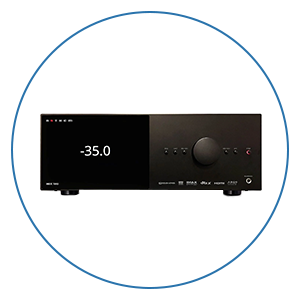
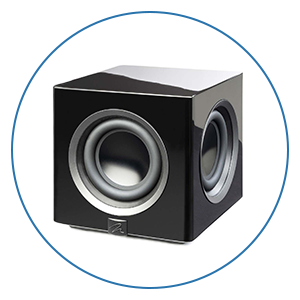
Trinnov's WaveForming Now Works With Two Subwoofers Instead of Four
Trinnov has spent three years telling installers the same thing: WaveForming, its active bass correction technology, needs four subwoofers minimum to qualify. That line moved. A new software update lets a two-subwoofer, front-only configuration deliver results Trinnov is now willing to call WaveForming, and it changes who this technology is realistically built for.
Most bass management treats subwoofers as speakers. Point them at the room, cross them over, and hope the low end sounds even from seat to seat. WaveForming treats them as acoustic tools instead. Through precise control of phase and amplitude across every subwoofer, each one works two jobs at once: helping generate the low-frequency wavefront, and absorbing the unwanted energy that bounces back off the room's walls. That dual role, emitter and absorber at the same time, is the core of what separates WaveForming from a standard multi-sub setup.
Since WaveForming launched, the baseline configuration has been two subwoofers up front and two in the rear, placed according to Trinnov's guidelines. The front pair generates the wavefront and starts absorbing reflections as they return from the back of the room. The rear pair catches those reflections earlier and helps keep performance consistent across a bigger listening area. Trinnov held that four-subwoofer line deliberately, prioritizing predictable results installers could design around over a lower entry point.
Trinnov's research team went back and tested configurations the company had previously ruled out, specifically whether front subwoofers alone, without any rear pair managing back-wall reflections, could still deliver results worth calling WaveForming. The measurements said yes. Two correctly positioned front subwoofers reduced decay time below 100Hz by up to 50%, a result that held up across multiple rooms, different subwoofer models, and a range of listening layouts.
A second finding pushed things further: subwoofers sharing a single Altitude output channel turned out to absorb more effectively than Trinnov's earlier models predicted, which lowers the channel-count barrier for some installations too. Trinnov's own conclusion was that its original four-subwoofer rule had been more conservative than the physics required.
The natural comparison here is a Single Bass Array, or SBA, a common approach that clusters multiple subs to smooth out frequency response by controlling which room modes get excited. An SBA can meaningfully improve consistency, but it generally still needs passive absorption on the rear wall to control decay time. Skip that treatment and decay times stay long no matter how well the subs are placed.
Two-subwoofer WaveForming works differently. Both subs are controlled simultaneously as emitters and active absorbers, so the same two-subwoofer footprint gets you decay-time control an SBA can't deliver through placement alone. It's not a better version of subwoofer placement. It's active control of the low-frequency field, with a smaller hardware footprint than WaveForming has ever needed before.
Two-subwoofer WaveForming isn't a shortcut to four-subwoofer performance in a bigger room. It shines in a narrower set of situations: small rooms, or setups where the subwoofers themselves are already serious performers with the output to spare. If you're working with modest subs in a larger space, this update won't get you there.
It also lines up well with a layout that comes up constantly in everyday homes: a sofa pushed back against the rear wall, with no room behind the seats for a proper rear-subwoofer pair anyway. That's close to the exact scenario Trinnov's own data points to, a compact, single-row listening area where two front subs can cover the whole seat without needing anything managing reflections from behind.
The update isn't limited to new two-subwoofer installs, either. Trinnov also refined the core WaveForming algorithms for every existing configuration, improving coherence between subwoofers and satellite speakers and making the system more predictable across a wider range of room conditions. Current WaveForming owners don't need to redo a full calibration to get those improvements; a Compute pass on an existing preset is enough.
As few as two, positioned at the front of the room according to Trinnov's placement guidelines. The original four-subwoofer configuration, two front and two rear, is still available and delivers more control across a wider seating area.
A Single Bass Array smooths frequency response through subwoofer placement and typically needs passive absorption on the rear wall to control decay time. WaveForming actively controls both the wavefront and the room's reflections through the subwoofers themselves, so it doesn't depend on that rear-wall treatment.
No. It's a free software update for Trinnov Altitude16, Altitude32, and AltitudeCI processors. Existing WaveForming installations don't need to recalibrate; a Compute pass applies the updated algorithms.
Not across a whole room. It delivers up to 50% reduction in decay time below 100Hz versus 60-70% with a four-subwoofer configuration, and performance is strongest near the optimized listening position rather than throughout a larger space.
We're here to help! Contact our experts via chat, phone, or email, visit one of our showrooms nationwide, or use our FREE Home Theater Design Tool.
Audio Advice has been a trusted seller since 1978, with Free Shipping, Lifetime Expert Support, and a Price Guarantee on everything we sell.

You'll be among the first to know about product launches, exclusive online deals, and the hottest audio trends.