Kanto Tuk G2 vs. Tuk Grand: What Changed and Which One Is Right for You

Kanto Tuk G2 vs. Tuk Grand: What Changed and Which One Is Right for You video cover
Play

Kanto's Tuk has been one of the better powered bookshelf speakers you could buy without spending serious money since it launched back in 2019. For 2026, Kanto rebuilt it from the cabinet out, and instead of one speaker, there are now two: the Tuk G2 at $899.99 a pair, and a new flagship above it, the Tuk Grand, at $999.99 a pair. Both debuted at Audio Advice Live 2026, and we've had them in for testing since the show closed.

The two models share a redesigned cabinet, a reworked tweeter waveguide, retuned DSP and crossover circuitry, and modernized connectivity. Where they split is scale: the Grand steps up to a larger cabinet, a bigger woofer, more power, and meaningfully deeper bass extension. Below, we break down what changed, what carried over from the original Tuk, and which of the two makes sense depending on your room and your gear.

Kanto Tuk G2

A Quick History of the Tuk

The original Tuk arrived in 2019 as Kanto's most ambitious speaker to date, built around a 5.25 inch aluminum woofer and a 28 by 35mm Air Motion Transformer (AMT) tweeter, a driver style that moves air by folding a pleated diaphragm rather than pushing a rigid dome back and forth. That tweeter, combined with a dedicated phono preamp built into the cabinet, made the original Tuk a favorite for anyone who wanted real hi-fi character out of a compact, all-in-one system without adding a turntable preamp or a separate amplifier.

One detail that rarely makes it into coverage of this speaker: its name. Tuk is short for Tuktoyaktuk, a hamlet on the Arctic Ocean in Canada's Northwest Territories, known for some of the best aurora borealis viewing anywhere. Kanto has said the name is meant to connect to that, sound with the same kind of impact as watching the northern lights. Six years later, Kanto rebuilt the platform rather than issuing a simple refresh, and split what used to be a single model into two tiers.


Design and Build

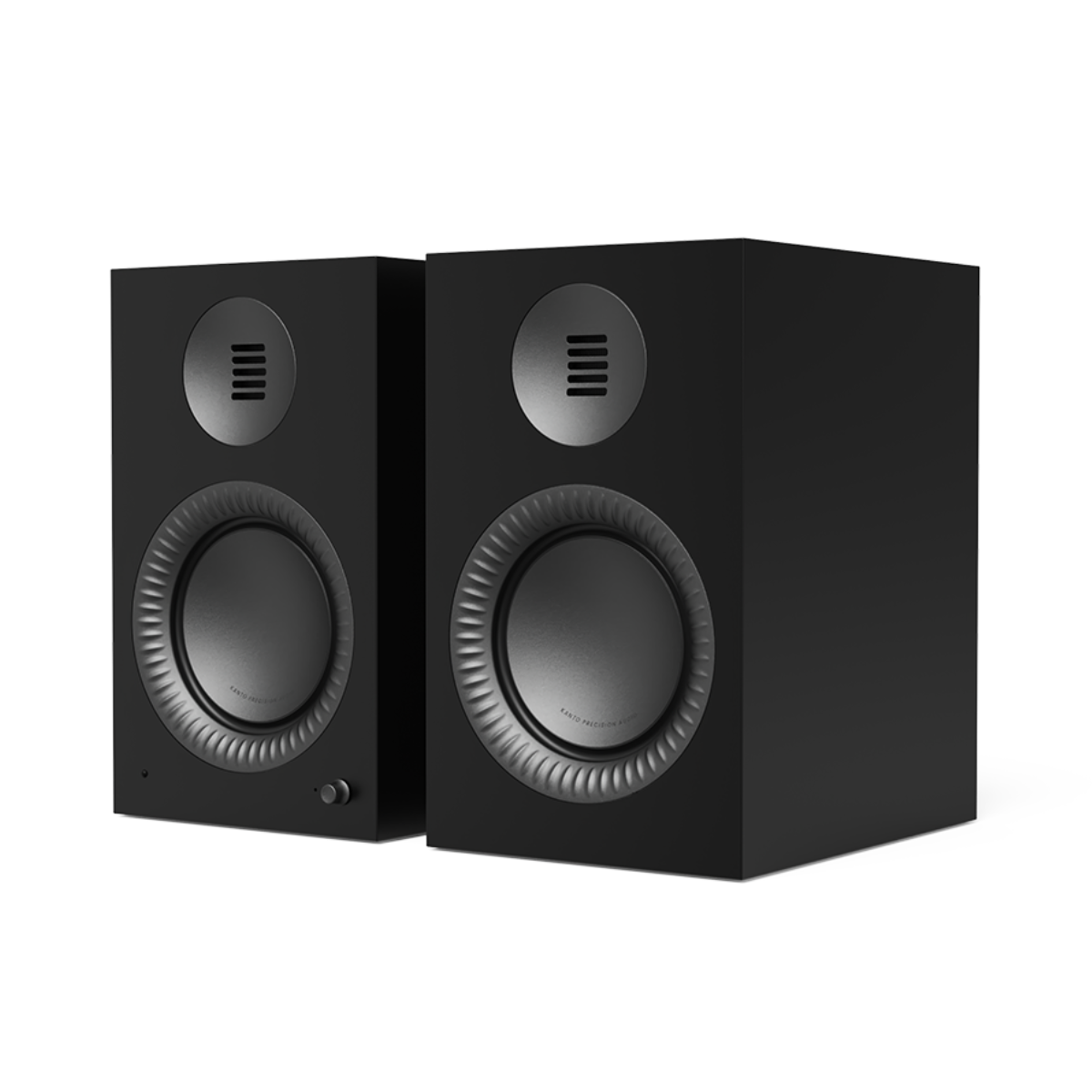
The most visible change is the cabinet itself. The original Tuk used softly rounded front edges; both new models move to a squared-off, more architectural profile instead. Sharp cabinet edges create diffraction, meaning sound leaving the driver interacts with the enclosure's edges on its way into the room, and Kanto says the new geometry reduces that interaction for a cleaner, more focused soundstage. Both cabinets are still hand built from high density acoustic MDF and finished in real wood veneers or paint with hand-polished lacquers.

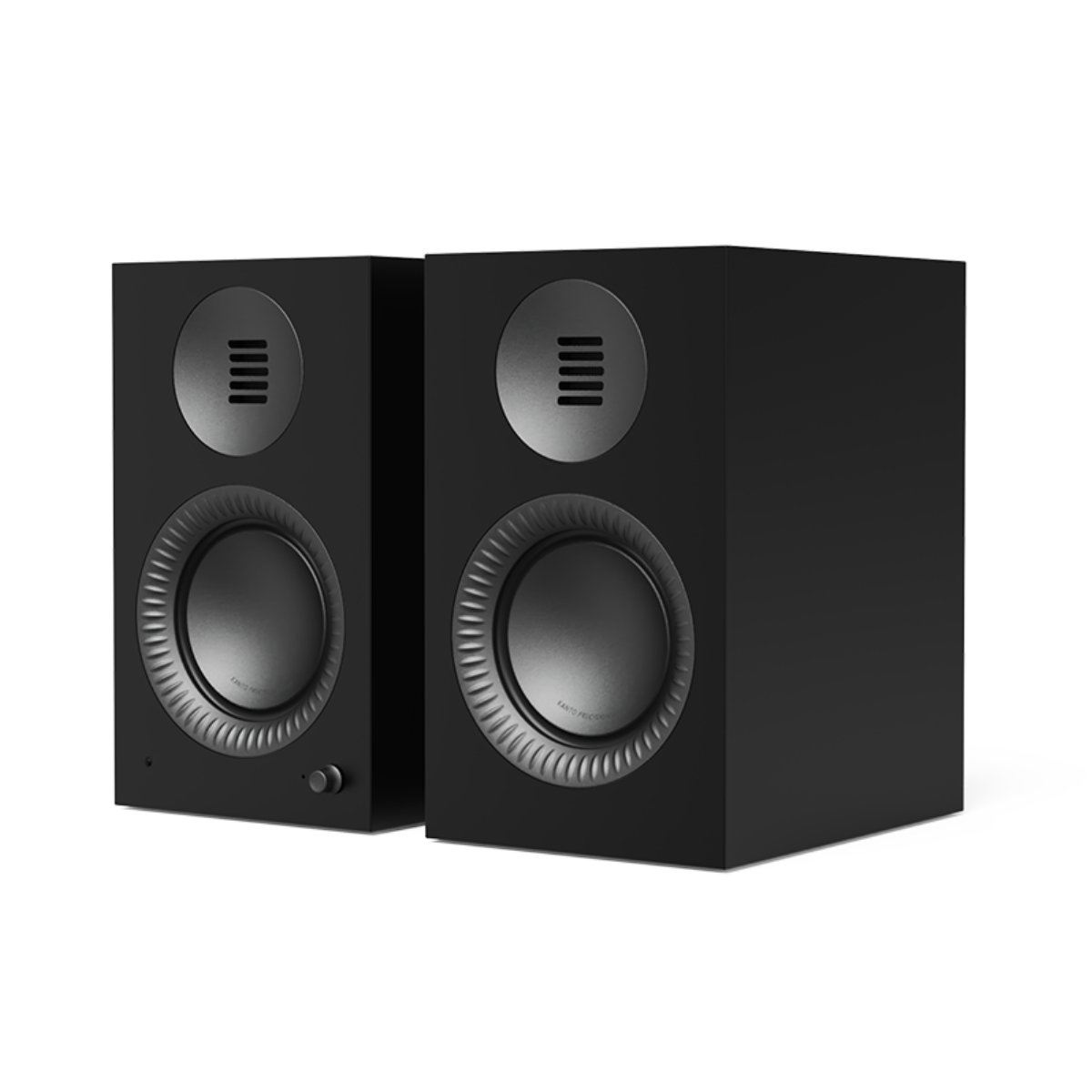
The front baffle changed just as much, and the difference is bigger in person than it looks in photos. The original Tuk used a row of five small LEDs next to its volume knob, one per input. Both new models replace that with a single recessed LED, a change that keeps the panel from washing out a dark room while still showing at a glance that the speakers are powered on. That single LED still communicates input status, it changes color depending on what's selected: teal for RCA 1, green for RCA 2, pink for optical, yellow for USB, and blue for Bluetooth (flashing while pairing, solid once connected). The IR sensor is now recessed instead of sitting proud as a raised bubble, and the tweeter grille moved from a rectangular slotted vent to a circular cutout that mirrors the round woofer beneath it rather than contrasting with it. Around the woofer itself, both new models add a fluted, ribbed trim ring finished in the same metallic tone as the waveguide, gold on the Rose Gold finishes and gunmetal on the rest. Kanto hasn't published a technical explanation for that ring, so it's best treated as a finish upgrade rather than an acoustic one, but it's a large part of why the driver reads as a finished component instead of a hole cut into the cabinet.

The finish lineup is worth calling out on its own. Tuk G2 ships in five options: Matte Black with Gunmetal, Matte White with Aluminum, Gloss Butter with Gunmetal, Matte Burl with Gunmetal, and Matte Walnut with Rose Gold. Tuk Grand ships in three: Matte Black with Gunmetal, Matte White with Aluminum, and Matte Walnut with Rose Gold. Kanto has a history of offering eclectic color choices across its lineup, its SYD desktop speaker alone has shipped in pink and burgundy, but these finishes lean more restrained and coordinated, with the woofer ring and waveguide color matched precisely to the wood grain or paint on every option. In hand, the fit and finish here is well ahead of what you'd expect at this price point.

Features and Technology

Both models keep the same AMT tweeter style that defined the original Tuk, but Kanto redesigned the waveguide around it, the shaped housing that sits in front of the diaphragm and directs how high frequencies spread into the room. The goal was a more consistent tonal balance and stereo image off-center, so a narrow sweet spot doesn't leave anyone sitting to the side hearing a noticeably different sound than someone in the middle seat.

Kanto also retuned the DSP and crossover on both new models, the electronics that split the incoming signal between tweeter and woofer and shape the sound before it reaches either driver. That kind of retuning can meaningfully change how a speaker sounds without changing a single piece of hardware, and Kanto says this pass produces a more natural, balanced profile out of the same driver sizes used before.

Connectivity picked up a real bump. Bluetooth moves from 4.2 with aptX HD on the original Tuk to 5.4 with aptX Adaptive, AAC, and SBC on both new models, for a more stable connection and better handling of higher resolution wireless streams. Both speakers also connect over USB-C at 24-bit/96kHz, which is worth using at a desk since it routes audio straight to the Tuk's own DAC and bypasses your computer's built-in sound card entirely. A Toslink optical input covers a TV or other digital source at the same resolution. A subwoofer output with a selectable 80Hz crossover carries over from the original Tuk as well, handing bass duties to a subwoofer so the Tuk's own woofer can focus on mids and highs. Kanto sells two subs sized for this pairing, the compact SUB6 and the larger SUB8.

On the input side, both new models list two RCA inputs at line level, and unlike the original Tuk, neither one is a dedicated phono input. The original Tuk had a separate RCA pair wired specifically for turntables, with a built-in preamp baked into the circuit. That's gone on the Tuk G2 and Tuk Grand, both RCA pairs here are line level only. If you're running a turntable, you'll need one with its own phono stage built in, or an outboard phono preamp between the table and the speaker.

We asked Kanto directly about that cut, and the reasoning holds up: a lot of turntables under $600 now ship with their own switchable phono stage built in, and buyers of pricier tables tend to prefer sourcing their own outboard phono preamp and interconnects rather than relying on a fixed one in the speaker. Building in two standard line inputs instead gives the speakers broader source compatibility overall, rather than dedicating one input to a feature a shrinking share of buyers were actually using.

Detail view of Kanto Tuk G2
Rear panel view of Kanto Tuk Grand G2

The original Tuk's front-panel headphone jack didn't make the trip either. It's gone on both new models, so anyone who used it for private late-night listening loses that option here.

One original feature that did carry over, and doesn't appear anywhere in Kanto's current marketing for either model: full left and right channel reversal. Because the amplifier and all the input jacks live inside just one speaker of the pair, powered speakers can be inconvenient if that active cabinet ends up on the wrong side of the room from your power outlet. Holding the previous track button on the remote assigns the powered speaker to the left channel, and holding the next track button assigns it to the right, so the amp can sit on whichever side makes sense for your room.

The remote itself was redesigned too. It now handles volume, input switching, treble and bass adjustment, balance, and Bluetooth playback from a single handset, control that on a lot of other powered speakers means digging into a phone app instead. It also lets you dim or fully turn off that recessed front LED, a nice option if you're running these in a bedroom or home theater where you don't want any ambient light at all.


Tuk G2 vs. Tuk Grand: What Changed

The Tuk G2 keeps the same 5.25 inch aluminum woofer size as the original Tuk, now called an Aircomb woofer, Kanto's trademark for the reworked cone, though the company hasn't published what changed structurally beyond claiming added depth, clarity, and dispersion. Power stays at 130 watts RMS and 260 watts peak, identical to the original Tuk, and frequency response is spec'd at 50Hz to 22kHz. In other words, the G2 isn't a louder or deeper speaker than the one it replaces, it's a refined one. The extra $100 over the original Tuk's price buys the cabinet redesign, the tweeter and waveguide work, and the retuned DSP, not more raw output.

The Tuk Grand is the bigger step. It moves up to a 6 inch Aircomb woofer and reaches down to 40Hz, a real jump over the G2's 50Hz floor, and those last ten hertz matter more than they look on a spec sheet, since the lowest notes are always the hardest for a compact woofer to reproduce cleanly. Power climbs to 160 watts RMS and 320 watts peak, which Kanto says works out to 30% more RMS power than the G2.

One wrinkle worth knowing before deciding between them: if you're planning to add a subwoofer regardless, the calculus shifts. Cross either speaker over to a sub at 80Hz and the Grand's headline advantage, that native 40Hz extension, stops mattering as much, since the subwoofer is handling everything below that point anyway. If you're running these on their own with no subwoofer in the plan, the Grand's case gets a lot stronger.


Setup and Placement

Both speakers carry a quarter-twenty threaded mounting hole on the bottom, so they'll sit directly on Kanto's own SX and SU2 stands. Getting the tweeter up to ear height matters more here than it would with a standard dome tweeter, since AMT tweeters disperse sound in a narrower vertical pattern, sit them too high or low relative to your ears and you'll lose top-end energy that a dome design would have preserved. Kanto recommends keeping the rear panel at least 8 inches from the wall behind the speakers, though placing them a little closer than that can reinforce bass through boundary gain if you want a fuller low end, a placement choice that showed up as a likely factor in differing reviews of the original Tuk's bass character. Avoid pushing either speaker into a room corner specifically, Kanto's own setup guide flags that corners tend to overrepresent low and midrange frequencies, muddying the exact detail these speakers are built to deliver. If your rear wall clearance is tight, angling the speakers slightly toward the listening position helps cut down on reflections without needing to move them any farther out.

Kanto Tuk Grande G2

Performance Impressions

We spent time listening to the original Tuk alongside both new models. On "Keith Don't Go" by Nils Lofgren, the original still had the fast, detailed character we've always liked from this line, but the G2 sounded more refined, the guitar kept the same crisp attack, but the tweeter blended more naturally into the woofer and the center image held together better as we moved off axis. The Grand kept that same clarity but everything sounded bigger, more body to the guitar, more space around the recording, a stronger overall sense of scale. On "Limit to Your Love" by James Blake, the difference down low got a lot more obvious: the G2 stayed tight and controlled, but the Grand added noticeably more weight and depth, and sounded less strained once the bass got heavy.

Independent reviews of the original Tuk were split on this exact territory. What Hi-Fi called its low end thin against the rest of the mix and said extended listening sessions got tiring, while Future Audiophile called the bass surprisingly strong for the cabinet size and said vocals stayed clean at volume without turning fatiguing. Tonal balance and long-session comfort are precisely what Kanto says the new DSP and crossover tuning targeted this time around, which is worth listening for specifically rather than taking on faith.


How the Tuk G2 and Tuk Grand Compare to Other Options

Inside Kanto's own lineup, the REN remains the better pick if HDMI ARC and TV sound matter more than a phono input, since neither new Tuk model has an HDMI input of any kind. Outside Kanto, the $899.99 Tuk G2 lands in the same price range as SVS's Prime Wireless Pro, which adds HDMI ARC and WiFi streaming that neither Tuk model offers, though one reviewer who tested both directly gave the edge in top-end openness to Kanto's AMT tweeter over SVS's dome design. The $999.99 Tuk Grand sits at the same price as KEF's LSX II LT, which uses a coaxial Uni-Q driver and a smaller 4.5 inch woofer that won't dig as deep as the Grand's 6 inch driver, but connects its two speakers fully wirelessly instead of over a physical speaker cable.


Tuk vs. Tuk G2 vs. Tuk Grand

 Original TukTuk G2Tuk Grand
Price (pair)$799.99$899.99$999.99
Woofer5.25" aluminum5.25" Aircomb aluminum6" Aircomb aluminum
Tweeter28x35mm AMT28x35mm AMT, new waveguide28x35mm AMT, new waveguide
Power (RMS / Peak)65W x2 / 130W total130W RMS / 260W peak160W RMS / 320W peak
Frequency response50Hz–20kHz50Hz–22kHz40Hz–22kHz
Bluetooth4.2, aptX HD5.4, aptX Adaptive5.4, aptX Adaptive
Phono preampYes, dedicated inputNoNo
Headphone jackYesNoNo
Channel swapYesYesYes
Sub crossover80Hz, selectable80Hz, selectable80Hz, selectable

Frequently Asked Questions

What is the difference between the Kanto Tuk G2 and Tuk Grand?

The Tuk Grand has a larger cabinet, a 6 inch woofer instead of 5.25 inches, more amplifier power (160W RMS vs. 130W RMS), and bass extension down to 40Hz instead of 50Hz. The G2 is a refined version of the original Tuk's formula; the Grand expands on it with more scale and deeper bass.

Does the Kanto Tuk G2 have a phono preamp?

No. Unlike the original Tuk, which had a dedicated phono input with a built-in preamp, the Tuk G2 and Tuk Grand both use two line-level RCA inputs only. If you want to connect a turntable, it will need its own phono stage, or you'll need an outboard phono preamp between the table and the speaker.

Does the Kanto Tuk G2 have a headphone jack?

No. The original Tuk's front-panel headphone jack was removed on both the Tuk G2 and Tuk Grand.

Can you use a subwoofer with the Kanto Tuk G2 or Tuk Grand?

Yes. Both models have a dedicated subwoofer output with a selectable 80Hz crossover. Engaging it sends bass below 80Hz to the subwoofer and lets the Tuk's own woofer focus on mids and highs.

What is an AMT tweeter?

An AMT, or Air Motion Transformer, uses a pleated diaphragm that folds in on itself as it moves, rather than the rigid dome shape used in most tweeters. This design pushes more air per millimeter of travel, which is part of why AMT tweeters tend to sound faster and more detailed at the top end.

Can you reverse the left and right channels on the Tuk G2 or Tuk Grand?

Yes. Holding the previous track button on the remote makes the powered speaker the left channel, and holding the next track button makes it the right channel, letting you place the active speaker on whichever side of the room makes the most sense for your power outlet.

Can you turn off the LED light on the Tuk G2 or Tuk Grand?

Yes. The remote lets you dim or fully turn off the recessed front LED, useful if you're running the speakers in a bedroom or home theater where you don't want any ambient light.
How much do the Kanto Tuk G2 and Tuk Grand cost?

The Tuk G2 is $899.99 per pair and the Tuk Grand is $999.99 per pair at Kanto's manufacturer pricing.

Why is there no sound or static coming through the optical connection on the Tuk G2 or Tuk Grand?

The optical input only decodes two-channel PCM audio. If a TV or game console is set to output a compressed surround format like Dolby or DTS instead of stereo PCM, the optical input will produce no sound or audible noise. Setting the source's audio output to stereo or PCM resolves it.

Do the Tuk G2 and Tuk Grand turn off automatically when not in use?

Yes. Both go into standby after 15 minutes without an audio signal or input from the front knob or remote, then wake automatically once a signal returns. Both the auto standby and auto wake behavior can be turned off separately from the remote if you'd rather the speakers stay powered on.


We're Here to Help

Choosing between two speakers that share this much DNA can be harder than choosing between two completely different products. If you're weighing the Tuk G2 against the Tuk Grand, or trying to figure out whether either one fits your room, your gear, and your budget, our product advisors can walk through it with you. Audio Advice has been helping people build systems they love since 1978, reach out online, by phone, or in one of our showrooms and we'll help you get it right.