

Hegel H200 & A200 Integrated Amplifiers Overview

Hegel H200 & A200 Integrated Amplifiers Overview video cover
Play

Hegel launched two new integrated amplifiers on the same day, and together they say more about the company's approach than either one would alone. The H200 and A200 share a 150 watt Class A/B amplifier platform, Hegel's SoundEngine2 distortion control, and a damping factor rated above 4000. From there, they split into two different products.

The H200 is what Hegel calls The Connected, built to be the single hub for a modern system, with streaming, a DAC, phono, and every analog input you'd want. The A200 is The Classic, a fully analog amplifier for listeners who already have their source components sorted out and want a serious amp to drive their speakers.

There's a bit of history in the H200 name too. Longtime Hegel listeners may recognize it from an earlier chapter in the company's catalog, but this is a completely new amplifier from the ground up, not a reissue.

Hegel H200

Design and Build Quality

Physically, the H200 and A200 are nearly identical. Both measure 17 x 16.2 x 4.7 inches (43 x 41 x 12 cm), and the weight only differs by two tenths of a pound, 30 lbs (13.6 kg) for the H200 versus 29.8 lbs (13.5 kg) for the A200, since the A200 doesn't need the extra boards for streaming and DAC duty.

The front panel follows Hegel's usual approach: a couple of rotary knobs, a small display, and nothing else competing for attention. The H200 is available in black or white, while the A200 is black only for now. If you've spent time with a Hegel integrated before, the look will be familiar. Clean lines, machined aluminum knobs, and a chassis built to last for decades rather than a product cycle.


What the H200 and A200 Have in Common

Both amplifiers are built around a 150 watt per channel Class A/B amplifier section, and both are rated stable down to 2 ohms. Hegel didn't cut corners on the output stage on either one.

Both also use Hegel's SoundEngine2 technology, the company's method for correcting distortion in real time. Instead of measuring the output and correcting after the fact the way many feedback-based designs work, SoundEngine2 catches distortion where it happens and cancels it before it travels further down the signal path.

Combine that with a damping factor rated above 4000 on both units, and you get an amplifier built to control a wide range of speakers, even ones with demanding impedance swings.


The H200: The Connected

The H200 is built to be the only box you need. On the streaming side, it supports Spotify Connect, Tidal Connect, Qobuz Connect, Apple AirPlay, Google Cast, and it's Roon Ready. Airable is built into the Hegel Control app for internet radio and podcasts, and UPnP handles browsing a music library stored on a NAS. None of this locks you into a proprietary ecosystem. You use the same Spotify, Tidal, and Qobuz apps already on your phone, and the amp becomes the endpoint.

Behind that streaming layer is a proper DAC, fed by a coaxial input, two optical inputs, USB-B for a computer, a network connection, and a USB-A port for direct playback off a flash drive or hard drive. Hegel rates the USB-A input to handle libraries of up to around 10,000 songs sitting directly on the drive, no computer or phone required.

The coaxial digital output is what makes Hegel's DAC Loop feature possible. If you want to add an outboard DAC later, you can send the digital signal out to that external unit and loop its analog return back into the H200's balanced XLR input. The amp handles the switching automatically, so you keep the H200's streaming platform and input switching while upgrading the digital conversion stage whenever you're ready.
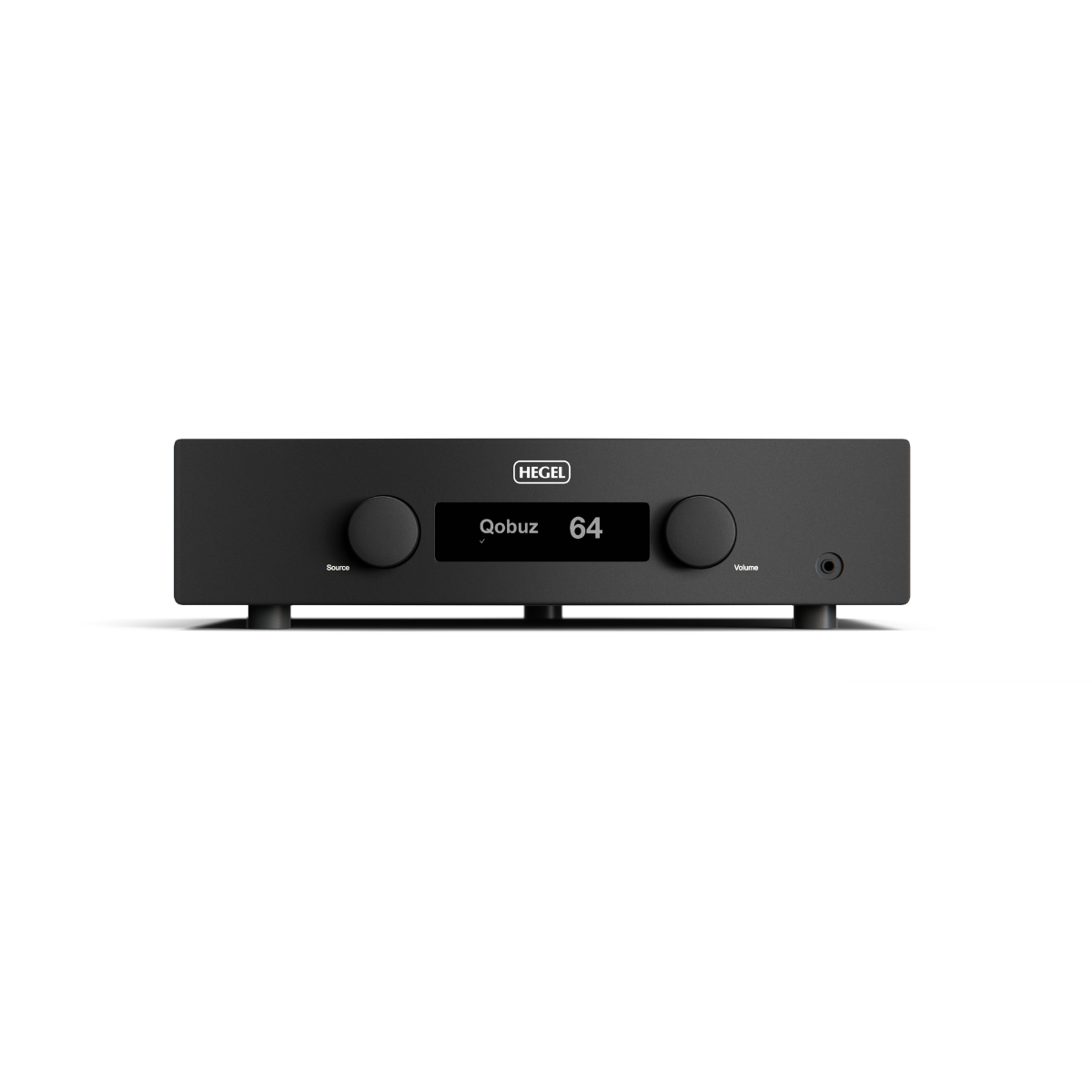
On the analog side, the H200 has one balanced XLR input, two unbalanced RCA inputs, a fixed and a variable line output, and a headphone output. The variable output is what you'd use to add a subwoofer. There's no onboard crossover for that sub output, so the crossover point gets set on the subwoofer itself rather than through the amp.

Each input can also be locked to a fixed volume level, which lets you use one as a home theater bypass, letting an AV receiver or processor feed the H200 a fixed-level signal while it handles the amplifier duty. Digital Input Sense wakes the amp and switches to the right input automatically when it detects a signal, and it can also learn volume commands from a TV remote. Add startup and max volume limits, auto standby, adjustable display dimming, and support for Control4, Crestron Home, and Crestron SIMPL, and the H200 fits into most smart home setups.

Then there's the phono stage, which tends to surprise people who assume a streaming-focused amp skips vinyl entirely. The moving magnet input is based on the MM section of Hegel's standalone V10 phono stage, using hand-matched FET transistor gain stages and carefully selected op-amps. The phono stage doesn't feel like a checkbox feature.


Performance

We got our hands on an H200 ahead of launch and spent several weeks with it, paired with a set of KEF R5 Meta towers. Fleetwood Mac's "Landslide" was one of the first tracks we played, and the H200 kept Stevie Nicks locked dead center with the acoustic guitar spread cleanly around her, no smearing when the electric guitar takes her place later in the song.

Bass control is where the damping factor shows up the most. On the George Clinton cut from the Wild Things soundtrack, the low end stayed tight through the build, nothing bloated or slow to let go. Vocals came through neutral across the board, nothing pushed forward or held back. The top end has real extension without turning bright over a long listening session.

We're impressed with the sound Hegel is pulling out of this platform, and the engineering shows. Every person we've demoed a Hegel for in one of our showrooms walks away surprised by it, and at this price point, we think the H200 will be hard to beat. The A200 hasn't shipped yet, but it shares the same amplifier section, so we expect a similar character once we get a unit in for testing.


The A200: The Classic

The A200 strips out everything digital. No DAC, no streaming section, no network input of any kind. If you already own a DAC you love, run a separate streamer, or have a system built around a turntable and a CD player, the A200 gives whatever you plug into it a clean, powerful, quiet foundation to work from.

Where the A200 pulls ahead of the H200 is on the analog side. Instead of one balanced XLR input, it has two, plus the same two unbalanced RCA inputs as the H200. If you've got multiple analog sources, say a DAC and a CD player, or two streamers you're deciding between, the A200 has room for both. You still get the same fixed and variable RCA outputs, so subwoofer integration is covered, plus a headphone output for private listening.

It carries over the same MM phono stage built off the V10. We do wish Hegel had added a moving coil input here, though it fits the philosophy behind The Classic. Most people considering the A200 with a moving coil cartridge likely already have a separate phono preamp.
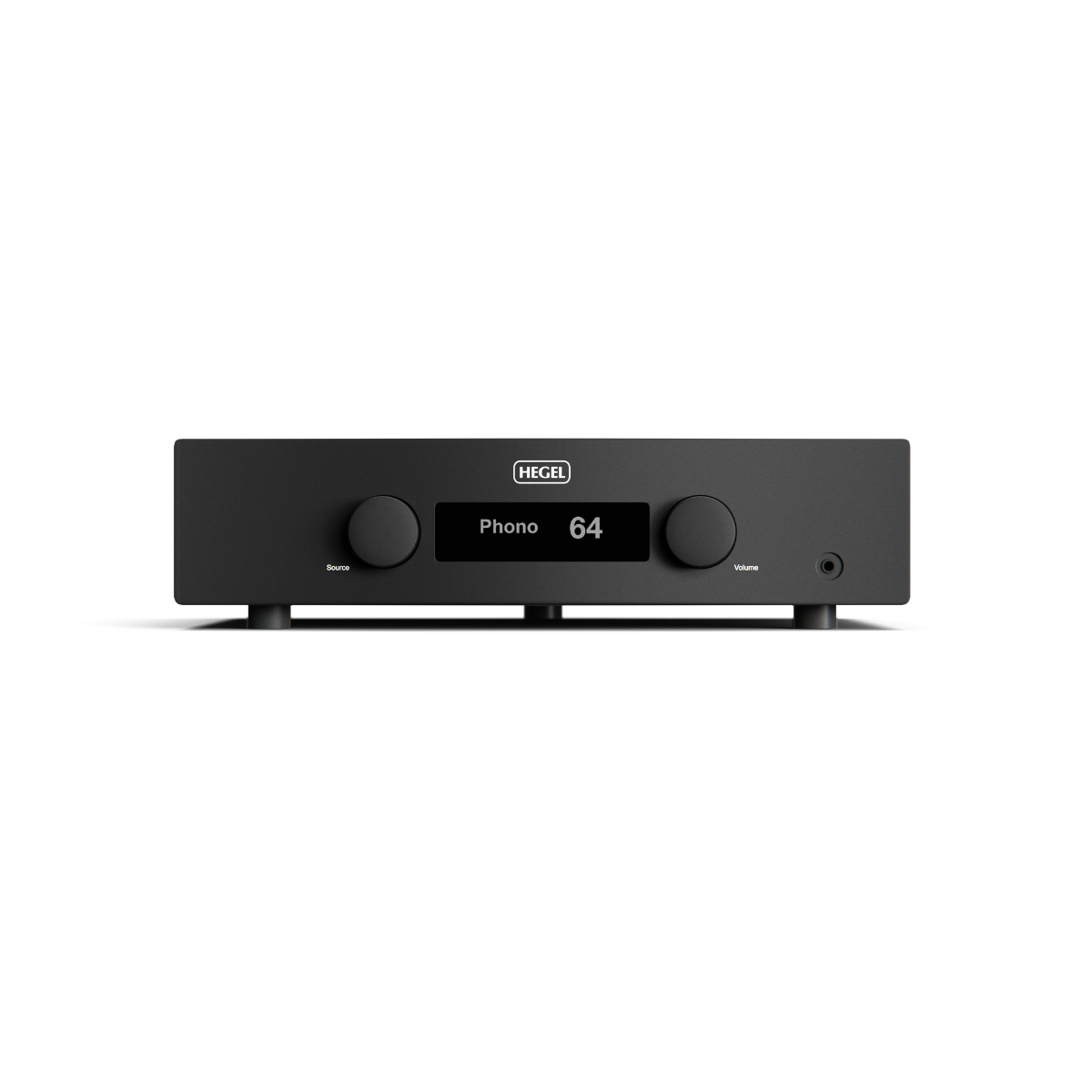
Cutting the digital section didn't mean losing the daily conveniences either. The A200 still lets you lock each input to a fixed volume for home theater integration, still has startup and max volume limits, auto standby, and the same adjustable display dimming as the H200.


Pairing and System Building

Both amps land in a price range where KEF's R Series makes a natural match, and Audio Advice already carries and has reviewed the line in depth. The R5 Meta runs about $5,000 a pair, close to either amp's price, and it's the easiest of KEF's towers to place in a room since its smaller woofers don't fight with room boundaries as much. The R7 Meta, around $6,000 a pair, is a good step up if you've got a larger room and want more low-end authority from its dual 6.5 inch woofers.

KEF rates both speakers to run on anywhere from 15 to 250 watts into a 4 ohm nominal load. With the H200 and A200's 2 ohm stability and damping factor above 4000, there's plenty of headroom to drive them properly.

As with any Hegel, speaker matching still matters. Both amps are built to control a wide range of speakers, but very inefficient designs, huge rooms, or speakers with punishing impedance swings are still better served by Hegel's higher-powered models.

Which One Should You Buy?

If you want one amplifier that handles everything from Spotify on your phone to a turntable in the corner, and you like the idea of a built-in upgrade path through the DAC Loop, the H200 is the easy answer. If you've already got your source components sorted out, the A200 gives you the same amplifier section and the same phono stage in a simpler, more focused package for $1,000 less.

Hegel isn't asking anyone to pick a side in the streaming versus analog debate. They built two amplifiers that match how people already listen, and left the amplifier section that made Hegel's reputation alone in both.


Frequently Asked Questions

What is the difference between the Hegel H200 and A200?

The H200 includes streaming, a built-in DAC, USB drive playback, and a coaxial DAC loop for adding an external DAC later. The A200 is fully analog, with no DAC, streaming, or network input, but it adds a second balanced XLR input in exchange.

Does the Hegel H200 have a phono stage?

Yes. Both the H200 and A200 include a moving magnet phono input based on the MM section of Hegel's standalone V10 phono stage.

Can I add a subwoofer to the Hegel H200 or A200?

Yes. Both amplifiers have a variable RCA line output for subwoofer integration. Neither amp has an onboard crossover for that output, so the crossover point is set on the subwoofer itself.

How much power do the H200 and A200 have?

Both are rated at 150 watts per channel into 8 ohms and are stable down to 2 ohm loads, with a damping factor above 4000.

Does the Hegel A200 have a DAC or streaming?

No. The A200 is a fully analog amplifier with no DAC, no streaming section, and no network input.


Final Thoughts

The H200 and A200 split one amplifier platform into two different products instead of one compromise. The H200 makes sense for someone who wants a single hub for a modern system, with streaming, a DAC, and an upgrade path built in. The A200 makes sense for someone who has already settled on their source components and wants a serious, fully analog amplifier behind them.

Either way, the part that matters most, the 150 watt amplifier section, SoundEngine2, and a damping factor above 4000, stays the same.


We're here to help!

If you have further questions, contact our experts via chat, phone, or email. Or simply visit one of our world-class showrooms to experience speakers, projectors, TVs, and everything in between for yourself before you make a purchase!

If you're planning your home theater or media room, check out our Home Theater Design page, where we have everything Home Theater related, including our FREE Home Theater Design Tool.

When you buy from Audio Advice, you're buying from a trusted seller since 1978. We offer Free Shipping, Lifetime Expert Support, and our Price Guarantee. We look forward to serving you!