

Bluesound PULSE CINEMA & PULSE CINEMA MINI Dolby Atmos Soundbars with BluOS
At Audio Advice, we’ve reviewed countless soundbars over the years, all claiming to deliver home theater performance without the hassle of receivers, bulky speakers, or wires running across the room. Some fall short, while others really impress us. But because the overall quality of soundbars has gotten so good, it now takes something special for a new one to grab our attention.
That’s why when Bluesound sent us early samples of their brand-new PULSE CINEMA and PULSE CINEMA MINI, we were immediately struck by how feature-packed they are and how confidently they perform. In a crowded field of Dolby Atmos soundbars, these two really do stand out.
We liked the previous Bluesound Pulse Soundbar+, but it had limitations. It supported Dolby Atmos, but all the drivers were front-facing and Atmos relied on virtualization. That never delivered the same sense of height and immersion as dedicated upfiring channels. The Soundbar+ was also taller than most competitors and often blocked the bottom of a TV unless wall-mounted. It still sounded good, but there was clear room to improve.
The new Pulse Cinema lineup feels like Bluesound listened closely and made the right upgrades.
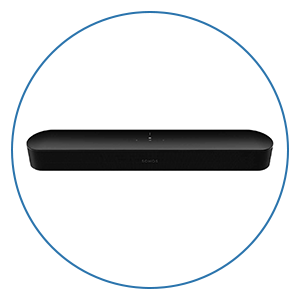
The first thing that stands out about these new soundbars is the design. The grey fabric-wrapped front and black aluminum body with rounded edges look sleek and modern. The Mini version also comes in a white and tan finish that blends beautifully in lighter interiors.
Both bars feature capacitive touch buttons with a proximity sensor, lighting up only when your hand approaches. Whether on a media console or wall-mounted with the included bracket, these soundbars look fantastic.
Another clever touch is auto orientation sensing. When mounted on the wall, the bar adjusts each driver’s role automatically for the best performance. In terms of size, the Pulse Cinema is about 48 inches wide, ideal for TVs 55 inches or larger. The Pulse Cinema Mini measures about 34 inches wide, making it a great fit for bedrooms, offices, or smaller TVs.
The larger Pulse Cinema uses a 3.1.2 layout with 500 watts of system power. Inside are 16 total drivers, including a dedicated left, center, and right front stage, plus a pair of discrete upfiring height channels. Two 4-inch internal woofers with four passive radiators provide low-end impact.
This design gives the Pulse Cinema enough output to fill medium to large rooms while keeping dialogue clear and effects immersive.
The Pulse Cinema Mini is just as exciting but designed for completely different setups. It’s a 2.1 array with two angled drivers to widen the front stage, two 4-inch woofers, and two passive radiators for the low end. With 280 watts of power, it’s plenty for small to medium spaces.
Instead of discrete upfiring height drivers, the Mini uses Dolby Atmos virtualization to create a 3D bubble of sound. While not as precise as real height channels, the Mini’s compact size makes it easier to place in cabinets or under shelves where upfiring drivers would be blocked. Just be sure to position it flush with the front edge for best results.
On the back of both soundbars you’ll find:
Both soundbars support hi-res audio up to 24-bit/192kHz and DSD256. Connectivity includes AirPlay 2, Spotify Connect, TIDAL Connect, and two-way Bluetooth 5.2 with aptX Adaptive. They’re also Roon Ready.
The real advantage, though, is Bluesound’s BluOS app platform. It integrates all major streaming services, local music libraries, and advanced features like:
The Pulse Cinema shines in medium to large rooms with flat ceilings between 10–12 feet high. The upfiring drivers bounce sound off the ceiling to create convincing height effects, while the dedicated center channel keeps dialogue anchored to the screen.
It’s not a substitute for true in-ceiling speakers, but it delivers a surprisingly immersive experience for a single soundbar.
The Mini is perfect for smaller rooms or layouts where upfiring speakers won’t work — like vaulted ceilings, ceiling fans, or furniture that blocks placement. Atmos virtualization uses advanced processing to simulate height and surround effects. While less precise than discrete height channels, it lifts the soundstage and spreads effects convincingly for its size.
On their own, both soundbars sound great, but they’re designed to expand:
We tested movies like The Irishman, a go-to for soundbar evaluations. Dialogue was crisp, ambient effects like chirping crickets were realistic, and height effects arced convincingly overhead with the Pulse Cinema. Adding the Sub+ and rears unlocked a fully immersive surround bubble.
The Mini held strong, too, with clear dialogue and surprisingly good virtualized height effects. For its size, it’s one of the most convincing compact soundbars we’ve tested.
Music performance is another strength. Hi-res playback through BluOS sounded excellent, with even tonal balance and clean imaging. Grouping the bars with other Bluesound gear around the house made for seamless whole-home audio.
One limitation is that Atmos music is not yet supported natively in BluOS. However, when streaming Atmos music through Apple TV over HDMI eARC, the bars played back correctly. We expect Bluesound to add native Atmos music in the future as the format grows.
While we’re impressed overall, a few areas could be refined:
What sets Bluesound apart is the combination of serious hardware and the BluOS ecosystem. The Pulse Cinema delivers real upfiring height channels, a dedicated center channel, and enough power for large rooms. The Mini offers compact flexibility with Atmos virtualization for spaces where height speakers won’t work.
Both scale easily with the Sub+ and wireless rears, and both double as hi-res music hubs when you’re not watching movies.
If you want a soundbar that simplifies your system while still giving you an upgrade path into surround sound, the Bluesound Pulse Cinema lineup makes a strong case in this price range.
The Pulse Cinema is a 47-inch 3.1.2 Dolby Atmos soundbar with discrete upfiring drivers and 500 watts of power. The Pulse Cinema Mini is a 34-inch 2.1 design with angled drivers, 280 watts of power, and Atmos virtualization.
No. Both soundbars include built-in amplification and Dolby Atmos decoding. Connect your TV with a single HDMI eARC cable and you’re ready to go.
Yes. Both models support a wired subwoofer via RCA and can pair wirelessly with the Pulse Sub+. You can also add Pulse M or Pulse Flex speakers as wireless rears, or use a Powernode with passive speakers.
Yes. Both support hi-res audio up to 24-bit/192kHz, MQA decoding, and DSD256 playback.
Yes. Dolby Atmos plays correctly when passed over HDMI eARC from your TV or external streaming device. Atmos music is not yet native in BluOS but works through HDMI connections like Apple TV.
The Pulse Cinema is best for medium to large rooms with flat ceilings that allow upfiring drivers to work. The Pulse Cinema Mini is better for smaller rooms, bedrooms, or spaces where placement flexibility is more important.
The Pulse Cinema comes in black with a dark grey grille. The Mini is available in black with dark grey or white with tan.
If you have further questions, contact our experts via chat, phone, or email. Or simply visit one of our world-class showrooms to experience speakers, projectors, TVs, and everything in between for yourself before you make a purchase!
If you’re planning your home theater or media room, check out our Home Theater Design page, where we have everything Home Theater related, including our FREE Home Theater Design Tool.
When you buy from Audio Advice, you’re buying from a trusted seller since 1978. We offer Free Shipping, Lifetime Expert Support, and our Price Guarantee. We look forward to serving you!
You'll be among the first to know about product launches, exclusive online deals, and the hottest audio trends.
