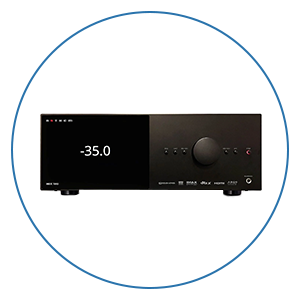
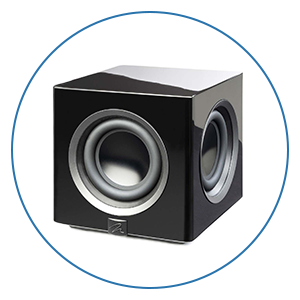
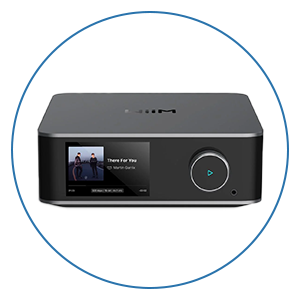

Welcome to Audio Advice’s top picks for the best high-performance streaming amplifiers. In our compact streaming amplifier guide, we focused on smaller, space-saving models that disappear into media consoles and desktop systems. This time, we are stepping up to full size, higher power streaming integrated amplifiers that can anchor serious two channel systems and dedicated listening rooms.
These are the one box solutions you reach for when you want real amplifier authority, high end DAC performance, and a feature set that can grow with your system over time. Every model here can drive demanding speakers with confidence and has the build quality to match. They still keep things simple with modern streaming platforms and clean system layouts, but the focus is squarely on higher performance and long term ownership.
During testing, we focused on the features and performance traits that matter most in systems, such as:
One of the biggest differences between streaming amps is the software experience. Fast navigation, the ability to stream full quality music over WiFi, and support for services like TIDAL Connect, Spotify Connect, Roon, Chromecast, and AirPlay make a huge difference in everyday use. Some systems include full streaming apps built in, so you browse and play music right inside their control app. Others rely mostly on casting from your phone using AirPlay or Chromecast. Both approaches work well, but they feel very different in practice, so we call out how each amp handles streaming and control.
The DAC stage plays a major role in how clean and natural your music sounds. Different amps use different DAC chips and processing, which can influence clarity, imaging, and the sense of space in your room. Combined with solid amplifier power delivery, low noise, and strong dynamics, the right DAC and amp pairing lets you hear fine detail even at low listening levels.
Not all amps offer room correction, but when done well, it can be one of the biggest upgrades in two-channel audio. We call out who does it best.
Subwoofer outputs, HDMI ARC for TV audio, pre-outs, digital and analog inputs, and multiroom support.
We test with bookshelf speakers, towers, and harder to drive loads at real listening volumes. Every model in our list brought something special to the table. There are plenty of other great options out there, but these are the ones that rose to the top in real listening spaces and across a range of speaker systems.
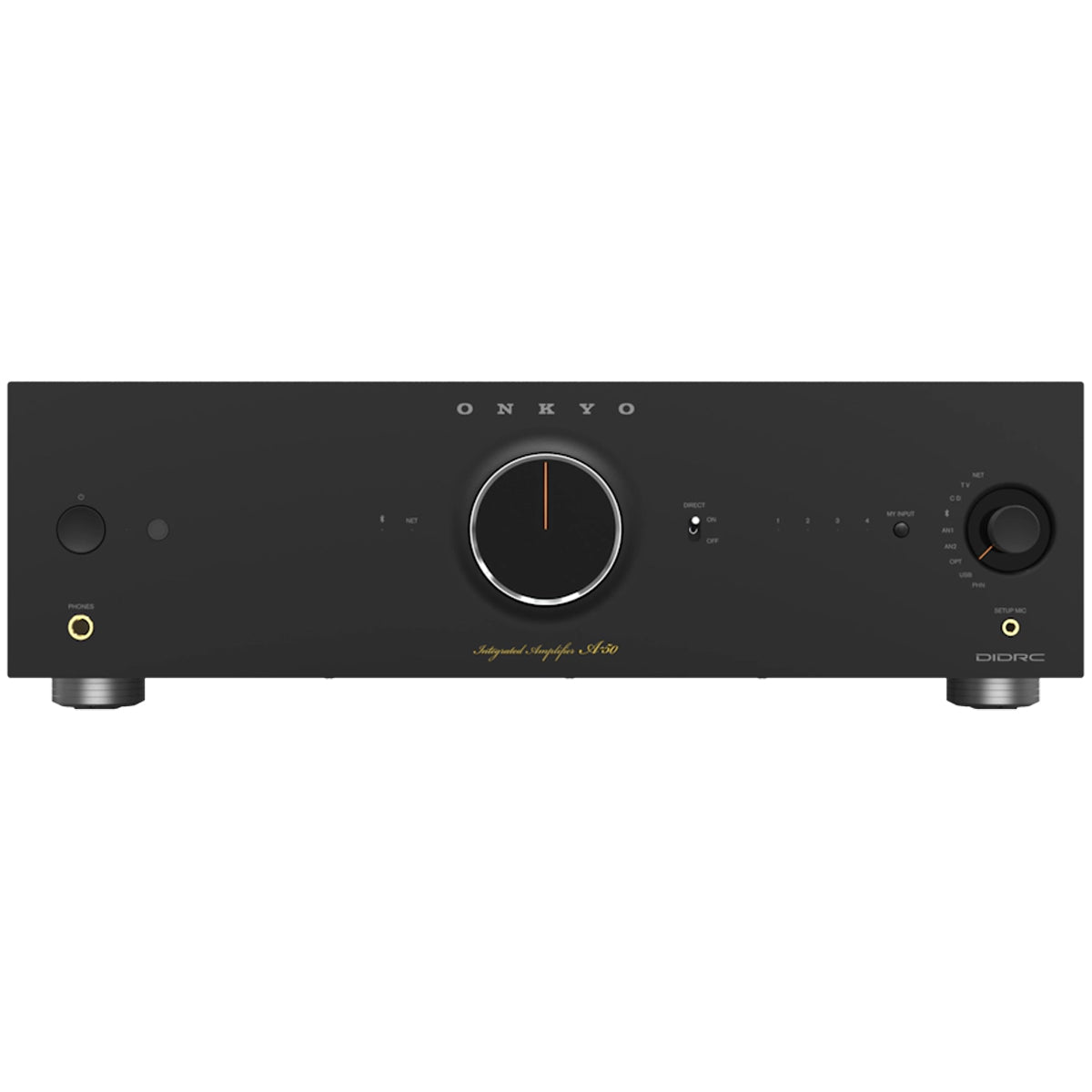
The Onkyo Icon A-50 stands out because it brings together three things that rarely coexist this cleanly in a single two-channel component: strong real-world power, a modern streaming platform, and true room correction built in. At $1,599, it is also the most affordable amplifier in this group, which makes its overall feature set even more impressive. It is designed for listeners who want performance that adapts to their space, rather than forcing their room to adapt to the system.
At its core, the A-50 is a traditional Class AB integrated amplifier, but it is executed with a clear focus on stability and control. It has the current delivery to confidently drive a wide range of speakers, from efficient bookshelf models to larger floorstanders that need more grip in the low end. The sound is controlled and composed, with bass that feels grounded and midrange detail that stays intact even as volume levels rise. It never feels strained or edgy, which makes it easy to listen to for long sessions.
Digital playback is handled by a high-resolution 32-bit DAC, and Onkyo’s approach here is worth noting. Rather than spotlighting a specific DAC chip, the A-50 focuses on overall implementation, including power supply design, filtering, and analog output stages. The result is a presentation that sounds clean and balanced rather than overly sharp or clinical. High-resolution streaming comes through with good separation and openness, while standard streaming and TV audio remain smooth and natural. This is the kind of DAC tuning that works across genres and listening habits without drawing attention to itself.
Where the A-50 really separates itself from most other streaming integrated amplifiers is its built-in Dirac Live room correction, which is included at no additional cost. Room acoustics play a massive role in two-channel sound quality, especially in the bass, and Dirac Live gives the A-50 the ability to actively correct those issues. With proper setup, Dirac can tighten low-frequency response, improve clarity, and lock in imaging in ways that hardware changes alone often cannot achieve. In many real living rooms and multipurpose spaces, this can be one of the most meaningful upgrades you can make to a system.
From a build and engineering standpoint, the A-50 is designed to stay quiet and mechanically stable. A thick aluminum front panel, reinforced chassis structure, high-quality internal components, and a fanless design all work together to reduce vibration and electrical noise. That attention to physical design shows up as a darker background and better low-level detail, which benefits both music listening and TV use.
The design itself deserves mention as well. The A-50 has a clean, modern look with a symmetrical front panel, subtle indicator lighting, and a large centered volume knob that gives it a confident but understated presence. Available in both black and silver finishes, it fits naturally into dedicated listening rooms and living room systems alike. It looks premium without feeling flashy or distracting, which is exactly what most people want from a long-term system component.
System flexibility is another strong point. The A-50 integrates easily into modern setups with HDMI ARC for TV audio, full MM and MC phono support for turntables, multiple analog and digital inputs, and a headphone output for private listening. Streaming support is comprehensive, with access to services like Spotify, TIDAL, Qobuz, AirPlay 2, Chromecast, and Roon. Everything is controlled through a clean, intuitive mobile app, making day-to-day use straightforward for everyone in the household.
The Onkyo Icon A-50 is ideal for listeners who want a single component that can anchor a serious two-channel system while also adapting to real-world rooms and mixed-use spaces. It may not chase a minimalist audiophile philosophy or ultra-luxury pricing, but at it’s price point, it delivers an unusual combination of power, flexibility, room correction, and clean design that is hard to match. For many listeners, it is one of the smartest and most well-rounded streaming integrated amplifiers available today.
The Marantz Model 40n blends the warm and musical Marantz sound with a clean, modern streaming platform and a design language pulled straight from the company’s classic components. It feels premium the moment you touch it. Every control moves with a smooth, deliberate action, and final assembly takes place by hand at the Shirakawa Audio Works facility in Japan, which gives the unit a level of craftsmanship that stands out in this category.
Inside, the engineering is more serious than you typically find at this price. A large toroidal transformer sits on the left side of the chassis, heavy heat sinks run through the center for consistent thermal performance, and the low level circuitry is isolated on the right. The entire amplifier weighs more than 36 pounds, which comes from real power supply mass and a rigid internal structure. The Hyper Dynamic Amplifier Modules, tuned by the Marantz Sound Masters, deliver the warm, rich tonal balance that listeners associate with the brand. Power comes in at 70 watts per channel into 8 ohms and 100 watts into 4 ohms, which works well with most speakers in a modest or medium sized room, especially when sensitivity is around 88 dB or higher.
Digital conversion is handled by an ESS Sabre ES9016K2M DAC, a proven chip known for clean, detailed playback with low noise. The analog section is also stronger than you might expect for this type of streaming integrated amplifier. There is a capable moving magnet phono stage derived from the Model 30 series, three additional line level inputs, and a dedicated tape output for those using cassette or reel to reel decks. The subwoofer output includes adjustable crossover points from 40 to 120 hertz in 10 hertz increments, which gives you simple but useful control when blending a sub into a two channel system. The crossover only applies to the subwoofer output, so your main speakers continue to run full range.
Modern features are fully supported, like the HDMI ARC input, which makes TV integration simple and lets the TV remote handle power and volume. HEOS provides access to major streaming services and multiroom playback, and AirPlay 2, Bluetooth, DLNA, and voice control through Alexa, Google, or Siri offer additional ways to play music.
Now, the Model 40n doesn’t include digital room correction. You do get traditional bass, treble, and balance controls along with the adjustable subwoofer crossover, but there is no automated room measurement or DSP based tuning. However, this isn’t what Marantz is chasing here anyways. Thie Model 40n is more focused on great build quality that will last you a lifetime and a warm sound that keeps you listening for hours.
In our tests, the Model 40n delivers a warm, textured midrange, a wide, dimensional soundstage, and bass that stays clean and controlled for an amplifier at this price. It remains composed at higher volumes and brings a musical, engaging quality to nearly every genre. While it doesn’t offer the extra power reserves of the Model 30, the Model 40n delivers a really solid and enjoyable sound that exceeds expectations and makes it one of the most compelling options under $3,000.
The HiFi Rose RS520 is one of the most unique streaming amplifiers you can buy. It feels like the RS150 network player and the RA180 amplifier came together in one elegant chassis, bringing high end streaming, a flagship DAC, and serious power into a single unit. HiFi Rose combines decades of touchscreen and UI engineering from its parent company with audiophile design, and it shows the moment you power this up.
Build quality is top tier, with a solid aluminum chassis and a stunning 12.6 inch touchscreen that sets it apart from every other streaming amp. The interface is a joy to use, giving you fast access to music services, settings, VU meters, and even video playback. You can browse music with album art, manage sources, and enjoy unique features like Rose Tube and Rose Radio. It also supports Roon and can play from local drives or an optional internal SSD.
Streaming services include Apple Music via AirPlay, Spotify Connect, TIDAL, Qobuz, and UPnP playback. Inside, you get the same ESS ES9038PRO DAC used in HiFi Rose’s top streamer, paired with a powerful GaN-based amplifier rated at 250 watts per channel at peak output. It has plenty of current and control, which means it can drive large floorstanding speakers with ease. If you need real power behind your system, the RS520 delivers without breaking a sweat. However, there is no automatic room correction, but HiFi Rose includes a five band parametric EQ that lets you dial out bass peaks and fine tune the overall balance to better match your room and speakers.
Connectivity is very strong with HDMI ARC for TV audio, digital and analog inputs, USB for computer audio, pre outs, and the option to connect external drives or a CD player if you prefer physical media. It also supports video output for RoseTube, their version of YouTube with tons of concerts loaded on, so you can pull up concert footage on your TV while the audio plays through your speakers.
The RS520 is ideal for someone who wants a luxurious, modern streaming experience with some serious power paired with a showpiece display. It brings high end build quality, a flagship DAC, and a fast touch interface into a single box that feels like a statement system for the living room or dedicated listening space.
The Hegel H150 is one of the strongest examples of a sound first streaming integrated amplifier in this price range. Hegel calls it the Prodigy because it brings a surprising amount of reference level engineering into a more accessible model. It borrows core concepts from Hegel’s higher end products and focuses almost entirely on delivering the best possible sound rather than loading the unit with every feature. The minimalist Scandinavian design, available in black or white, keeps the front panel clean with a thick aluminum faceplate, precise control knobs, and a simple OLED display.
The amplifier stage is where the H150 truly earns its reputation. The 75 watt rating looks modest, but the custom class AB topology with SoundEngine 2 produces extremely low distortion, fast transient response, and a remarkably high damping factor of 2000. Combined with a large toroidal transformer and a fast, quiet power supply, the H150 delivers bass grip and midrange clarity that feel closer to far more expensive amplifiers. The internal DAC follows the same philosophy. Based on a custom four layer design inspired by their Viking CD player, it provides clean, detailed digital conversion with very low noise.
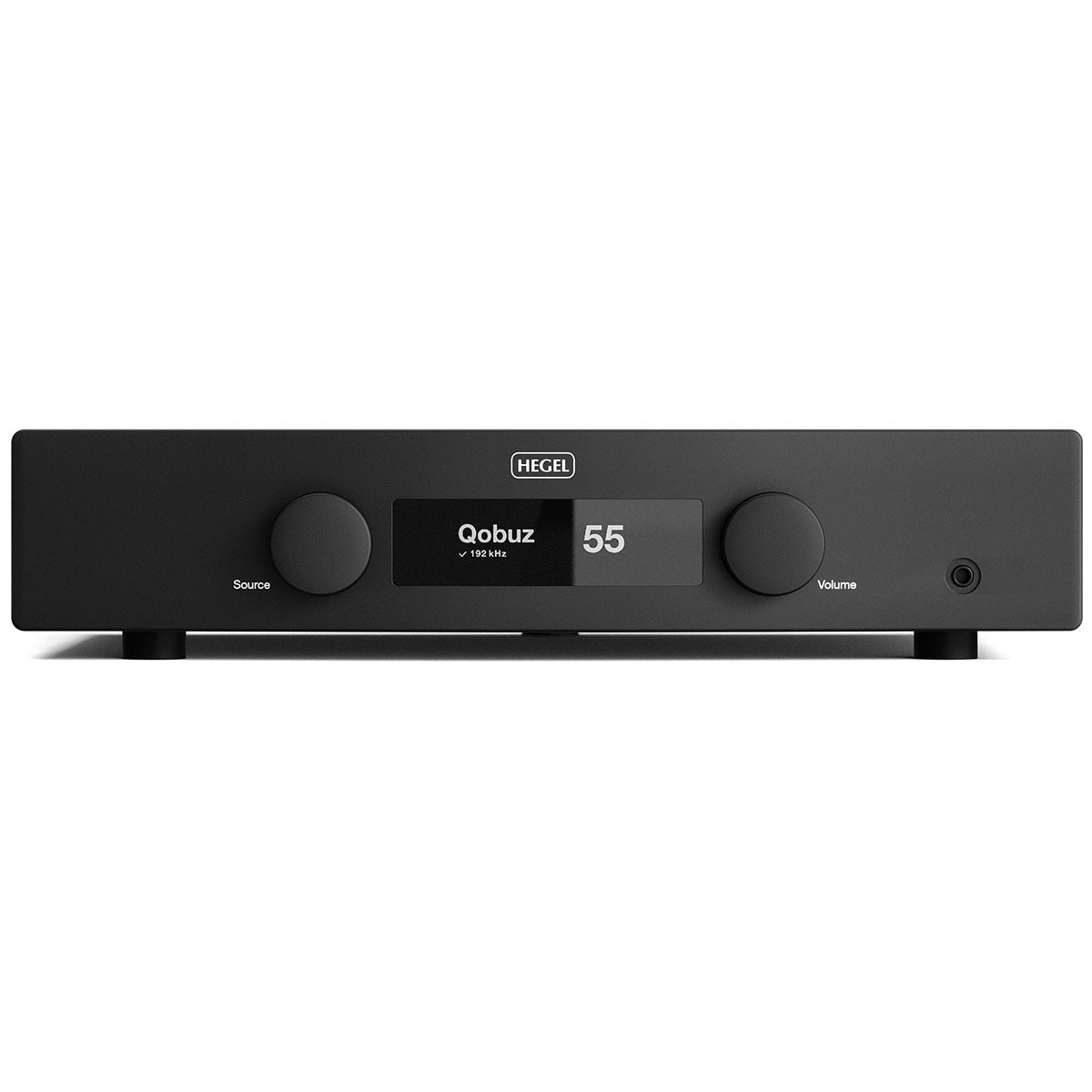
However, this design focus comes with some trade offs for those who are looking for more than just the best possible sound. The H150 does not include HDMI eARC, does not have built in room correction, and does not offer a full featured streaming app where you can log into services or browse natively. Instead, you rely on Spotify Connect, TIDAL Connect, Qobuz Connect, Roon, AirPlay, Google Cast, or UPnP. Most listeners will stream directly from their favorite service and never miss an app, but those who want a more integrated platform may prefer another model. And if you don’t plan to use a TV in your setup and don’t want need room correction, these may not even be considered trade offs to you.
Connectivity on the back includes two optical inputs, one coaxial input, USB B for computer audio, USB A for storage devices, and a network port. A coaxial digital output creates a DAC loop path for future DAC upgrades. The analog section includes an RCA input, a balanced XLR input, and a surprisingly strong moving magnet phono stage. A variable line output lets you add subwoofers or external amplifiers, and the built in headphone output is useful for late night listening.
Where Hegel has always done a great job is in their simplicity of using their units. Input sensing wakes the amplifier automatically when playback starts, and there are no complicated menus, no extra layers of DSP, and no advanced configuration needed. It’s built for listeners who want to sit down and play music that sounds amazing without any fuss.
The H150 succeeds because it puts its energy into the parts that matter most for musical performance. It’s not the most versatile streaming amplifier in this group, but if sound quality, internal engineering, and clean Scandinavian design matter more than features like HDMI or room correction, the H150 stands out as one of the most impressive choices under $5,000.
The SA45 is the flagship streaming integrated amplifier in ARCAM’s Radia Series, and it feels like it. The first thing you notice is the design. It keeps the clean Radia look, but steps up to a larger, high resolution front display that really elevates the experience. It is crisp and bright, sits beautifully in a media room or two channel setup, and makes album art and menus easy to see from across the room. We only wish it were a touchscreen, because the interface looks like it is begging to be tapped.
Under the hood, this is pure ARCAM, and Class G is the star. At low and moderate listening levels, the amplifier runs in Class A for that smooth, liquid character that audiophiles chase. When music demands more punch, it lifts into a higher voltage rail and behaves like a high current Class A/B design. You get the warmth and finesse of Class A, plus the grip and dynamic control of a powerful modern amp. At 180 watts per channel into 8 ohms, the SA45 has no trouble taking command of full size towers.
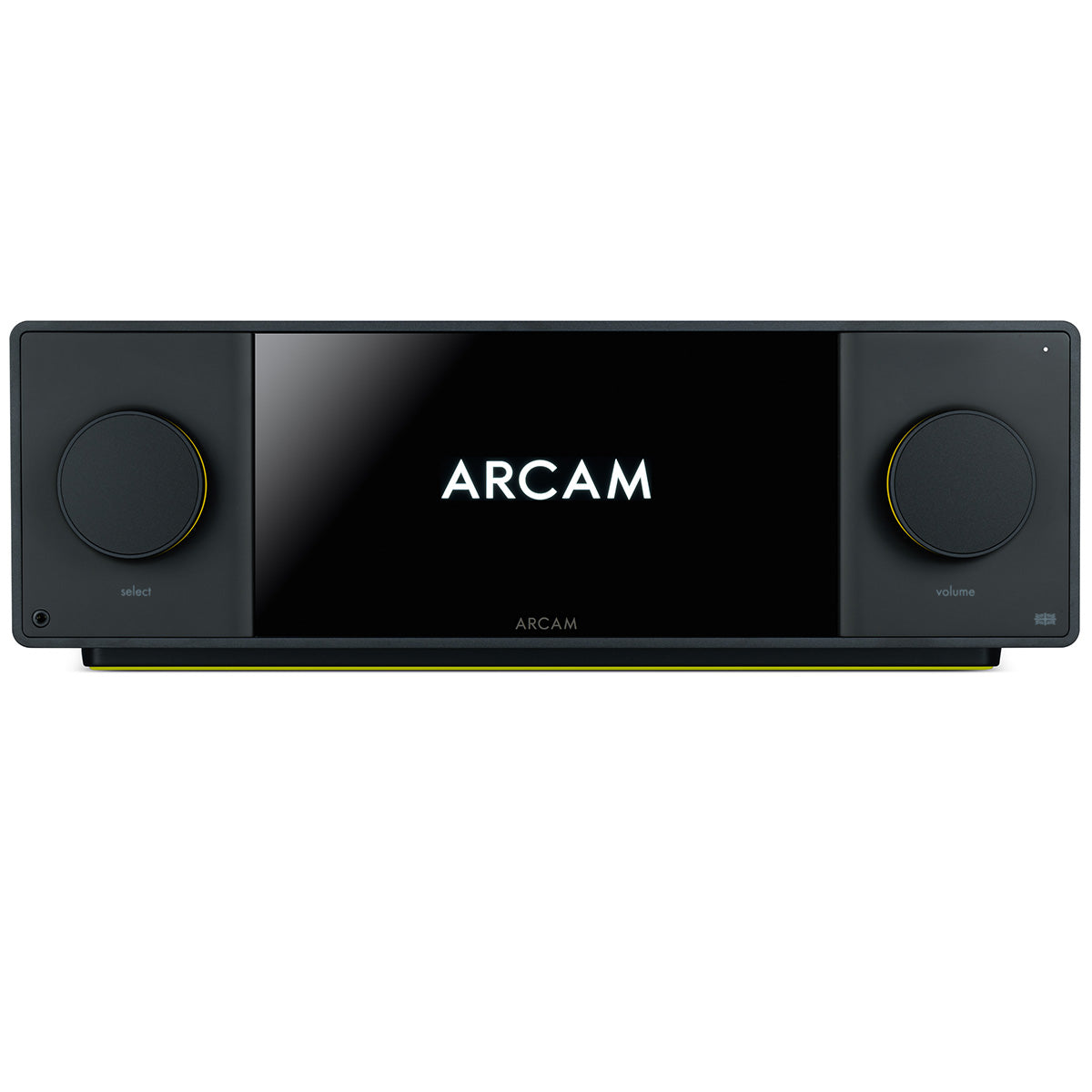
While many competitors charge extra for room correction, the SA45 includes Dirac Live right out of the box. And if you have two subwoofers, the dual sub outputs make setup simple. You can even unlock Dirac Live Bass Control later for an additional fee for advanced multi-sub tuning and time alignment. We can’t emphasize how great this is that it’s included for free!
For streaming and daily use, the SA45 is very well equipped. Chromecast, AirPlay 2, Spotify Connect, Qobuz and Amazon Music through the ARCAM app, Roon Ready support, Bluetooth aptX Adaptive, USB playback, and HDMI eARC for TV audio are all here. It plays just as well with a turntable thanks to balanced and single ended inputs. Balanced main out is included too if you ever want to use it as a streaming preamp.
In our listening, the SA45 presented music with an easy sense of space and control. Voices felt natural, instruments stayed separated even in busy mixes, and bass remained tight and fast. With Dirac engaged, imaging locked in and the tonal balance gained that clean, confident feel that usually takes a full stack of separates.
If you want a one box solution that looks premium and gives you powerful room correction without extra software purchases, the ARCAM SA45 stands out. Class G, a beautiful display, dual subs with Dirac, and real system flexibility make this one of the most complete streaming amps in its class.
The Naim Uniti Nova earns its place in this guide because it delivers one of the most emotionally engaging and musically satisfying listening experiences you can get from a single chassis. Naim has always designed products around timing, dynamics, and musical flow rather than chasing spec-sheet dominance, and the Nova captures that philosophy perfectly.
At its core, the Uniti Nova is about making music feel alive. There is a sense of drive and momentum to the sound that pulls you in immediately. Rhythms feel locked together, bass lines have real propulsion, and transients snap with energy without sounding aggressive. It is the kind of amplifier that makes long listening sessions effortless and keeps you reaching for just one more track.
The amplifier section delivers a rated 80 watts per channel into 8 ohms, but like most Naim designs, the real story is current delivery and control. The Nova drives demanding speakers confidently, maintaining grip and punch even as volumes rise. It does not sound soft or polite. Instead, it balances warmth with speed, producing a presentation that feels engaging across every genre, from acoustic recordings to dense, dynamic rock and electronic music.
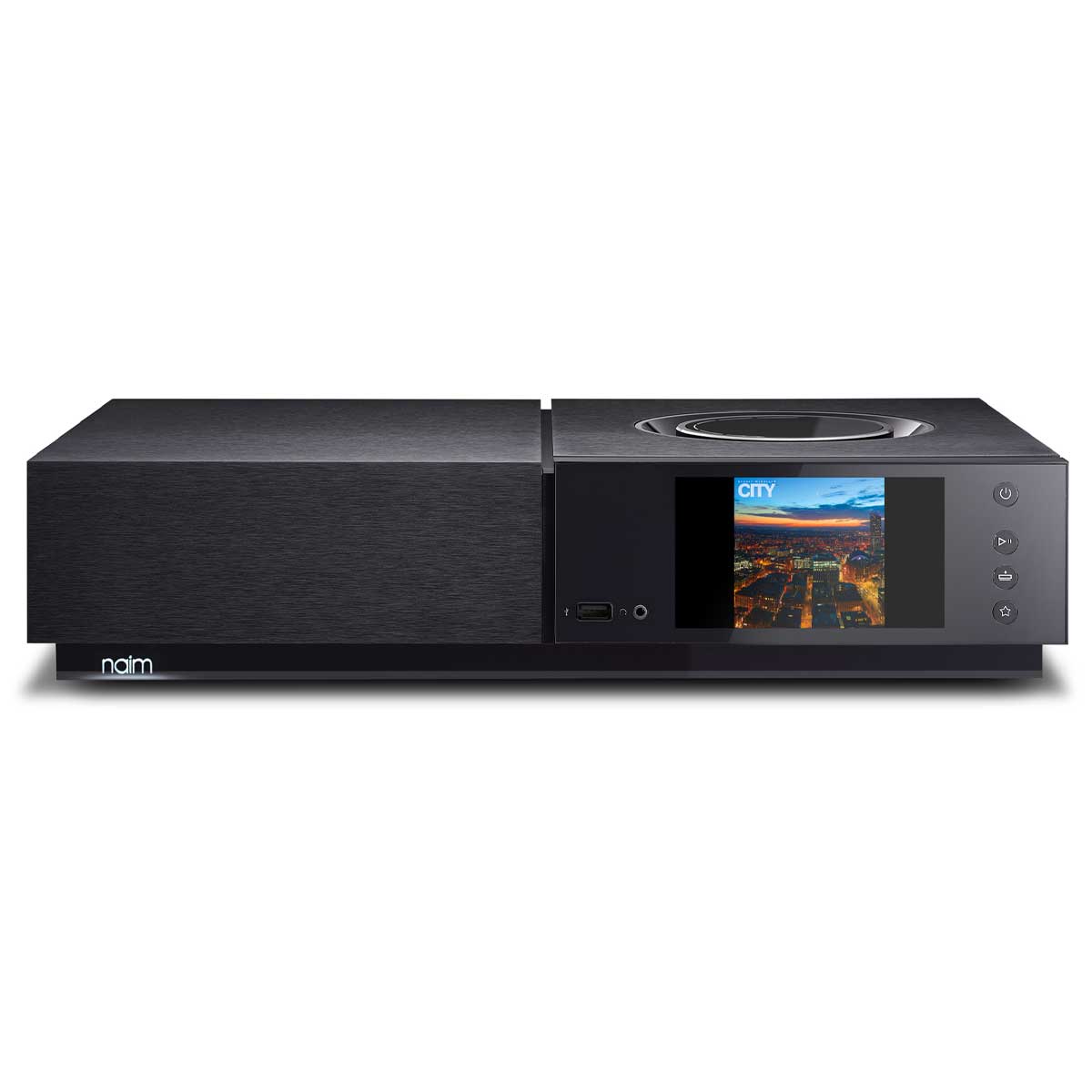
Digital playback is handled with the same care. The Uniti Nova supports an extremely wide range of formats, including high-resolution PCM up to 24-bit 384 kHz and DSD64 and DSD128. Gapless playback is supported across all formats, and the internal streaming platform is fast, stable, and intuitive. Using the Focal & Naim app, browsing Qobuz, TIDAL, Spotify, internet radio, or local network storage feels seamless and reliable. Roon Ready support integrates cleanly for users with more advanced music libraries.
Physically, the Uniti Nova feels every bit like a premium component. The heavy, beautifully machined aluminum chassis is built in Britain and designed for long-term ownership. The large top-mounted rotary volume control with proximity sensing is one of the most satisfying controls in audio, and the front color display provides clear playback information without distracting from the listening experience. Everything about the Nova feels intentional and refined.
Unlike some of the other amplifiers in this guide, the Uniti Nova does not attempt to be a hybrid home theater hub or a DSP-heavy problem solver. There is no room correction, no subwoofer crossover management, and no attempt to optimize the system for every possible use case. HDMI ARC is included to give your TV a meaningful sound upgrade, but the Nova’s priority is music first, always.
Connectivity is extensive, with multiple digital and analog inputs including Naim’s preferred DIN connections, USB playback, HDMI ARC, and both RCA and BNC coaxial inputs. Multiroom support and Party Mode allow synchronization with up to six Naim streamers, and smart home integration is available through platforms like Control4, Crestron, Savant, and others.
In listening, the Uniti Nova stands apart not because it measures better or offers more features, but because of how it makes music feel. Vocals carry weight and texture, rhythms stay tight and engaging, and the overall presentation has a natural musical flow that is difficult to quantify but instantly recognizable.
If you value emotional connection over technical complexity, long listening sessions over endless tweaking, and a system that simply makes you want to play music, the Naim Uniti Nova is one of the most rewarding all-in-one streaming amplifiers available today. That is exactly why it earns our pick for Best Musical All-In-One Streaming Amplifier.
The McIntosh MSA5500 brings the classic McIntosh experience into a modern, compact, all in one streaming amplifier. You get the blue power meters, the polished glass front panel, the red power button, and the timeless layout that McIntosh fans love. The design stays true to the brand’s heritage while delivering a streamlined user experience that fits easily into today’s listening spaces. It is sized to work in small or large rooms and pairs beautifully with a wide variety of speakers.
Inside, the MSA5500 is powered by a robust Class A/B amplifier that delivers 100 watts into 8 ohms and 160 watts into 4 ohms. This is backed by McIntosh’s well known engineering, including a substantial power supply, high current output transistors, and their Monogrammed Heatsinks that help maintain stable thermal performance. Power Guard continuously monitors the output to protect your speakers from clipping, while Sentry Monitor adds short circuit protection. The result is a clean, controlled sound with plenty of headroom for dynamic peaks. The built in headphone amplifier also includes McIntosh’s HXD circuit, which can be enabled or disabled depending on your listening preference.
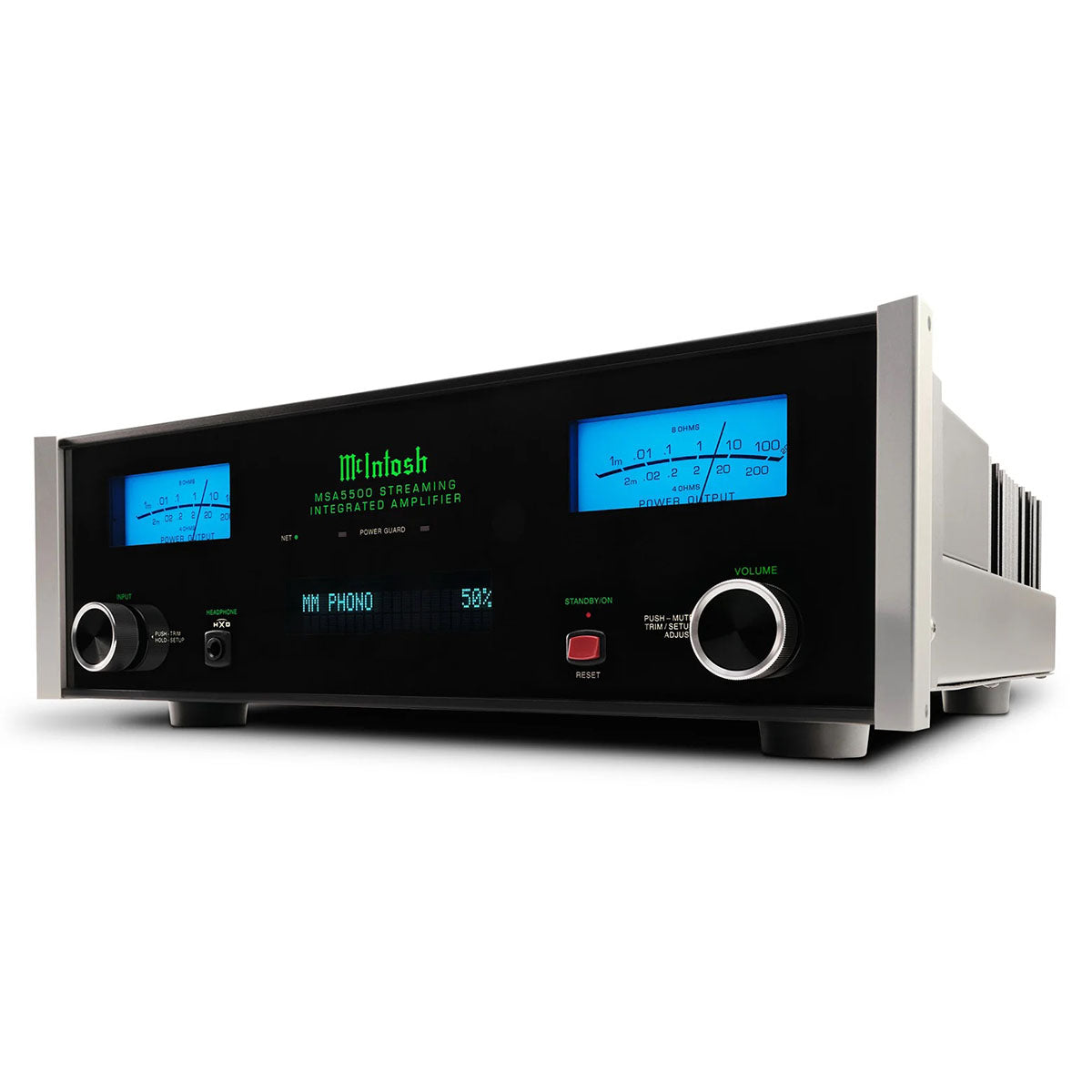
It supports Spotify Connect, TIDAL Connect, Apple AirPlay, Google Cast, and Bluetooth 5.0. Roon support is available as well. The included McIntosh Connect app lets you manage streaming, set up WiFi, organize your music sources, and even enjoy a virtual blue meter on your phone. This keeps the experience intuitive for anyone in the household.
On the back, you get four analog inputs plus a balanced XLR input, a moving magnet phono stage for vinyl lovers, preamp outputs, main inputs, and a subwoofer output for system growth. The sub output does not include a built in crossover, so your subwoofer will handle its own low pass filtering. We do wish it had an onboard crossover for easier integration, but most powered subs give you enough control to get a good blend. The digital side is equally complete with USB, coaxial, optical, and McIntosh’s MCT connection for pairing with their CD transports. The HDMI ARC input makes it easy to integrate TV audio and control volume with your TV remote. For multi component McIntosh systems, data ports and IR inputs allow unified control with matching players. Home Theater Pass Through adds flexibility for hybrid two channel and surround setups, letting the MSA5500 power your front speakers in a theater system while keeping the receiver fully out of the signal path for music listening. Coaxial, optical, and MCT inputs cover standard digital formats.
The internal DAC is built around an ESS 8 channel design with four DAC channels per side in a balanced configuration to reduce noise and increase dynamic range. This DAC implementation plays a major role in the MSA5500’s clean, detailed sound. Music feels warm and natural with a strong sense of body in the midrange, smooth highs, and authoritative bass control. Imaging and soundstage performance are excellent for an all in one design at this price.
The MSA5500 is ideal for music lovers who want the signature McIntosh sound and style in a simplified system that replaces separate components. The amplifier section is powerful enough to handle a wide range of speakers, and the build quality lives up to McIntosh’s reputation for long lasting products. With its combination of streaming convenience, flexible connectivity, high end DAC technology, and unmistakable design, the MSA5500 is one of the most complete and enjoyable all in one streaming amplifiers available today.
If you are investing in a higher performance two channel system, these streaming amplifiers represent the best full size options we have tested across a range of price points and system needs. They deliver real amplifier authority, high quality DAC stages, and modern streaming convenience in one chassis, which makes them especially appealing if you want reference level sound without filling a rack with separates.
If you are working with a smaller space or a tighter budget, our separate compact streaming amplifier guide is the better place to start. For listeners who are ready to step up to more powerful, full width components that can be the long term foundation of a serious system, the models in this article are the ones we would look at first.
If you have further questions, contact our experts via chat, phone, or email. Or simply visit one of our world-class showrooms to experience speakers, projectors, TVs, and everything in between for yourself before you make a purchase!
If you’re planning your home theater or media room, check out our Home Theater Design page, where we have everything Home Theater related, including our FREE Home Theater Design Tool.
When you buy from Audio Advice, you’re buying from a trusted seller since 1978. We offer Free Shipping, Lifetime Expert Support, and our Price Guarantee. We look forward to serving you!
Onkyo Icon A-50 Network Integrated Amplifier
$1,599.99
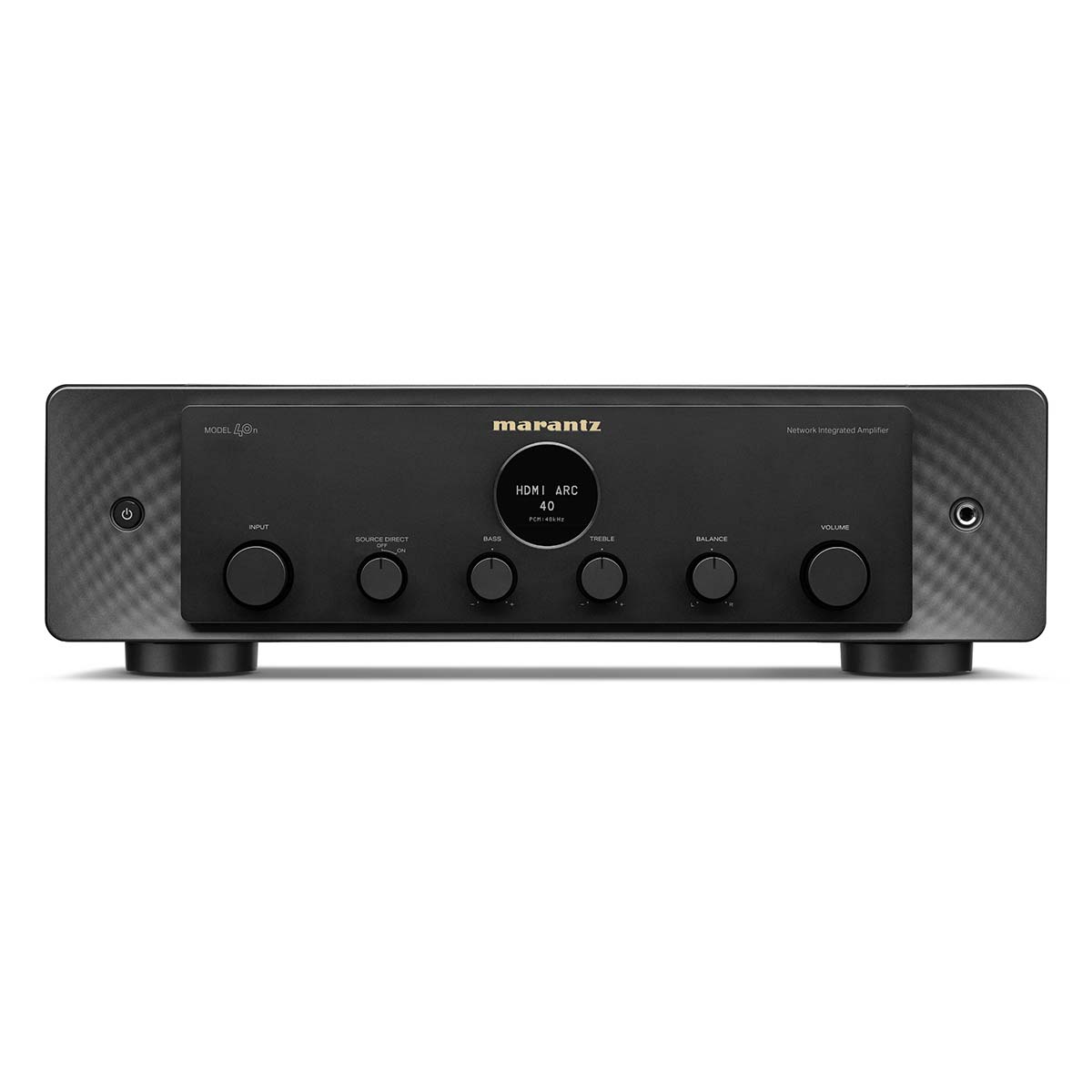
Marantz Model 40n Integrated Amplifier
$2,700.00
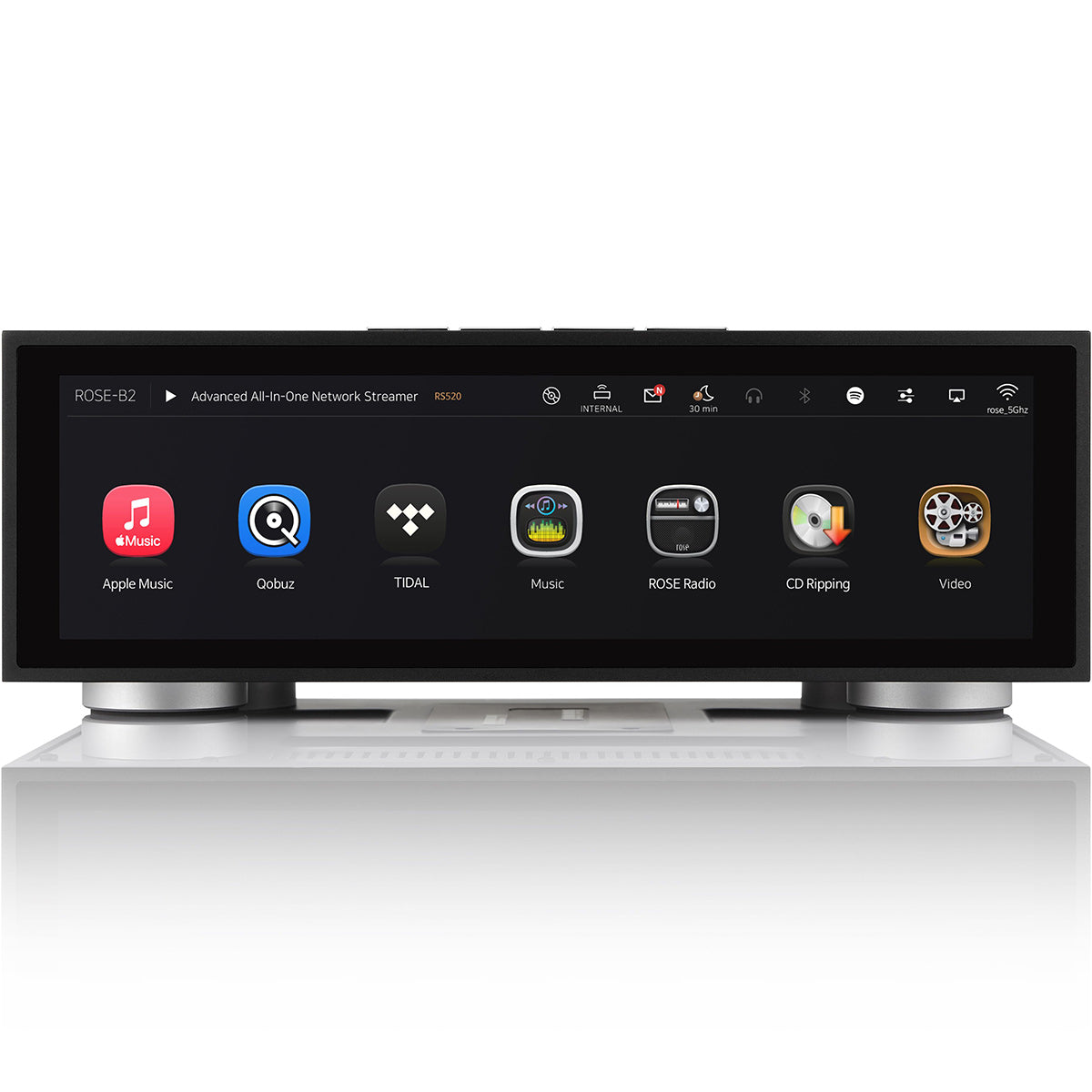
HiFi Rose RS520 All-in-One Network Streamer
$3,995.00
You'll be among the first to know about product launches, exclusive online deals, and the hottest audio trends.