NAD C 3030 & C 3030S: Classic Hi-Fi Design, Modern NAD Sound

youtube cover image
Play

The New Guard of Heritage Hi-Fi: The NAD C 3030 and C 3030S

At Audio Advice, we’ve always felt that the best audio gear is built on a simple foundation: get the basics right, keep the design honest, and let the sound do the talking. NAD has followed this playbook for decades, stretching back to the late 1970s when they changed the game with the original 3020 integrated amplifier. Those early designs didn't win over listeners by chasing headline specs; they won because they delivered massive performance and challenged gear that cost four times as much.

The new C 3030 and C 3030S are modern examples of that same thinking. While they look like they stepped right out of a 1974 catalog—specifically modeled after the original 1976 NAD 3030—what’s happening under the hood is entirely contemporary. These models are built for the way we listen today, balancing classic analog soul with the digital precision required for modern systems.

NAD C 3030 Integrated Amplifier

Design & Build Quality: A Tactile Connection to Music

The C 3030 is the kind of component that reminds you what was fun about classic hi-fi. It isn't just a box; it’s a physical interface designed around the tactile experience of listening. In an era of touchscreens and app-only control, there is something deeply satisfying about the "click" of a physical switch.


The Return of the Meters

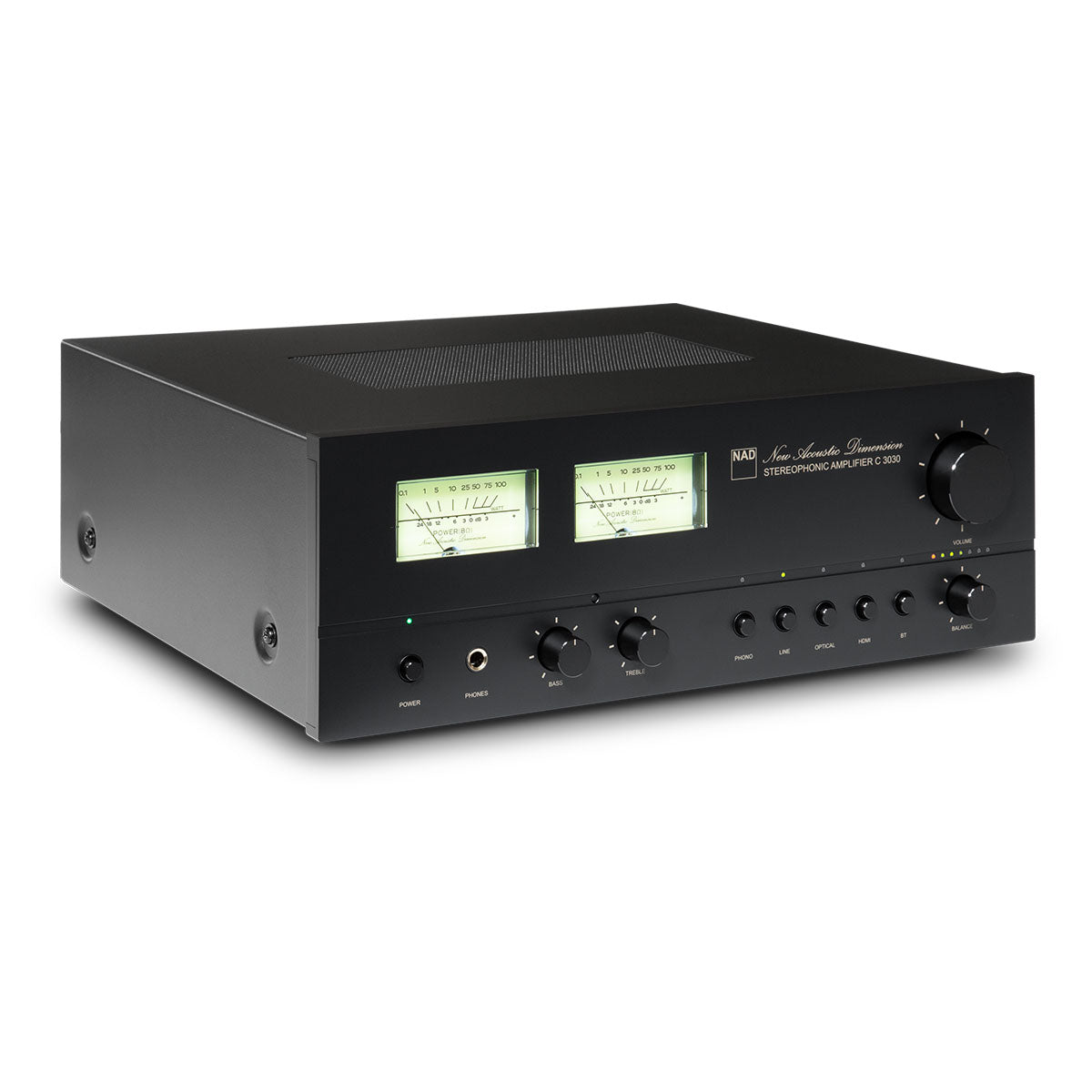
The dual illuminated VU meters provide that iconic “this is a real stereo” vibe. But these aren't just for show. In the original 1976 3030, these meters were essential for monitoring the output of the early transistor stages to avoid clipping. Today, they serve as a real-time window into the amplifier’s dynamic behavior. Even at low volumes, you can watch the needles dance, giving you a visual representation of the energy in your music.

NAD C 3030 VU Meters

Ergonomics and Footprint

The front panel layout is just so classic. By using physical push-button selectors, NAD eliminates the need for frustrating on-screen menus. You can see your input at a glance and make adjustments without picking up a remote or opening an app. The volume control is equally well-executed, offering the kind of smooth, weighted resistance that allows for those tiny, precise adjustments during a serious listening session.

NAD C 3030 front panel buttons

Physically, the C 3030 is more compact than the flagship C 3050. Measuring about 14 inches wide, 5 inches tall, and 13 inches deep, it weighs in at just under 12 pounds. This makes it significantly easier to place on a standard bookshelf or in a shallow media cabinet where full-sized 17-inch components might feel like they are “eating” the room. Despite the smaller footprint, the build quality remains high, with the original 1970s cursive NAD branding. It feels like a piece of gear that was built to be touched, used, and enjoyed out in the open, rather than hidden in a rack.


The Engineering: HybridDigital UcD Technology

Under the hood, the C 3030 is built around NAD’s advanced HybridDigital UcD (Universal Class D) amplifier design. To understand why this matters, you have to look at the history of Class D. Early "switching" amplifiers often sounded thin or overly clinical because they were sensitive to the "load" (the speakers) you connected to them. If your speakers had a complex impedance curve, the frequency response of the amp would shift, often resulting in a harsh or bright sound.

The UcD architecture solved this. It is a self-oscillating design that incorporates a massive amount of feedback after the output filter. This makes the amplifier equally at home with any speaker load. Whether you are driving a 4-ohm speaker or an 8-ohm speaker, the C 3030 stays flat and distortion-free across the entire audio band. It is also highly efficient, meaning it runs cool even after hours of use. This efficiency allowed NAD to spend more of the budget on the quality of the power supply and the output stages rather than just massive heat sinks.


Understanding the "Real World" Power Rating

NAD has always been famously conservative with their power ratings, and the C 3030 is no exception. It is officially rated at 50 watts per channel into 8 ohms using their Full Disclosure Power (FDP) method. Most manufacturers quote power at a single frequency (usually 1kHz) with only one channel driven. NAD measures this with both channels driven across the full 20Hz to 20kHz frequency range at rated distortion.

More importantly, the C 3030 can deliver over 100 watts of dynamic power into 8 ohms. This massive "headroom" is what gives the amplifier its sense of ease. When a recording hits a major transient—like a snare drum crack or a sudden orchestral swell—the C 3030 has the instantaneous current to handle that peak without the sound compressing or turning brittle.

NAD C 3030 Integrated Amplifier on a credenza

The Signal Path: Digital Precision and Analog Soul

The Texas Instruments DAC

On the digital side, the C 3030 utilizes a high-performance Texas Instruments PCM5242 differential DAC. In the world of DACs, many brands chase the newest ESS Sabre chips for their headline-grabbing spec sheets. NAD chose the TI platform for a different reason: its musicality. The PCM5242 is known for its excellent dynamic range and its immunity to clock jitter. By implementing it in a differential configuration, NAD is able to cancel out common-mode noise, resulting in a digital presentation that is clear, holographic, and remarkably free of "digital glare."


The Phono Stage and Infrasonic Filter

For vinyl enthusiasts, the inclusion of a dedicated moving magnet phono stage is a major win. This isn't just a cheap add-on chip. It is a high-gain, low-noise circuit designed to handle the delicate signal from a turntable with care.

One feature we really appreciate is the infrasonic suppression circuit. When a record is slightly warped, it creates massive amounts of low-frequency energy (rumble) that you can't hear, but your woofer can "see." This wasted energy causes the woofer to pump wildly, which stresses the amplifier and distorts the midrange. The C 3030’s filter is specifically tuned to cut out that rumble without sacrificing the actual musical bass you want to hear.


Input Options: The Modern Hub

One of the reasons we expect the C 3030 to be so popular is the way it handles inputs. It covers the essential analog bases with a phono and line input while offering a "no-compromise" digital bridge for your TV and streaming devices.

NAD C 3030 rear panel view

HDMI eARC: The Living Room Revolution

This is the feature that turns a high-end stereo into an everyday system. HDMI eARC (Enhanced Audio Return Channel) allows you to connect a single cable from your TV to the amp. Suddenly, you get better dialogue clarity and more dynamic headroom than any soundbar could dream of. Because it supports CEC, the C 3030 will wake up when you turn on the TV, and you can still use your TV’s original remote to control the volume.


Flexible Digital and Analog

  • Optical and Coaxial: For your CD player or a dedicated media box, these inputs take full advantage of the internal TI DAC.

  • Bluetooth aptX HD: This is bidirectional. You can stream high-res audio from your phone to the amp, or you can stream the sound from the amp to a pair of high-quality wireless headphones.

  • Subwoofer Management: The C 3030 includes a dedicated subwoofer output with an optional fixed 80Hz high-pass filter. When you flip this switch, the amplifier stops sending deep bass to your main speakers. This "cleans up" the midrange because your main speakers no longer have to work as hard to move air, making the entire system sound much larger and more effortless.


Choosing Your Path: C 3030 vs. C 3030S

The decision between the two models is straightforward:

  • The C 3030 is for the traditionalist. It gives you all the physical inputs, the internal DAC, and HDMI eARC. It’s the perfect choice if you already have a streamer you love or if you prefer to stream through your TV.

  • The C 3030S is the model for the modern "all-in-one" fan. It comes with BluOS built-in. This gives you access to nearly every streaming service (Tidal, Qobuz, Spotify) and integrates perfectly with any other Bluesound gear in your home. If your system revolves around streaming, the S model is a no-brainer.

C 3030 vs C 3050

While both amplifiers share a common lineage and aesthetic, they are designed for very different listener profiles.


Power and Scale

The primary differentiator is the scale of the power delivery. While the C 3030 offers an honest 50 watts per channel (with 100W dynamic), the C 3050 steps up to a commanding 100 watts per channel of continuous power. Under the hood, the C 3050 utilizes a more robust implementation of the HybridDigital UcD architecture with a significantly larger power supply. This allows the C 3050 to deliver up to 180W of dynamic power into 8 ohms and a massive 300W into 2 ohms. If you are driving demanding, low-efficiency speakers or filling a large open-concept living room, that extra headroom in the C 3050 is a necessity rather than a luxury.


Flexibility and Modular Growth

The other major "Why" behind the C 3050 is the MDC2 (Modular Design Construction) expansion slot. This is a second-generation bidirectional architecture that allows you to future-proof your system. With the C 3050, you can add an MDC2 module to gain Dirac Live room correction and BluOS streaming at any time. The C 3030 is a more "fixed" platform. It focuses on getting the core connections right for a lower price point but doesn't offer the modular upgrade path of its larger sibling.


Physical Footprint

Logistically, the C 3050 is a full-size component at 17.25 inches wide, whereas the C 3030 is significantly more furniture-friendly at 14 inches. If you are building a high-end system for a dedicated listening room, the size of the 3050 is a non-issue. However, if your stereo is part of a multi-functional living space, the compact nature of the 3030 allows it to disappear into your decor much more easily.

NAD C 3030 Integrated Amp

Final Performance Notes

When we put the C 3030 through its paces, we weren't just listening for "detail." We were looking for that classic NAD composure. On a sparse track like Norah Jones’ Don't Know Why, the C 3030 renders the vocal with a sense of body and presence that feels human, not processed. The midrange is fluid and textured, avoiding the "clinical" sound that plagues many affordable Class D designs.

Moving to something more aggressive, like David Bowie’s Stay, the amplifier’s control becomes evident. The rhythmic drive stays tight and propulsive, and the guitars retain their bite without turning brittle. It’s a balanced, tonally consistent presentation that makes it easy to listen for hours on end.


Conclusion

The NAD C 3030 is exactly the kind of product we love recommending. It doesn't rely on flashy gimmicks or inflated specs. Instead, it leans on proven engineering—like the HybridDigital UcD architecture and the TI PCM5242 DAC—to deliver a listening experience that is genuinely musical. Whether you’re building a system around a turntable, a TV, or a high-res streamer, the C 3030 provides a foundation that is honest, powerful, and fun to use.


We’re Here to Help!

If you have further questions, contact our experts via chat, phone, or email. Or simply visit one of our world-class showrooms to experience speakers, projectors, TVs, and everything in between for yourself before you make a purchase!

If you’re planning your home theater or media room, check out our Home Theater Design page, where we have everything Home Theater related, including our FREE Home Theater Design Tool.

When you buy from Audio Advice, you’re buying from a trusted seller since 1978. We offer Free Shipping, Lifetime Expert Support, and our Price Guarantee. We look forward to serving you!