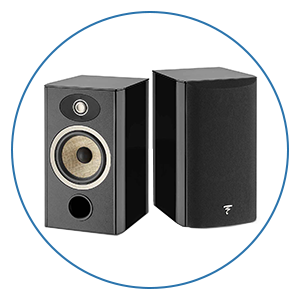
Most Common Speaker Placement Mistakes

youtube cover image
Play

This article covers some of the most common mistakes we see people make when setting up their speakers. In nearly all of these cases, the fix is completely free and only takes a little effort. If your room layout makes it impossible to correct all of them, that is perfectly fine. Like any stereo tweak, the goal is simply to do the best you can within the limitations of your space. For many of you, especially if your speakers were just plopped into place without much thought, these small adjustments can lead to big improvements in sound quality.

If you’d like to take a deeper dive into speaker placement, we have a separate, in-depth article that covers the topic in detail. In this one, we will focus on the most common mistakes and how to avoid them. So let’s dive in!

Mistake #1

Having Your Speakers Right Against a Wall

We see so many rooms where the speakers are placed right against the back wall. Yes, this is usually what will “look” the best in a room, but unless your speakers are specifically designed to be against a wall (and very few are), you will probably hear a big improvement if you can move them out a little bit. Usually, they are pushed back against the wall behind them, but we also see speakers shoved against a side wall too.

Unlike on-wall or in-wall speakers, which are designed to use the wall as part of the speaker, most speakers should usually be at least 12” or more away from a wall. The reason is, the wall will interact with the speaker and reinforce lower frequencies that will override and color the all-important midrange part of the audio spectrum. Getting your speakers away from the rear or side walls will usually dramatically improve the clarity you hear in voices and instruments. This one simple step should give you a new appreciation for the more subtle details hiding in your favorite music that you have probably never heard before.


Mistake #2

Having Your Speakers Too Close Together

Unless you listen to only mono recordings, it’s important to have your speakers spread far enough apart to get a more enveloping stereo experience. Let's say you are sitting 10 feet away from your speakers, yet they are only 3 feet apart. In that situation, you will not get a wide presentation of your music. When we are playing back recorded music, we are trying to create that live music experience, which usually fills the room from left to right. There are many so-called ideal ratios for the distance your speakers should be apart compared to how far you are sitting from them, but we feel they should be at least in a 2:3 ratio, where if they were 2 feet apart, you sit 3 feet away from them, and some people even prefer a 3:2 ratio where they are spread very far apart. The key is to experiment with placement until you find the setup that sounds best to your ears.

Mistake #3

Not Having Your Speakers Symmetrically Placed in Relation to Your Main Listening Spot

This one is more nuanced and not possible in some rooms, but it's worth discussing. Many recording engineers spend a great deal of time working on the left-to-right balance of the presentation. They will usually mix the main singer or instrument dead center between left and right and spread the remaining musicians or vocalists out between the speakers. Experiencing this on a well-set-up system is something special, but your ears and brain can only decode it all if you are sitting pretty close to the center point between your speakers. Once you get your speakers out from the wall and spread the right distance apart, try putting your main chair at the center spot, and you will hear what we mean.


Mistake #4

Having Large Objects Between Your Speakers

All of that great left-to-right spread of the music will not be as faithfully reproduced if you have a large piece of furniture blocking the sound path from your speakers. This is especially true if the piece of furniture is in front of the speakers. You are usually fine if you can get the front of your speakers 6-8” or more ahead of the furniture, but if they sit behind it, the furniture not only blocks the sound, but adds reflected sound, which changes that mix the engineer worked so hard on. We realize you may not be able to change this in your home, but if you can, give it a try.

Mistake #5

Having Bookshelf Speakers Shoved into the Back of a Cabinet

Bookshelf speakers serve a nice purpose when you do not have space for a large floor-standing speaker. Most are designed to work well in a bookcase. But just a few inches can make a big difference in the sound you hear. We always recommend you place your bookshelf speakers right on the front edge or, even better, sticking out an inch from the front of your cabinet. This will minimize the effect the cabinet has on your speakers and give you a much clearer and open sound.

Mistake #6

Having Your Speakers on the Same Shelf as Your Turntable

Obviously, this one only applies to those of you with turntables and speakers on the same surface, but we actually see this all the time. A turntable is a mechanical device, just like a speaker. You don’t want the vibrations from your speakers reaching your turntable, which is likely to happen if they are sitting on the same shelf, especially as you increase the volume. If you can, separate your turntable and speakers. If this is not possible, there are both turntable and speaker isolation devices available that will help diminish the problem.

Mistake #7

The Speaker Wobble

When you put the flat bottom of a floor-standing speaker on carpet, it will most likely wobble. A good push can even topple it over. Several decades ago, speaker companies figured this out and came up with carpet spikes that fit into the bottom of your speakers that punch through the carpet to touch the subfloor, which is a solid surface.

Speakers produce sound by moving the speaker drivers, and you don’t want any of that sound changed as it comes out. But if your speakers wobble, the woofer movements can cause the entire speaker to move, which can really muddy the midrange and upper frequencies. So, if your speakers are wobbling on carpet, find the spikes they came with and put them on. You’ll get bonus points in your sound if you spend a little extra time getting them leveled up, so there is zero rocking.

Even speakers sitting on a hard surface will benefit from fewer points of contact than the flat bottom, which is why most good tower speakers also come with some kind of spike made for hardwood or tile floors. It may have a cup for a spike or a rubber cap on the end. But if your speakers came with these, put them on and adjust them so they do not rock, and you will hear big improvements in clarity.

Mistake #8

The Dreaded Out-of-Phase Syndrome

Here is another free fix that we encounter more often than you would think. You want both your left and right speakers pushing out the sound in sync with each other. But if you wire them out of phase, one will be pushing while the other is pulling, which usually takes away a lot of bass energy and blurs all the other sounds. The way to check is really simple. On your amp or receiver, the wire connected to the red post should also go to the red post on the speaker. That takes care of the positive connection, and if you get it right, the other one will be correct too. And while you are at it, confirm the side labeled right is also headed out to the right speaker as you are facing it, sitting down, looking at your speakers.

Alright, so far, all of these have been pretty much free with a little effort. But we have to mention one last thing that can make a big difference in your audio quality that we see so many people ignore. This is the room itself that the speakers are placed in. If you have ever walked into a recording studio, you probably noticed they put some effort into acoustic treatments. We are not saying you have to make your room look like a recording studio, but some simple acoustic treatments can, in many cases, make a bigger improvement than a better pair of speakers or upgraded components. We will not get into all of the details here as we have another article devoted to this subject, but we highly recommend you consider the acoustics of your room as part of your audio system.

We hope you have learned how to improve the sound quality of your system by reading this article and following up on some of these tips. And A+ to those of you who had them all fixed to begin with!


We’re Here to Help!

If you have further questions, contact our experts via chat, phone, or email. Or simply visit one of our world-class showrooms to experience speakers, projectors, TVs, and everything in between for yourself before you make a purchase!

If you’re planning your home theater or media room, check out our Home Theater Design page, where we have everything Home Theater related, including our FREE Home Theater Design Tool.

When you buy from Audio Advice, you’re buying from a trusted seller since 1978. We offer Free Shipping, Lifetime Expert Support, and our Price Guarantee. We look forward to serving you!