JBL PartyBox Buyers Guide: Everything You Need to Know Before You Buy

JBL PartyBox Buyers Guide video cover
Play

JBL PartyBox Club 120 vs Stage 320 vs 520 vs 720

Which One Is Right for You?

JBL has completely refreshed the PartyBox lineup, and if you've been eyeing one of these speakers, the options can feel a little overwhelming. We've been testing the full new generation hands-on, and in this article we're breaking down the PartyBox Club 120, Stage 320, 520, and 720 so you can figure out exactly which one belongs at your next party. We'll also touch on the Encore series and the PartyBox Ultimate at the end.

What's New Across the Entire Lineup

Before diving into individual speakers, there are three platform-level changes in the new generation worth understanding because they apply to every model on this list.

Auracast replaces TWS pairing

The old lineup limited you to two speakers wirelessly paired, and they had to be the same model. Auracast lets you link multiple JBL Auracast-enabled speakers wirelessly with no model restriction. At Audio Advice Live 2025 we had over 20 PartyBoxes all linked up at once, which gives you a sense of how far this can scale. Even pairing two in stereo makes a huge difference in how a backyard sounds, and running four — one in each corner of a space — is a really effective way to fill a larger area without cranking any single speaker. You can still stereo pair two of the same model for a proper left/right soundstage.

AI Sound Boost is now standard

JBL's AI Sound Boost analyzes your audio signal in real time and pushes the drivers to their maximum output without adding distortion. In practice, every speaker in this lineup gets louder and stays cleaner at high volumes than its predecessor.

Every speaker now has a replaceable battery.

This is huge, especially at the top of the lineup. The old PartyBox 710 had no battery at all and required a wall outlet at all times. Every speaker in this new lineup runs on a swappable battery pack, meaning you can keep the party going indefinitely by dropping in a fresh battery.

All four models also share Bluetooth 5.4, IPX4 splashproofing, and full integration with the JBL PartyBox app for EQ, lightshow customization, and Auracast pairing.

JBL Partybox Club 120 being carried by the handle

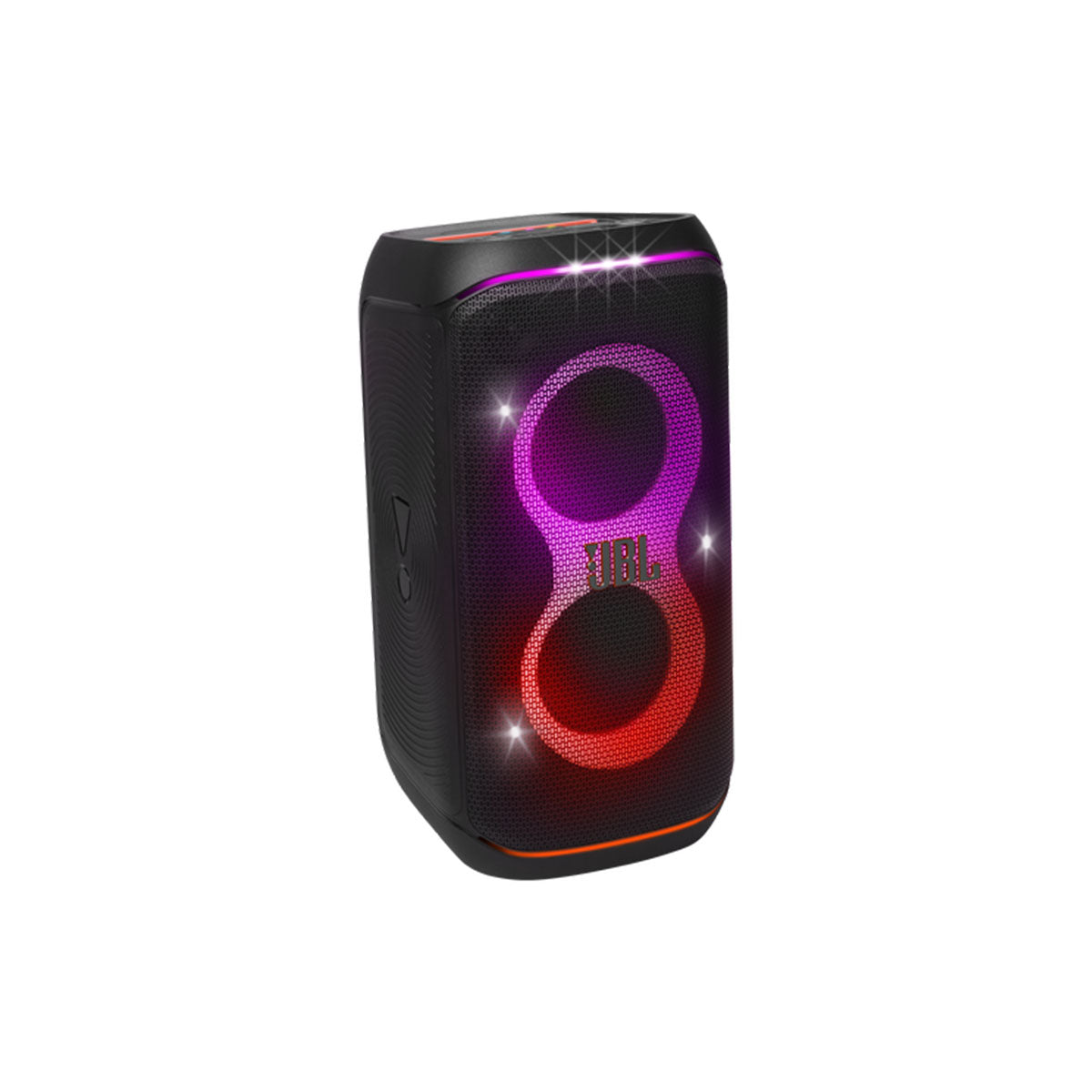
JBL PartyBox Club 120

Best for: Small to medium gatherings, decks, backyards, gym setups, and anyone who wants to run two in stereo.

The Club 120 is the entry point of this lineup and the direct successor to the PartyBox 110. At 24 pounds with a foldable handle on top, it's the most portable of the four by a significant margin. The handle folds flat for storage, which is a nice practical improvement over the old design.

Specs at a glance:
  • 160 watts RMS
  • 2 x 5.25" woofers, 2 x 2.25" tweeters
  • Up to 12 hours battery life (JBL BATTERY200, hot-swappable)
  • 10-minute fast charge = 80 additional minutes
  • Bluetooth 5.4 with Auracast
  • IPX4 splashproof
  • Quarter-inch mic and guitar inputs (dual)
  • Aux in, USB audio

One of the more meaningful design updates is the tweeter placement. On the old 110, the tweeters sat at the top of the cabinet. On the Club 120 they've been repositioned to the middle of the baffle flanking the woofers on either side, which improves how the sound disperses into the room. The lightshow is also worth calling out — you get LEDs around the woofers with starry lights, light trails, and strobe effects all syncing to the beat, fully customizable through the app.

For placement, getting this speaker off the floor makes a noticeable difference. There's a pole mount on the bottom so it fits right onto a speaker stand or PA pole mount, which is honestly the best way to run it. A table or countertop works too, either way, elevated is better.

Our take on the sound: The Club 120 is a party speaker, not an audiophile tool, and it delivers exactly what that means — a fun, energetic sound with solid vocal clarity and punchy bass when you engage the boost. If you're considering the Club 120, we'd strongly recommend buying two and running them in stereo via Auracast. The soundstage improvement is significant, and two Club 120s together easily outperform a single Stage 320 at a fraction of the footprint.

JBL Partybox Stage 320

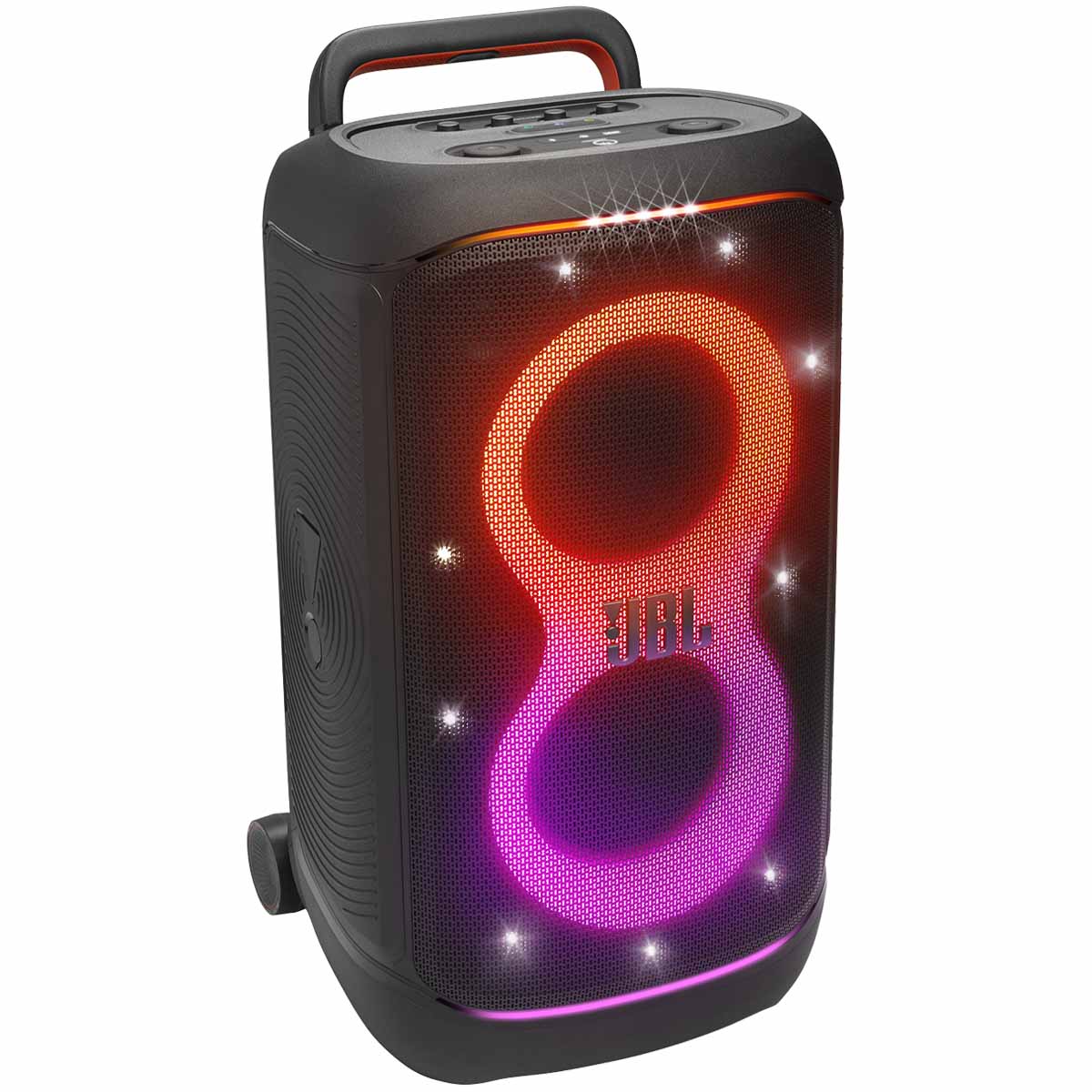
JBL PartyBox Stage 320

Best for: Backyard parties, parks, events where you need to cover more ground without hauling something enormous.

The Stage 320 is the direct successor to the PartyBox 310. The most visible upgrade is the wider, sturdier wheel base combined with a telescopic handle, making it genuinely easy to roll even on uneven surfaces. At 36 pounds it's also lighter than you might expect for a speaker this capable.

Specs at a glance:
  • 240 watts RMS
  • 2 x 6.5" woofers, 2 x 1" dome tweeters
  • Up to 18 hours battery life (JBL BATTERY400, hot-swappable)
  • 10-minute fast charge = 2 additional hours
  • Bluetooth 5.4 with Auracast
  • IPX4 splashproof
  • Quarter-inch mic and guitar inputs (dual)
  • Bass, treble, and echo knobs on top panel
  • Three assignable DJ preset buttons

The 18-hour battery is the best runtime in the entire lineup and a genuine upgrade from the 310, which had no replaceable battery at all. The lightshow steps up from the Club 120 with a larger LED ring around each woofer, strobe effects along the top, and full sync to your music — the kind of thing that genuinely transforms a backyard at night.

Our take on the sound: JBL claims the Stage 320 can fill a space the size of a tennis court, and while that's probably a best-case number, it doesn't feel far off from what we heard outdoors. The low end is tight and punchy, the AI Sound Boost keeps things clean at high volumes, and the top-panel controls mean you rarely need to open the app mid-party. Like the Club 120, there's also a pole mount on the bottom if you want to run it on a speaker stand or PA pole mount. It's the sweet spot of this lineup for most people.

JBL PartyBox 520

Best for: Larger outdoor events, semi-professional DJ setups, venues where the Stage 320 isn't quite enough.

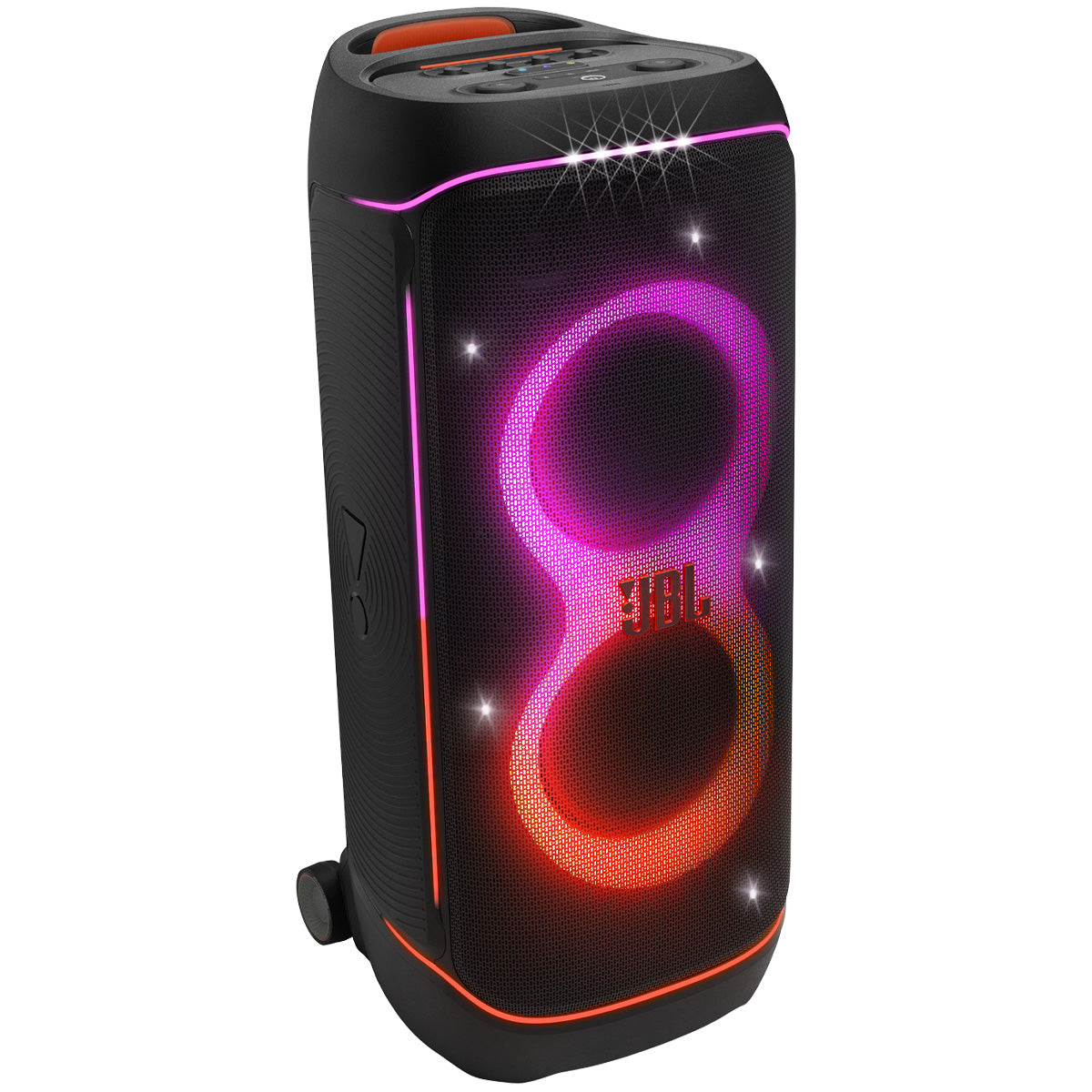
The 520 is brand new in 2025 and fills a gap that genuinely needed filling. Previously, JBL's battery-powered lineup skipped from the 310 straight to the 710, which had no battery at all. The 520 sits in the middle and delivers serious power while still running completely off a swappable pack.

JBL Partybox 520
Specs at a glance:
  • 400 watts RMS
  • 2 x 7.5" woofers, 2 x 1" dome tweeters
  • Up to 15 hours battery life (JBL BATTERY600, hot-swappable)
  • 10-minute fast charge = 2 additional hours
  • Bluetooth 5.4 with Auracast
  • IPX4 splashproof
  • Dual XLR combo inputs (mic, guitar, or DJ console)
  • USB-C digital audio input
  • Pole mount on bottom (speaker stand or PA pole mount compatible)
  • Telescopic handle and wheels
  • 56 pounds

The jump from 6.5-inch to 7.5-inch woofers over the Stage 320 is immediately noticeable. Where the 320 gives you punchy, controlled bass, the 520 starts to move air in a way you feel in your chest, crossing 105 decibels of measured output. The connectivity upgrade is also significant. The 520 drops the quarter-inch inputs in favor of dual XLR combo jacks, meaning you can run a proper DJ mixer or professional microphones directly into this speaker. The lightshow matches the Stage 320 visually with dual light rings and strobe effects, all controllable through the app.

Our take on the sound: The 520 has been tuned more balanced than the old 710, which was famously bass-forward. The default profile is versatile and sounds good across genres, and if you want more low end you can dial it in through the EQ. Testing it with "This Is What You Came For" felt noticeably closer to a live concert than either of the smaller speakers.

JBL Partybox 720

JBL PartyBox 720

Best for: Large-scale events, serious DJ setups, anyone who wants maximum output in a battery-powered speaker.

The 720 is the new flagship of JBL's battery-powered lineup and solves the single biggest problem with the 710 it replaces: the 710 required a wall outlet at all times. The 720 runs on battery.

Specs at a glance:
  • 800 watts RMS
  • 2 x 9" woofers, 2 x 1.25" dome tweeters
  • Frequency response down to 32 Hz
  • Up to 15 hours battery life (2 x JBL BATTERY600, both included in box, hot-swappable)
  • 10-minute fast charge = 2 additional hours
  • Bluetooth 5.4 with Auracast
  • IPX4 splashproof
  • Dual XLR combo inputs
  • USB-C digital audio
  • Pole mount on bottom (speaker stand or PA pole mount compatible)
  • Ergonomic integrated handle and wide wheels
  • 68 pounds

The 9-inch woofers extend down to 32 Hz, which is low enough that bass becomes physical — you feel it in the floor and in your chest. JBL recommends plugging it in whenever an outlet is available, since that keeps the batteries topped off and unlocks the full 800-watt output. The lightshow is the most elaborate in the battery-powered lineup, with LEDs around each woofer, RGB strips down the sides of the grill, strobes on top, and additional flashing lights behind the grill. When you have it running at a party, you genuinely don't need a separate lighting setup.

Our take on the sound: Authoritative is the word we kept coming back to. Every song we played felt like it had room to breathe in a way the smaller models don't achieve. The bass was tight and physical, the vocals had real presence, and the overall energy in the room was on a different level. This is the one you reach for when you're covering a large outdoor event, a festival-style setup, or any space where you need serious output and don't want to compromise. At $1,099.95, it's a meaningful investment, but compared to what you'd spend renting or buying professional PA equipment for the same coverage, it starts looking reasonable quickly.


A Quick Note on the Encore Series

If the Club 120 sounds like more speaker than you need, JBL also makes the Encore 2 and Encore Essential 2. Both put out 100 watts from a single 5.25-inch woofer and two 20mm tweeters, support Auracast, and run up to 15 hours on a charge. The key difference: the Encore 2 includes two wireless microphones and has a replaceable battery and a more elaborate lightshow. The Encore Essential 2 is the more affordable option without the bundled mics.


A Quick Note on the PartyBox Ultimate

If the 720 still isn't enough, we have a full dedicated video and article on the PartyBox Ultimate. The short version: 1,100 watts through a true three-way speaker system with dual 9-inch subwoofers, 4.5-inch midrange drivers, and 2.75-inch tweeters, plus Wi-Fi streaming with Dolby Atmos and the JBL PartyPad touch controller. No battery, AC power only, so it's best suited to a permanent home or venue installation.


Which JBL PartyBox Is Right for You?

SpeakerPowerWeightBatteryBest For
Club 120160W24 lbs12 hrsSmall gatherings, stereo pairs
Stage 320240W36 lbs18 hrsBackyard parties, parks
520400W56 lbs15 hrsLarge events, DJ setups
720800W68 lbs15 hrsMaximum output, professional use
  • Club 120 if you want a portable, fun speaker for smaller gatherings. Buy two and run them in stereo for the best experience.
  • Stage 320 if you're hosting regular backyard parties and want the best balance of portability and output. The 18-hour battery is the best in the group.
  • 520 if you're running bigger events or doing semi-professional DJ work and need the most powerful battery-powered speaker you can still move by yourself.
  • 720 if you refuse to compromise. The old 710 made you choose between power and portability. The 720 doesn't.

Audio Advice Take

Every speaker in the new PartyBox lineup is a meaningful upgrade over the generation it replaces, and the addition of Auracast and replaceable batteries across the board makes all of them more versatile than ever. Our team has tested the full lineup and is happy to help you pick the right one for your setup. Stop by one of our Experience Centers or reach out at audioadvice.com and we'll point you in the right direction.