
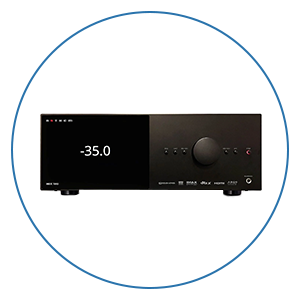

Denon AVR-X2900H vs AVR-X3900H
What's New and Which One Is Right for Your System?
Denon just released two new X-Series AV receivers, the AVR-X2900H and the AVR-X3900H. Both replace their predecessors, the X2800H and X3800H, and both bring a handful of meaningful upgrades to the table. If you're shopping in this range or sitting on an older Denon and wondering whether it's time to move up, this article covers everything you need to know.
We've had hands-on time with both units here at Audio Advice, and we'll walk you through what's actually new, what both receivers share, where they differ, and which one makes sense depending on your room and your system goals.
If you're already on a Denon X2800H or X3800H, this is probably your first question.
The most significant change at the X2900H level is Dirac Live. The X2800H never had it, full stop. Dirac Live is an optional, paid room correction upgrade, but having it available on the X2900H for the first time at this price tier is a genuinely big deal. If you've been wanting more than what Audyssey offers, the X2900H now gives you that path. We'll cover more on Dirac Live below, and we also have a full Dirac Live walkthrough video on our channel if you want a deep dive.
Both new models also add AMD FreeSync to their gaming feature sets. The X2800H and X3800H had Variable Refresh Rate and Auto Low Latency Mode, but FreeSync wasn't part of the picture. That's a worthwhile addition for anyone running an AMD GPU or a FreeSync-compatible display.
For X3800H owners, the jump to the X3900H is more incremental, but the full Dirac Live suite including Bass Control and Active Room Treatment is now a formal, day-one upgrade option rather than something that got patched in after launch. AMD FreeSync is also new at that tier.
The X2900H and X3900H sit in the middle of Denon's receiver range. They're not entry-level and they're not flagship. What they are is well-equipped for their price points. You're getting every major audio format, modern HDMI connectivity, solid room correction, and flexible system configurations without paying for the kind of over-engineered amplifier section that only makes sense in a much larger room with much more demanding speakers. For most buyers, this is exactly where the sweet spot is.
If you're still trying to figure out the right home theater receiver for your system, our buying guide covers the full range of what's available.
There's a lot of common ground between these two receivers. Here's what you get on both models.
Both receivers support Dolby Atmos and DTS:X. If you have height speakers in your room or are planning to add them, these receivers will handle both formats properly. If you're not running height speakers yet, Dolby Atmos Height Virtualization simulates overhead sound from your existing speaker layout. It's a decent stopgap, though not a substitute for real Atmos speakers.
Both units support 4K and 8K passthrough with Dolby Vision and HDR10+ for richer color and contrast. HD sources are upscaled for modern displays, which helps if you have a mix of older Blu-rays or a cable box running through the system.
For gaming, both offer 4K at 120Hz, Variable Refresh Rate, Auto Low Latency Mode, and AMD FreeSync. eARC is supported on the HDMI output as well, which is useful if you want to pull audio from your TV's built-in streaming apps back through the receiver.
Both units have a front USB port supporting playback up to 24-bit/192kHz, including FLAC, WAV, and ALAC. If you keep a local music library on a drive, it's a convenient way to access it without a streaming device in the chain.
Room correction is included on both, and if you've never used it before it's worth understanding what it's actually doing. Every room has acoustic problems, whether that's bass buildup in corners, early reflections off hard surfaces, or uneven frequency response from the way your speakers interact with the walls and floor. Audyssey uses the included setup microphone to measure each speaker from multiple positions and applies filters to compensate for what your room is doing to the sound. The on-screen guide walks you through the whole process in around 15 to 20 minutes.
It's not a magic fix. Proper speaker placement and acoustic treatment still matter, and if your room has serious problems, DSP alone won't fully solve them. But as a starting point for getting everything dialed in, it makes a real and noticeable difference, especially on bass response and channel balance. If you want to go deeper, we have a full video on room correction and acoustics on our channel.
Both units also support an optional upgrade to Dirac Live Room Correction. Dirac Live is one of the best room correction software solutions in the world, used in professional environments and high-end custom installs. Having it available as an upgrade path on receivers at this price point is a big deal, and we have a full Dirac Live walkthrough video if you want to see exactly what it does and whether it makes sense for your system. Bear in mind it's a paid upgrade, not included.
Both receivers include HEOS, Denon's multiroom streaming platform. Your AVR becomes the first zone in a whole-home audio system, and you can push audio to other HEOS-compatible speakers and components throughout the house from the same app. Both support AirPlay 2, Spotify Connect, Qobuz, Tidal Connect, Bluetooth, Wi-Fi, and Roon Ready certification. HEOS has improved significantly in recent years, with Qobuz and Tidal Connect making high-res audio streaming genuinely effortless.
Both units also work with Josh.ai, Alexa, and Google Assistant for voice control.
Both have a redesigned web-based interface that lets you access settings and make adjustments from a phone or laptop without the TV being on. Both also include on-screen channel input level monitoring for real-time visibility into what each speaker channel is doing, and a backlit remote for comfortable use in a dark room.
Denon backs both receivers with their 70% Power Guarantee, meaning each unit is built to deliver more than 70% of its rated output to up to five channels simultaneously. That's not a single-channel peak number like some receivers advertise, where the wattage looks great on paper but falls apart the moment you're driving five or seven channels at the same time.
The X2900H is a 7.2-channel receiver rated at 95 watts per channel. That 7.2 designation means 7 amplified speaker channels and 2 subwoofer outputs. It's worth noting that both subwoofer outputs carry the same signal — there's no independent control between them. If you're running two subs, you're getting one signal split across two jacks for convenience rather than true dual-sub management.
Those 7 speaker channels give you real flexibility. You can run a traditional 7.1 surround layout, a 5.1 setup, or pull two of those channels up to height speakers for a 5.2.2 Dolby Atmos configuration. You can also assign two channels to Zone 2 for audio in a second room, though if you do that you're down to 5 channels in the main space.
Back panel: 6 HDMI inputs and 2 outputs, with 3 inputs supporting 8K. Built-in MM phono stage for a turntable. 4 analog inputs, 2 optical and 1 coaxial digital input for legacy sources. Ethernet alongside built-in Wi-Fi.
The Audyssey suite on the X2900H includes MultEQ XT, Dynamic EQ, and Dynamic Volume. The optional Dirac Live upgrade at this tier covers Room Correction only, not Bass Control or Active Room Treatment. Those are part of the full suite available on the X3900H. If you're planning to go deep on room tuning, that distinction is worth understanding before you buy.
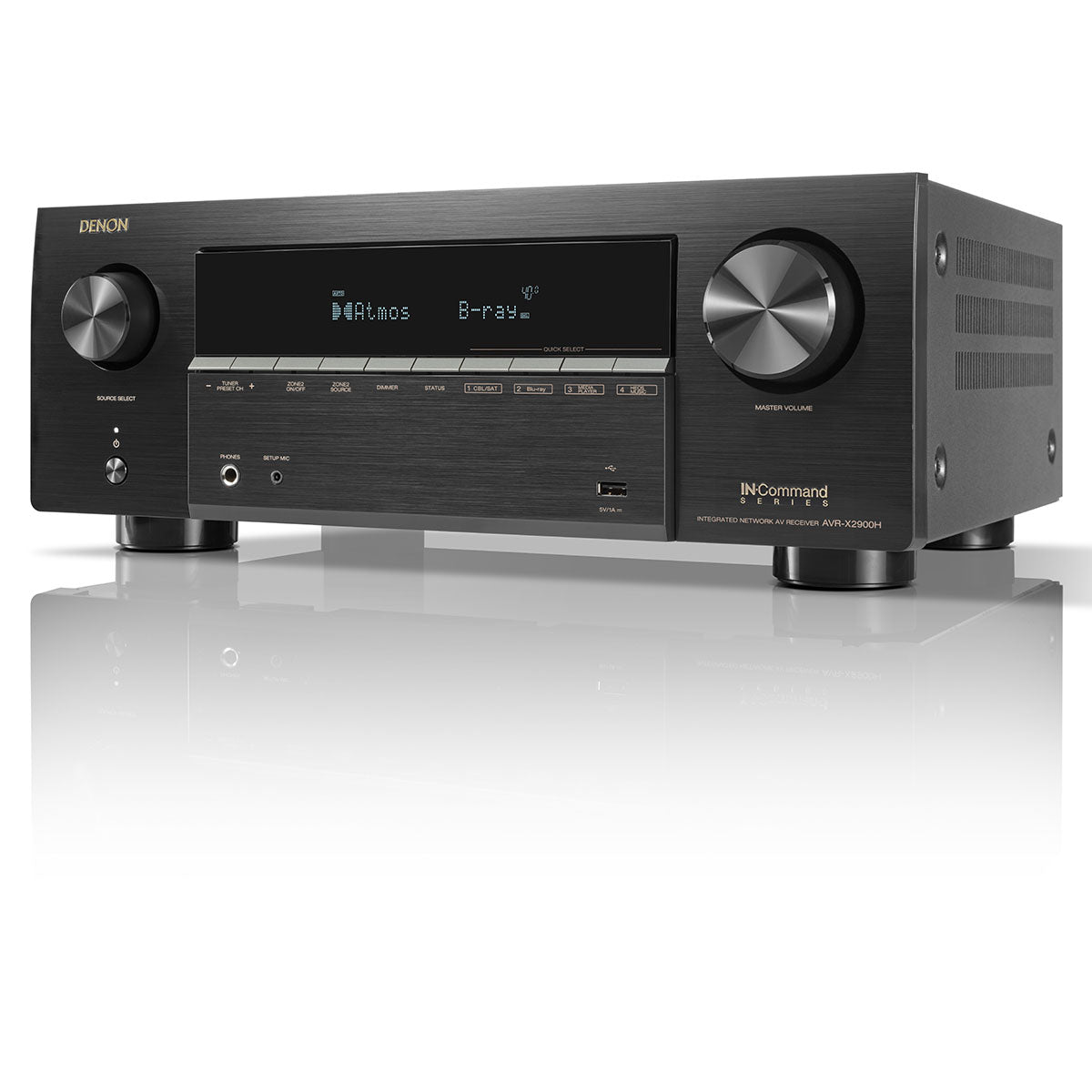
The X2900H is the right choice if: you're building or upgrading a home theater in a typical room, want proper Dolby Atmos support in a 5.1.2 or 7.1 configuration, and don't need more than two subwoofer outputs. It's a well-rounded receiver at a competitive price point with a real upgrade path now that Dirac Live is in the picture.
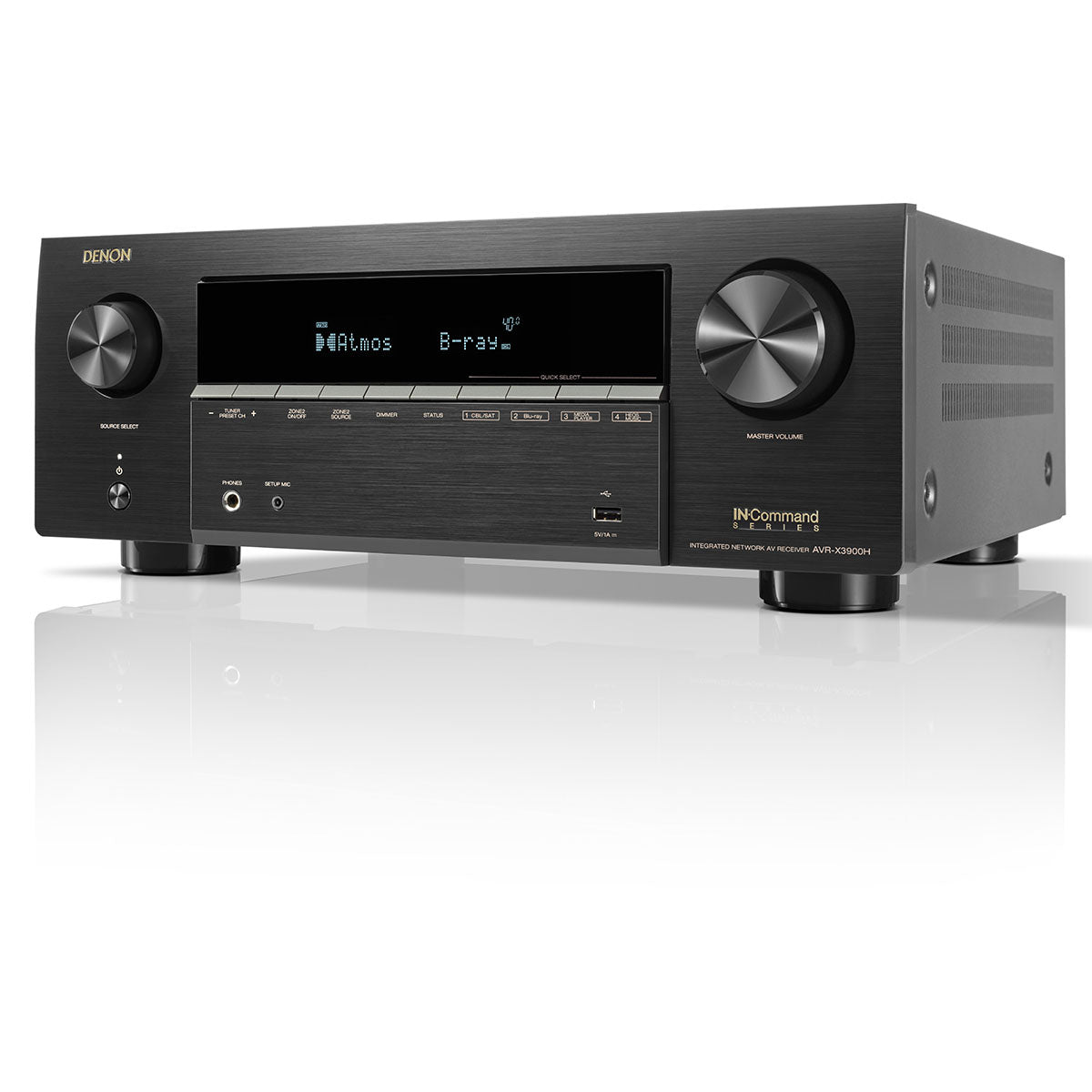
The X3900H is a 9.4-channel receiver rated at 105 watts per channel with 11-channel processing capability. That means 9 powered speaker channels plus 4 independent subwoofer outputs. The 11-channel processing headroom lets you run configurations like 7.1.4 or 5.1.6, and if you pair it with an external amplifier down the road you can expand to a full 11-channel system without replacing the receiver.
The X3900H adds IMAX Enhanced, AURO-3D, and 360 Reality Audio on top of Dolby Atmos and DTS:X. IMAX Enhanced is the most practically relevant for most buyers, especially with a growing 4K Blu-ray library. AURO-3D has a smaller catalog but a dedicated following among people who use their theater setup heavily for music listening. 360 Reality Audio is Sony's object-based streaming format, available on select platforms. None of these formats are available on the X2900H.
The X3900H supports up to four independent subwoofer outputs with Sub EQ HT for individual level and delay calibration on each sub. This is a meaningful step up from the X2900H's two outputs sharing a single signal. Getting even bass distribution across every seat in a larger room is genuinely difficult with a single sub or with multiple subs running the same uncalibrated signal. Sub EQ HT addresses that directly.
Two operating modes give you additional control. Standard mode blends all subwoofers for smooth, consistent bass across the room. Directional mode associates each subwoofer with the nearest speaker channel, so bass effects feel spatially connected to what's happening on screen rather than emanating from wherever the subs happen to be placed. This level of bass management used to be reserved for much more expensive standalone processors.
The X3900H runs Audyssey MultEQ XT32 instead of MultEQ XT, using more filter points for a more precise correction curve. It also adds Sub EQ HT for independent subwoofer calibration and Low Frequency Containment (LFC), which reduces bass bleed through walls into adjacent rooms — useful if your theater shares a wall with a bedroom or living space.
The optional Dirac Live upgrade on the X3900H includes the full suite: Room Correction, Bass Control, and Active Room Treatment. Bass Control and Active Room Treatment give you tools to manage your room acoustics at a level that goes well beyond automated calibration.
Back panel: 6 HDMI inputs and 3 outputs, with Zone 2 getting its own dedicated HDMI output so you can send a full video signal to a second display without extra hardware. The X2900H's Zone 2 is audio pre-outs only.
The X3900H is the right choice if: you have a larger or dedicated room, want to run a more complex speaker configuration like 7.1.4, are running multiple subwoofers, or want the more advanced Audyssey suite and the full Dirac Live upgrade path. It's also the better long-term foundation if you're planning to expand the system, since the 11-channel processing gives you room to grow without replacing the receiver.
Denon has been building audio equipment since 1910. The first commercial CD player came from Denon in 1981. The first AV receiver with Dolby Atmos support came from Denon in 2014. The first 8K AV receiver came from Denon in 2020. Being first repeatedly isn't coincidence — it means they're helping shape where the industry goes, not just following it.
All of their high-end products are built and tuned at Shirakawa Audio Works in Japan, their manufacturing home since 1983. The facility operates more like a workshop than a factory, with apprentices spending years learning under experienced engineers before working independently. The Japanese philosophy of Kaizen — continuous, incremental improvement adding up to substantial change over time — runs through everything they do there. Final voicing on every receiver goes through Denon's Sound Masters, senior engineers whose job is to sign off on how the product actually sounds, not just whether it measures correctly. That process is part of why Denon receivers carry a consistency of presentation across the lineup. We've been selling Denon at Audio Advice since 1978, and that consistency is one of the reasons they stay in our lineup.
Yes. The X2900H supports an optional paid upgrade to Dirac Live Room Correction. This is the first time Dirac Live has been available at this tier — the X2800H never had it. Note that the Dirac upgrade on the X2900H covers Room Correction only. Bass Control and Active Room Treatment are part of the full suite available on the X3900H.
The X3900H has more amplified channels (9 vs 7), wider format support (adding IMAX Enhanced, AURO-3D, and 360 Reality Audio), four independent subwoofer outputs with Sub EQ HT versus two shared outputs on the X2900H, more advanced Audyssey room correction (MultEQ XT32 with Sub EQ HT and LFC), and the full Dirac Live upgrade suite including Bass Control and Active Room Treatment. The X3900H also includes a dedicated Zone 2 HDMI output.
The two hardware-level additions are Dirac Live (unavailable on the X2800H entirely) and AMD FreeSync. The X2800H had VRR and ALLM but not FreeSync.
AMD FreeSync is new on both models. On the X3900H specifically, the full Dirac Live suite including Bass Control and Active Room Treatment is available as a formal upgrade path from launch, where on the X3800H those features arrived later via firmware.
Yes. Both the X2900H and X3900H support 4K at 120Hz, Variable Refresh Rate, Auto Low Latency Mode, and AMD FreeSync. Either unit handles current-generation consoles well.
Yes. With 9 amplified channels and 11-channel processing capability, the X3900H supports configurations including 7.1.4 and 5.1.6. Pairing it with an external two-channel amplifier lets you reach a full 11-channel layout without replacing the receiver.
Yes. The X2900H has 6 HDMI inputs with 3 supporting 8K passthrough, plus 2 HDMI outputs.
If you have further questions, contact our experts via chat, phone, or email. Or simply visit one of our world-class showrooms to experience speakers, projectors, TVs, and everything in between for yourself before you make a purchase!
If you’re planning your home theater or media room, check out our Home Theater Design page, where we have everything Home Theater related, including our FREE Home Theater Design Tool.
When you buy from Audio Advice, you’re buying from a trusted seller since 1978. We offer Free Shipping, Lifetime Expert Support, and our Price Guarantee. We look forward to serving you!
You'll be among the first to know about product launches, exclusive online deals, and the hottest audio trends.
