
Our 2026 list of the best AV receivers for home theater covers a wide price range and just about every type of system. From a budget friendly starter AVR to true high end Class G designs and a 15 channel flagship, there is almost certainly a model here that fits your room, speakers, and goals.
To make this list, a receiver had to check several boxes. It needed to be straightforward to set up, sound great for the money, support modern HDMI 2.1 connections and immersive formats like Dolby Atmos, and have a track record of reliability. For the premium models on the list, we also put a lot of weight on advanced room correction, flexible bass management, and expandability with external amps and additional speakers.
If you are thinking about upgrading your home theater receiver, we also recommend checking out our in-depth Home Theater Receiver Buying Guide, where we explain each of these features in more detail and walk through how to match an AVR to your room size, speakers, and listening habits.
Before we get into the winners, it helps to understand the key features that separate a basic receiver from something that can anchor a serious home cinema.
There are a few key features we focus on when we evaluate home theater receivers. We used to call out a long list of things like Dolby Atmos, 4K video switching, Bluetooth, streaming apps, and basic app control. At this point, every receiver on this list already includes those features, so we are going to zoom in on the things that really separate an average AVR from a great one.
We go into even more detail in our Home Theater Receiver Buying Guide, but the quick checklist below will help you understand how we picked the models in this article and which one is right for you.
Channels tell you how many speakers the receiver can power. A 7 channel AVR is enough for a 5.1.2 Dolby Atmos layout, while 9 or 11 channels open the door to 5.1.4, 7.1.2, or even 7.1.4 and beyond, which are great choices for dedicated theaters. When we talk about channels, we are focusing on powered channels. Several models on this list can actually process more channels than they can power on their own, which is where external amps come into play.
Power specs can be confusing. Some brands rate power with only two channels driven, others with all channels driven, and some don’t cover the full 20 hertz to 20 kilohertz audio band in their headline spec. The most honest specification would be all channels driven, full bandwidth, at a low distortion number.
The good news is you don’t need to obsess over every watt if you choose a receiver from a reputable audio company and match it to a reasonable speaker system. In general, as you step up in price the size of the power supply and the current delivery improve, which gives you better dynamics and control over your speakers, especially in bigger rooms.
Preamp outputs let you add separate power amps later without replacing your receiver. This can be a huge advantage if you think your system might grow over time. For example, an AVR might have 9 powered channels on board, but preamp outputs for 11 or more. You can start with just the receiver, then add a two or four channel amp to drive additional surround or height speakers. We’ll note how many channels each receiver can process, how many it can power on its own, and which ones have full sets of preamp outputs if you want to upgrade down the road.
At Audio Advice we’re big believers in multiple subwoofers. Two or more subs, placed correctly and calibrated independently, can give you smoother and more even bass across the seating area, along with more impact and headroom.
Some receivers have two or more subwoofer jacks, but treat them as a single channel. It’s important to pay attention to receivers that offer truly independent subwoofer outputs, with separate distance, level, and EQ settings for each to fine tune your low end.
Power amp matrixing lets you reroute the internal amp channels to different speaker positions. This becomes very useful when you start adding external amps.
For example, you might use an outboard power amp on your left and right speakers, then reassign those freed up internal channels to extra height or surround speakers. Some of the higher end receivers on this list, like the Anthem MRX 740, ARCAM AVR31, and Denon AVR A1H, give you a lot of flexibility here, which helps you grow from a simpler configuration to something like 7.2.4 or beyond without wasting any built in power.
ARC stands for Audio Return Channel, and eARC is the enhanced version designed to handle much higher bandwidth audio formats. If you rely on your TV’s built in streaming apps, ARC can send audio back to your receiver over a single HDMI cable, but it cannot carry full lossless Dolby Atmos. It only supports the compressed version that streaming services use. eARC is required if you want the highest quality audio formats like Dolby TrueHD based Atmos, which you get from a 4K Blu ray player or a high quality media server. Since every receiver in this guide includes eARC, you are fully covered for both streaming and true lossless formats.
No home theater room is acoustically perfect. Room correction has become one of the most important technologies in modern AV receivers. It can help tame boomy bass, smooth out big peaks and dips, and get your speakers working together more coherently in your specific space. We’ll call out which room correction system each model uses and share a bit about how it performs.
If you spin vinyl, a built in moving magnet phono stage is a nice bonus. Several of the receivers in this guide have a phono input that works with most turntables. Even if a receiver doesn’t have a phono input, you can always use an external phono preamp, but having it built in keeps things simpler.
Next generation gaming consoles and modern PCs can output 4K at 120 frames per second, and some even support 8K video. That’s why HDMI 2.1 has become such an important feature on today’s receivers. In this price range you may not get a full bank of HDMI 2.1 ports, but the better models include at least a couple of inputs that support 4K120 and 8K60 so you have room to grow.
Core gaming features like Variable Refresh Rate, Auto Low Latency Mode, and Quick Frame Transport help reduce input lag and keep the signal smooth during fast paced gameplay. If your receiver supports them, great. If it doesn’t, you still have a very simple workaround. As long as your TV has eARC, you can plug your gaming console directly into the TV to get full bandwidth video, then send the uncompressed audio back to the receiver through the eARC connection. This keeps you completely compatible with high frame rate gaming even if your AVR doesn’t have HDMI 2.1 on every input.
The bottom line is that you don’t need a fully loaded HDMI 2.1 receiver to enjoy the best gaming performance today, but having at least one or two 2.1 ports on your AVR or on your TV ensures you’re covered for modern sources and anything you might add later.
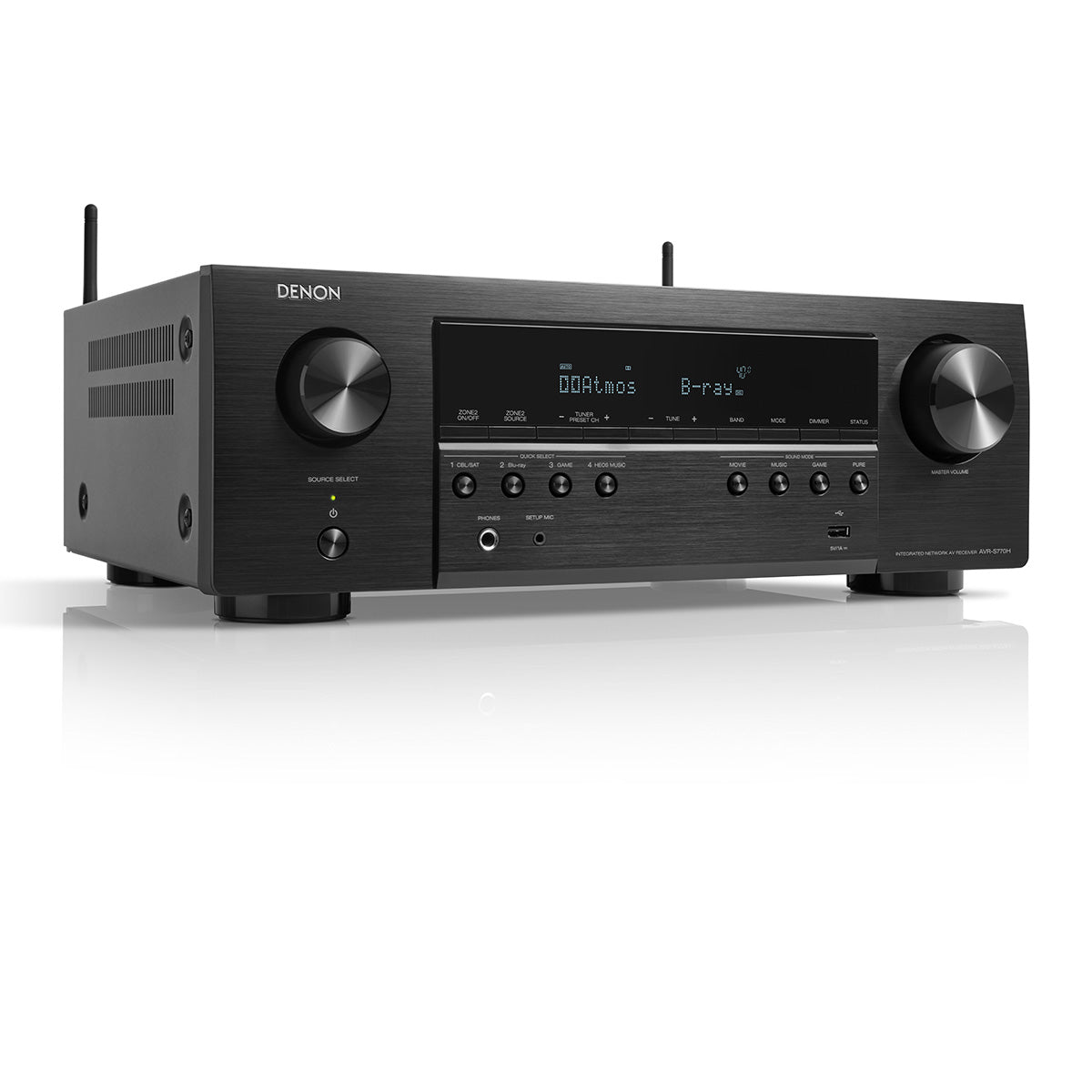
Denon has been part of the Audio Advice story since the late 1970’s, and they built their reputation on reliable, great sounding receivers that last for years. The AVR S770H brings that same DNA to a very approachable price. If you are building your first real surround system or upgrading an older HDMI receiver, this is one of the best budget AVRs you can pick.
Inside, you get 7 channels of discrete amplification that can power either a 5.2.2 Dolby Atmos layout or a traditional 7.2 system. For small to medium rooms, it delivers more than enough punch to bring movies, shows, and games to life. The discrete output stage and solid power supply give the S770H a clean, dynamic sound, with smooth music playback and plenty of impact during action scenes without harshness.
On the video side, you get 6 HDMI inputs, with 3 supporting 8K and 4K at one hundred twenty frames per second for next generation gaming and future sources. Dolby Vision and HDR10 are supported, and the receiver can upscale content to 8K.
Streaming and whole home audio are fully covered. The S770H includes Wi Fi, HEOS, AirPlay 2, and Bluetooth with both transmit and receive. That means easy playback from all major streaming services and the option to send audio to Bluetooth headphones for late night viewing. There is also voice control support and even a built-in moving magnet phono stage for vinyl.
Room correction is another strong point. Denon includes Audyssey MultiEQ with an on screen setup wizard that guides you through wiring, mic placement, and measurements. After calibration, the system smooths out common room issues like boomy bass and uneven dialogue, which makes a noticeable difference in real world living rooms.
Put everything together and the AVR S770H checks every box we expect in a modern budget home theater receiver. You get solid amplification, modern HDMI support, simple streaming, vinyl compatibility, and proven room correction in a package that is easy to set up and enjoyable to listen to. It remains our top choice for the best budget home theater receiver.
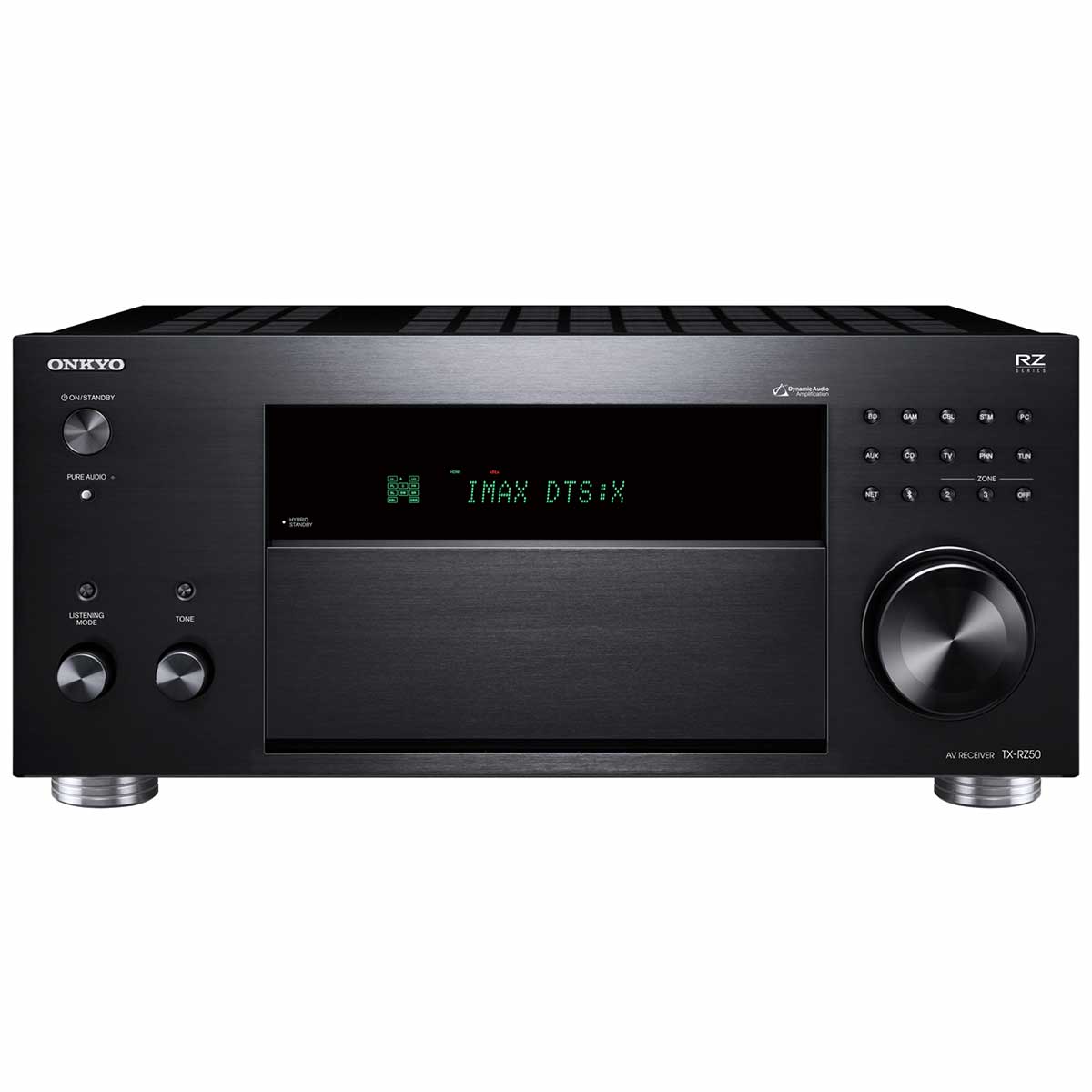
The Onkyo TX-RZ50 has become one of the most popular midrange home theater receivers for a simple reason. It’s one of the most affordable AVRs that includes true Dirac Live room correction along with strong power, HDMI 2.1 support, and a feature set that used to require spending far more. If you’re building a higher performance living room or a dedicated theater and want to step up from the entry level segment, this is where things start getting serious.
You get nine channels of high current amplification rated at one hundred twenty watts per channel into eight ohms with two channels driven. That is plenty of power for most modern speakers in small to medium large rooms, and the RZ50 can comfortably handle layouts like 5.1.4 or 7.1.2 without external amps. The discrete output stages and robust power supply give it a punchy, controlled sound that works well for both movies and music. THX certification is another bonus that confirms the receiver meets strict performance and noise standards.
Dirac Live is the biggest standout feature. It analyzes your speakers and subwoofer in your actual room, then applies precise digital filters to correct timing and frequency issues. You can use the included microphone or upgrade to a USB measurement mic for even better accuracy. If you love deep, accurate bass, Dirac Live Bass Control is available as an optional upgrade and can make a significant difference in larger or more challenging rooms.
On the video side, you get six HDMI 2.1 inputs that support up to 8K60 or 4K120, plus two HDMI outputs for a main display and a second zone. All ports support HDR10+, Dolby Vision, and HLG. HDMI zone 2 lets you watch a movie in the main theater while sending a different 4K source to another room, a flexibility you normally do not see at this price.
For streaming and music, the RZ50 includes Chromecast built in, AirPlay 2, DTS Play Fi, and native support for major services like Spotify and Tidal. Bi directional Bluetooth lets you stream to the receiver or send audio to wireless headphones. A moving magnet phono input is onboard, along with a wide range of analog and digital inputs. The receiver processes up to 11.2 channels and has full preamp outputs, so adding a two channel amp later takes you to a full 7.2.4 Dolby Atmos system.
If you want something slightly simpler or more powerful, Onkyo offers two strong alternatives. The RZ30 is a streamlined, more affordable option that still gives you HDMI 2.1 and great sound, while the RZ70 steps up to even more power, better components, and extra processing for larger home theaters. All three share the same design philosophy and are excellent choices depending on your room and budget.
When you add everything up, the TX RZ50 hits a sweet spot. You get real HDMI 2.1, solid power, excellent streaming, and full Dirac Live at a price that is hard to beat. For anyone wanting a midrange AVR with serious performance and long term flexibility, the Onkyo TX RZ50 is our top pick.
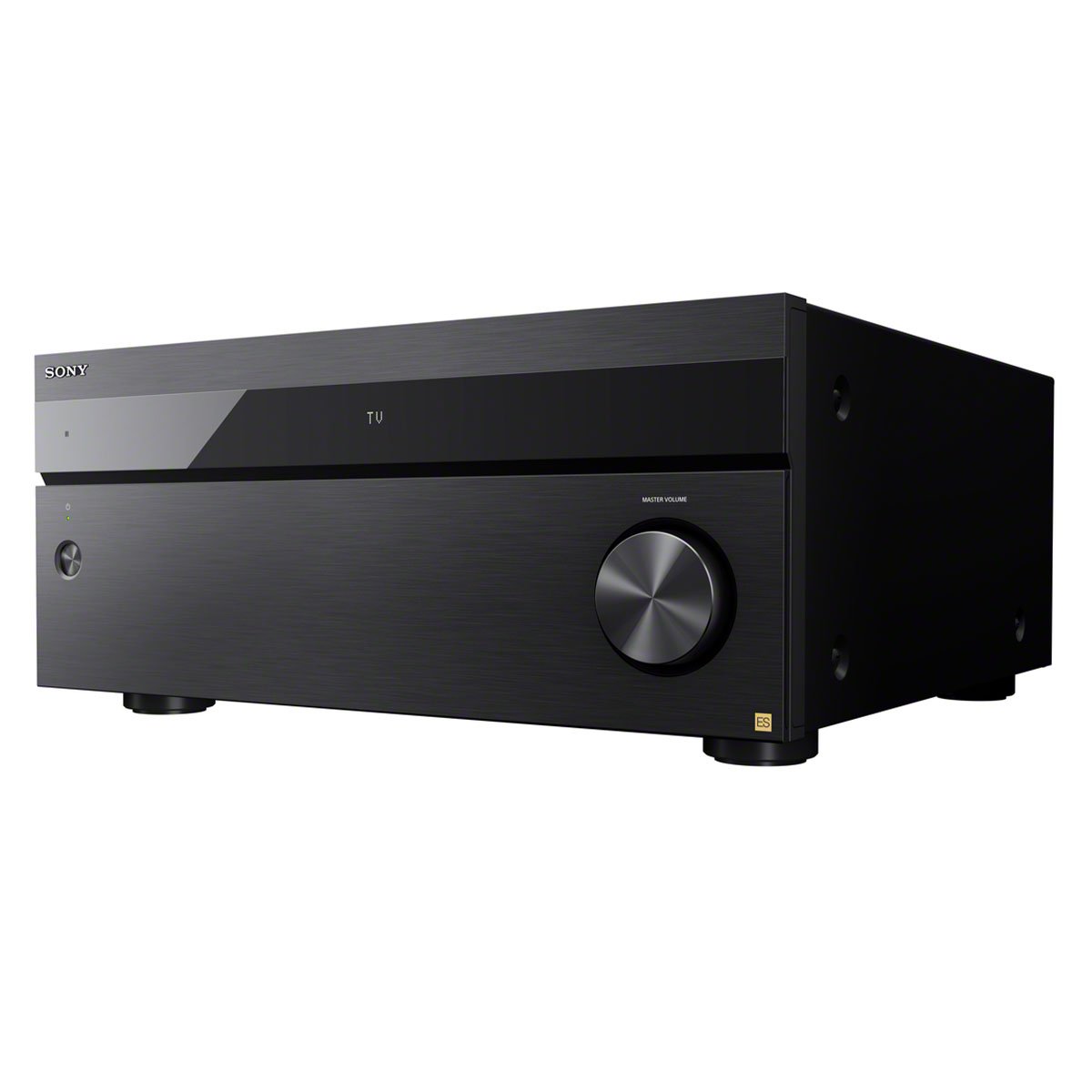
The Denon AVR X3800H is one of the most versatile receivers you can buy for under $2,000. Denon designed it as the perfect “grow with you” platform for home theater fans who want a strong amp section today with a clear path to bigger systems down the road. If you think you might eventually add external amplifiers, expand to 7.2.4, or fine tune multiple subwoofers, the X3800H stands out immediately.
You get 9 powered channels on board, which lets you run layouts like 5.1.4 or 7.1.2 right out of the box. The receiver can process up to 11 channels, so adding a two channel amp later gets you to a full 7.2.4 setup without replacing anything. Denon also gives you 4 completely independent subwoofer outputs that can be measured and corrected separately, which is rare even on far more expensive units. For rooms where bass matters, this alone can justify the upgrade.
On the video side, the X3800H supports 8K and 4K120 across six HDMI 2.1 inputs, making it fully ready for next generation gaming consoles and modern 8K displays. Dolby Vision, HDR10+, HLG, and ALLM are supported, and you get HEOS for music, AirPlay 2, Spotify Connect, Bluetooth, and voice control through all major platforms.
Room correction is powerful as well. Audyssey MultEQ XT32 is included for free and while it’s not quite as powerful as Dirac Live, it does an excellent job balancing a system with a very easy to use setup interface. However, if you want to take things even further, you can upgrade to Dirac Live for a fee, to get even better room correction. This won’t be needed for everyone, but gives you a chance to upgrade down the line if you wish. Between the flexible preamp outputs, channel reassignment, and the option for Dirac, it is one of the most tweakable receivers Denon has ever made.
So, when you add up the power, the expandability, the HDMI 2.1 support, and the best in class subwoofer flexibility, the AVR X3800H becomes an easy choice. If you want a receiver that can start simple but has the horsepower, processing, and calibration tools to anchor a serious 7.2.4 theater in the future, this is the one to get.
The Sony STR-AZ5000ES is one of the most impressive 11 channel receivers you can buy without jumping into the ultra high end category. Sony completely redesigned their ES line, and the result is a receiver that delivers an incredibly immersive soundstage, strong power, and one of the most advanced calibration systems available. If you want an AVR that feels purpose built for cinema-like Dolby Atmos, this is the one to look at.
The AZ5000ES gives you 11 powered channels on board, which lets you run serious layouts such as 7.1.4 or 9.1.2 with no external amplification required. Sony uses a heavy duty chassis, a large power supply, and discrete amplification stages that help the receiver deliver a clean, authoritative sound with excellent channel separation. It weighs over 40 pounds, which tells you a lot about the build quality and why the audio performance punches above its price.
Sony’s Digital Cinema Auto Calibration IX is a big part of what makes this receiver shine. Instead of just measuring distances, Sony maps your room in three dimensions and uses 360 Spatial Sound Mapping to create a much wider, more enveloping surround field. Even in challenging rooms, the AZ5000ES makes effects feel more pinpointed and height channels more convincing. For people who cannot run physical surround or rear speakers, Sony also gives you clever phantom and wireless speaker options to fill in the gaps.
On the video side, the ES line checks all the modern boxes. You get multiple HDMI 2.1 inputs supporting 8K60 and 4K120, plus full compatibility with Dolby Vision, HDR10, and HLG. Gamers will appreciate the low latency modes and smooth 120 fps support. There are two HDMI outputs for dual display setups or a TV plus projector system.
For music and connectivity, the AZ5000ES includes Chromecast built in, AirPlay 2, Spotify Connect, Bluetooth, and “Works With Sonos” integration when paired with a Sonos Port. There is plenty of flexibility for whole home audio or multi-zone use, and the ES series is fully designed for custom installation with features like IP control, RS-232, and a five year warranty.
When you combine the 11 powered channels, the impressive immersive audio performance, the robust build, and the modern HDMI feature set, the STR-AZ5000ES stands out as one of the best receivers in its class. It is a fantastic choice for anyone who wants a true 11 channel Atmos system without having to step up to separate.
The Anthem MRX 740 is where this guide shifts from versatility to pure sound quality. Anthem builds its receivers with the same engineering mindset found in their high end amplifiers and processors, and it absolutely shows once you listen. If you want an AVR that delivers exceptional clarity, dynamics, and precision along with one of the most advanced room correction systems available, the MRX 740 sits at the top of its class.
Although it has 7 powered channels onboard, the MRX 740 can process up to 11 channels, allowing you to expand to a full 7.2.4 Dolby Atmos layout with external amplification. The internal amp section is substantial, using a high current power supply and discrete output stages that give the receiver a natural, highly detailed presentation with excellent dynamic punch. Music sounds open and engaging, and movie soundtracks have outstanding clarity, impact, and spatial definition.
ARC Genesis room correction is another major part of why Anthem receivers perform so well. ARC gives you an extremely deep level of control, letting you adjust each speaker’s response, define target curves, fine tune crossover settings, and perfectly blend your subwoofers.
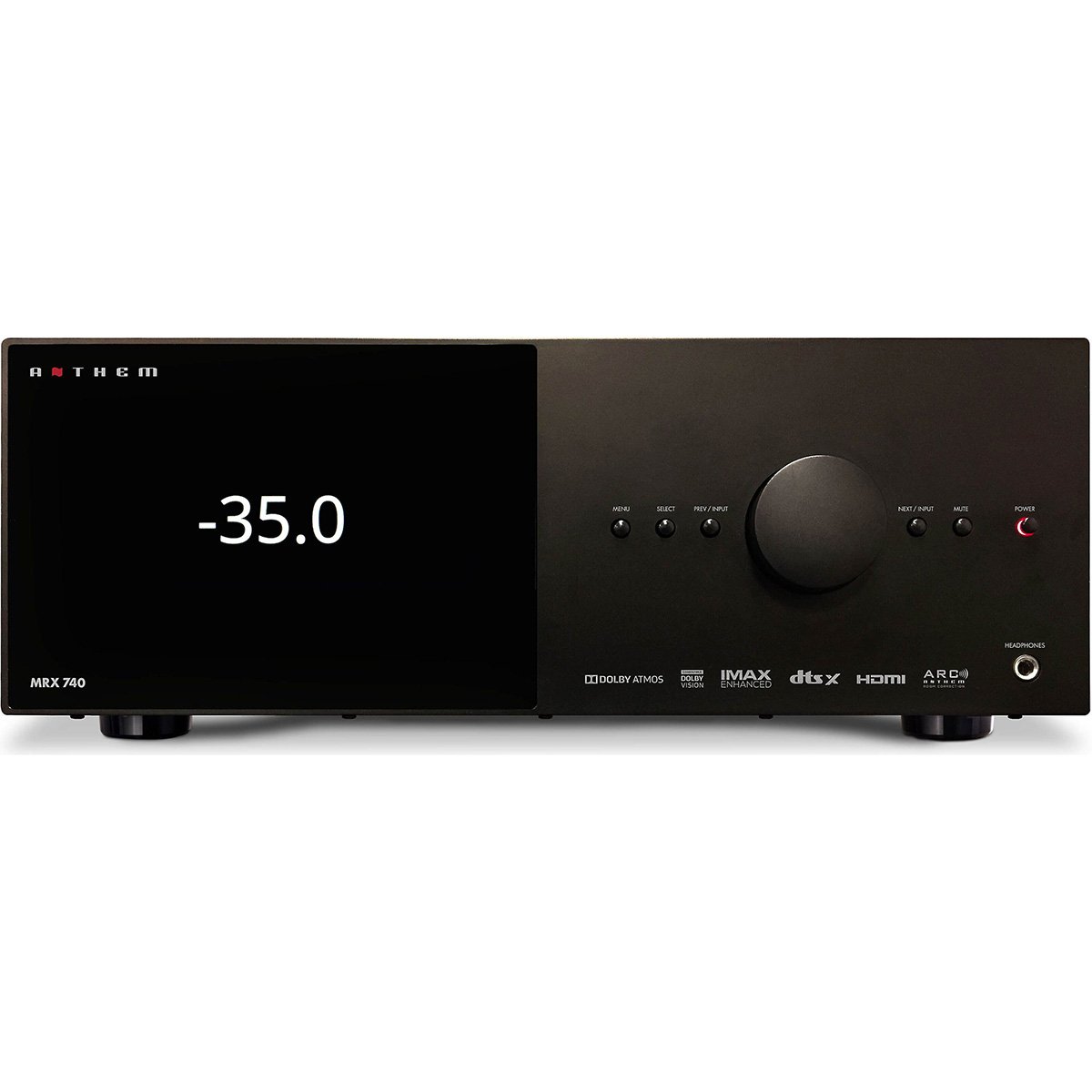
The included calibrated microphone is matched to the system, ensuring accurate measurements right out of the box. You can even store multiple listening profiles, making it easy to create presets for single seat listening, group viewing, or music only sessions.
On the video side, the MRX 740 includes support for 8K video, Dolby Vision, HDR10, HLG, and IMAX Enhanced content. Streaming options include AirPlay 2, Chromecast, Bluetooth, and Roon readiness, all controlled through a clean and responsive interface. Anthem also offers excellent integration features for custom installations, adding to its long term flexibility.
If sound quality is your top priority, the MRX 740 is one of the best performing receivers you can buy at this price. It delivers rich, dynamic audio, powerful processing, and an upgrade path to 11 channels for a full immersive setup. And if you want even more power and the ability to run a complete 7.2.4 system without adding external amps, the Anthem MRX 1140 is a great step up.
The Marantz Cinema 30 sits at the top of Marantz’s receiver lineup and is designed for people who want premium sound, premium design, and premium flexibility all in one chassis. It feels every bit like a luxury product, from the build quality to the sound signature to the advanced processing under the hood. If you want an AVR that looks as stunning as it sounds, the Cinema 30 is the clear choice.
With 11 powered channels onboard, the Cinema 30 can run full 7.1.4 or 9.1.2 systems without needing any external amplification. Marantz uses a large toroidal transformer and discrete HDAM amplifier modules, giving the Cinema 30 its signature warm, musical sound. Dialogue is rich and natural, music has body and texture, and Atmos soundtracks have a smooth, enveloping quality that feels effortless even at higher volumes.
One of the Cinema 30’s biggest strengths is bass management. You get four fully independent subwoofer outputs, each with its own distance, level, and EQ control. This gives you far more precise bass performance across multiple seats and makes the Cinema 30 a perfect choice for immersive rooms where low frequency accuracy really matters. Marantz also allows channel reassignment and full 11.4 processing, offering a lot of flexibility for system growth.
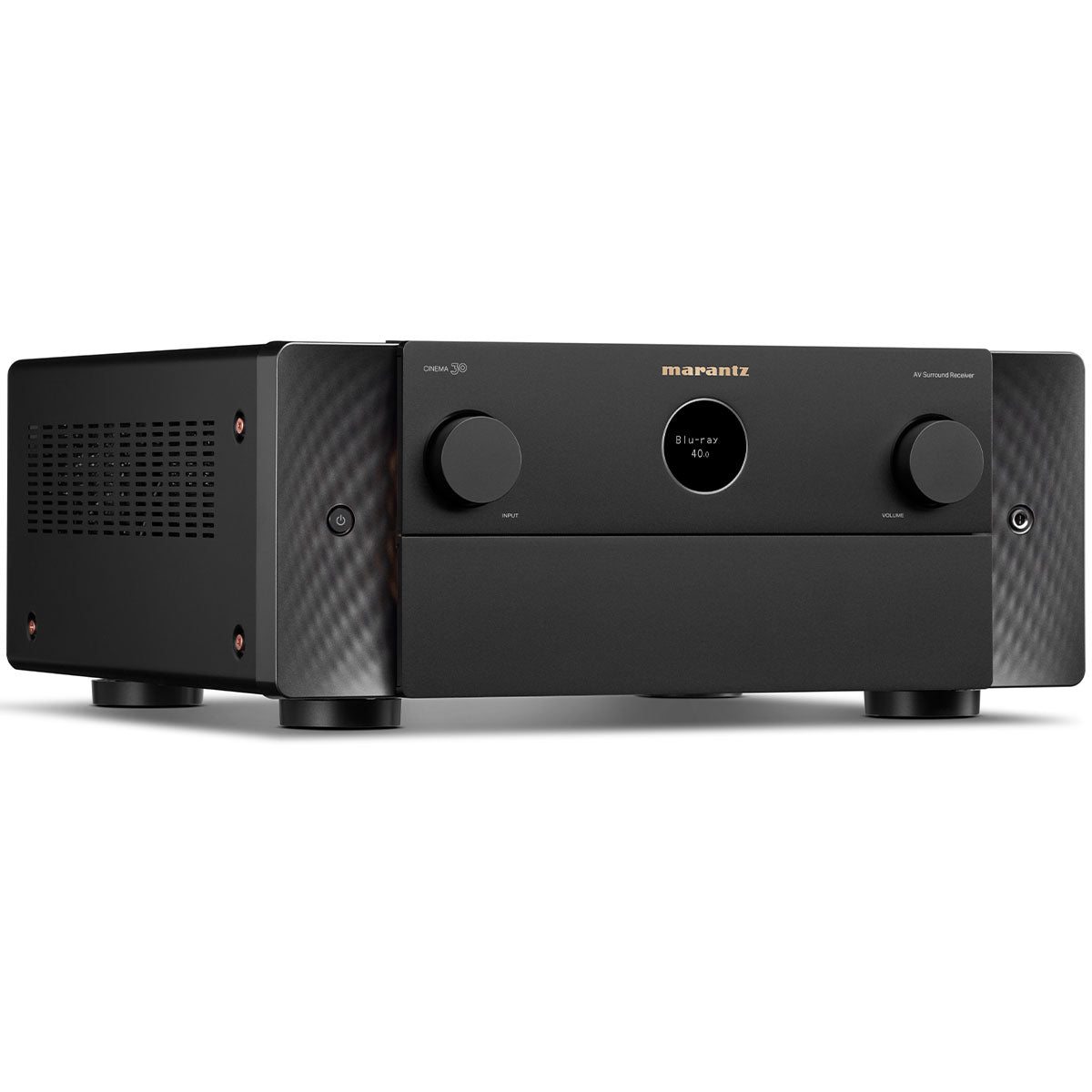
For room correction, the Cinema 30 includes Audyssey MultEQ XT32, which does an excellent job in most rooms. If you want to take things further, you can upgrade to Dirac Live and Dirac Live Bass Control, giving you one of the most advanced correction engines available and taking the sound from this receiver to another level. This combination makes the Cinema 30 both easy for beginners and extremely powerful for experienced home theater builders.
On the video side, you get a full suite of HDMI 2.1 inputs supporting 8K60 and 4K120, plus HDR10, HDR10+, Dolby Vision, and HLG. Connectivity includes HEOS for multiroom audio, AirPlay 2, Spotify Connect, Bluetooth, and a moving magnet phono stage for vinyl playback. The Cinema 30 is also built for custom installation, with robust control options and a polished on screen setup interface that is among the best in the industry.
If you want luxury fit and finish, excellent musicality, and serious home theater performance in one flagship receiver, the Marantz Cinema 30 delivers. It combines power, flexibility, and refinement with a build quality that stands out instantly. For premium living rooms and high end dedicated theaters alike, it is one of the most complete receivers you can buy.
The ARCAM AVR31 is a dream receiver for anyone who loves both home theater and high end two channel music. It’s one of the only AVRs on the market to feature Class G amplification, a design ARCAM developed to deliver the purity and finesse of a great audiophile amplifier while still providing the dynamic power needed for big soundtracks. If music performance is as important to you as movie performance, the AVR31 rises to the top instantly.
ARCAM equips the AVR31 with 7 powered Class G channels and processing for up to 16, allowing you to build a full 7.1.4 or even 9.1.6 Atmos system with external amps. The internal amplifier stage is substantial and incredibly refined. Class G uses multiple power rails to deliver low distortion and high current on demand, which results in cleaner dynamics, better detail, and a noticeably more natural presentation compared to traditional Class AB receivers.
The digital section is equally impressive. ARCAM uses audiophile grade ESS 9026PRO DACs with reference voltage regulators, giving you superb clarity with high resolution music. The AVR31 supports MQA, AirPlay 2, Chromecast, Roon, aptX HD Bluetooth, and nearly all major streaming platforms. Whether you’re listening to a stereo album or switching back into a Dolby Atmos soundtrack, the receiver keeps everything smooth and cohesive with a level of musicality that stands out.
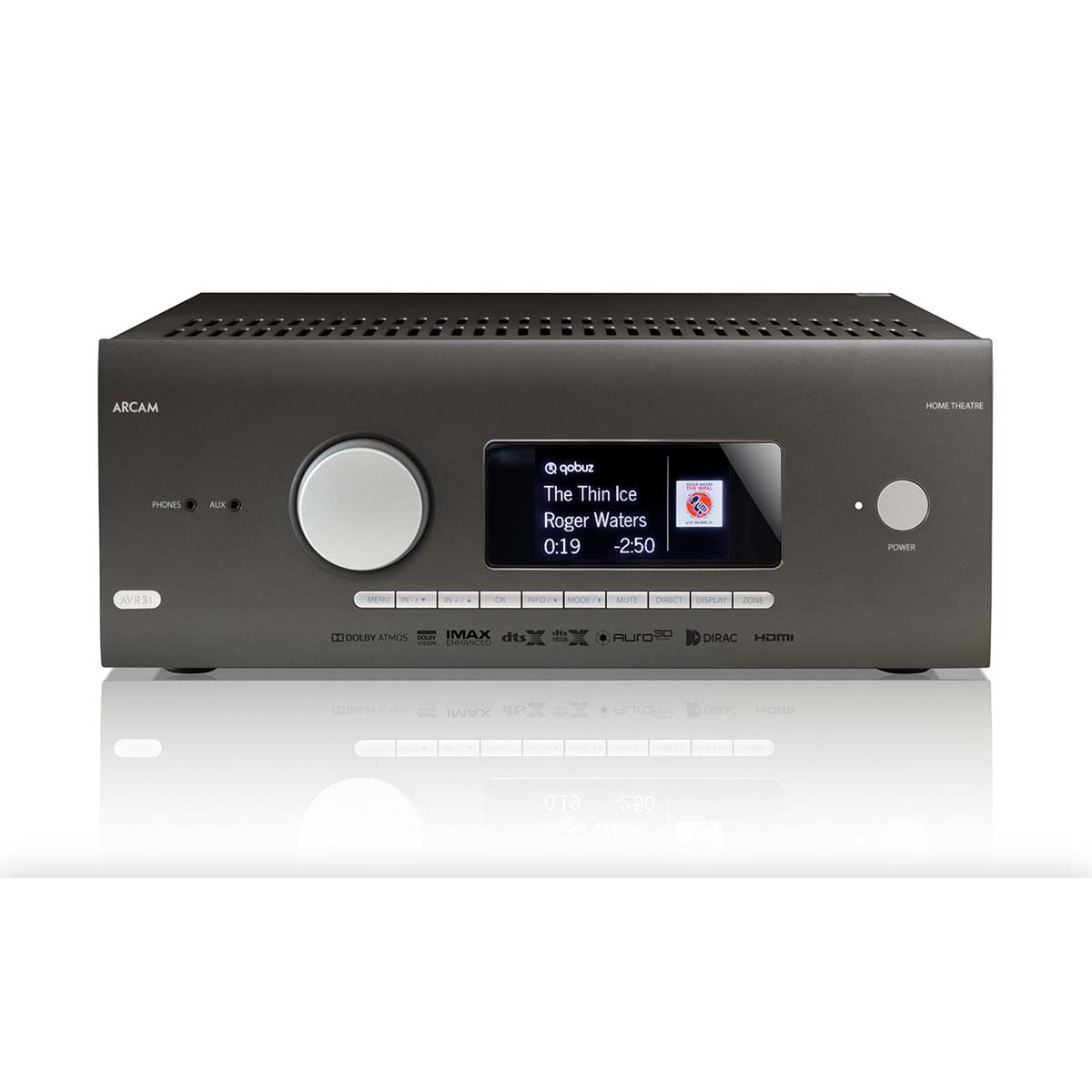
Room correction is handled by Dirac Live, one of the best systems available, and you can unlock Dirac Live Bass Control for even more accurate low frequency performance if you’re running multiple subwoofers. Combined with the AVR31’s clean amplification, Dirac helps you achieve a very balanced, precise sound that adapts beautifully to real living rooms and dedicated theaters alike.
On the video side, the AVR31 checks every modern box with full 8K HDMI 2.1 support, plus Dolby Vision, HDR10+, and HLG compatibility. You get 7 HDMI inputs, dual outputs, and the flexibility to integrate the receiver into a full home theater or mixed media setup. Build quality is excellent, and ARCAM’s interface and app controls have become much more polished over recent generations.
If you want a receiver that excels with stereo music but also transforms into a powerhouse for immersive movie playback, the ARCAM AVR31 is one of the best you can buy. It brings real audiophile performance into the home theater world and offers enough processing power for ambitious multi channel layouts with external amps.
The Denon AVR-A1H is the most powerful and most advanced home theater receiver Denon has ever built. At over 70 pounds with a massive 29 pound transformer inside, it’s designed for enthusiasts who want the most immersive, highest channel count home theater experience possible without stepping into full separates. If you want a receiver that can anchor a reference grade system, the A1H is in a class of its own.
With 15 powered channels, the A1H lets you run extremely advanced layouts like 9.1.6 or 7.1.6 without adding any external amplification. You can even bi-amp your front speakers if you’re not using all channels for Atmos. The amplifier section is muscular and incredibly dynamic, giving you the kind of effortless slam, clarity, and headroom that makes large speakers and big rooms come alive during action movies, concerts, and gaming.
One of the A1H's most impressive features is its bass management system. You get 4 fully independent subwoofer outputs, each with its own delay, EQ, and level settings. This makes it possible to build a world class multi-sub system with perfectly blended low frequency response across multiple seats. It includes Audyssey MultEQ XT32, and you can upgrade to Dirac Live and Dirac Live Bass Control for even more precise fine tuning, putting you in the same league as high end processors.
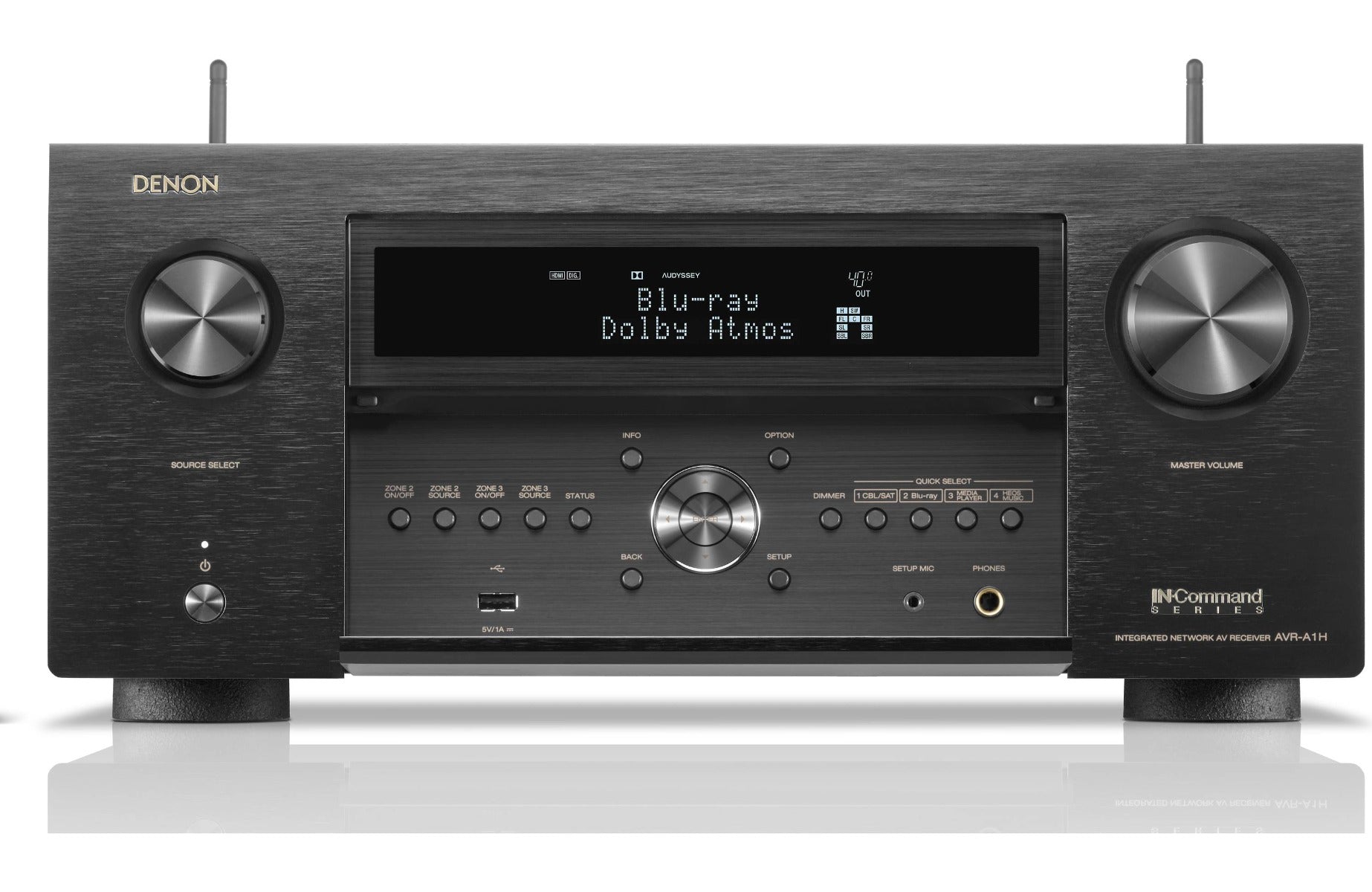
On the processing side, the A1H supports practically everything: Dolby Atmos, DTS:X, IMAX Enhanced, Auro-3D, and even Sony’s 360 Spatial Sound Mapping. The flexibility in layout options is unmatched, giving you the freedom to design a system that matches your room and your exact speaker configuration. If you want to push the limits of what a receiver can decode and drive on its own, this is the model that does it.
For video and gaming, you get 7 HDMI 2.1 inputs supporting 8K60, 4K120, VRR, ALLM, and all major HDR formats including Dolby Vision and HDR10+. Music streaming is covered with HEOS, AirPlay 2, Spotify Connect, Bluetooth, and Roon. Despite its size and power, the A1H also has one of the cleanest on screen setup interfaces, and Denon's setup assistant makes installation surprisingly straightforward.
If you want the biggest, most capable AV receiver available today, the Denon AVR-A1H is the clear top pick. It delivers enormous power, an unmatched channel count, incredible bass management, and a feature set that rivals many high end separates. For serious home theater builders who want endgame performance in one component, nothing else comes close.
Choosing between an AV receiver and a separate processor and amplifier system usually comes down to room size, speaker demands, and how far you want to push performance. Modern AVRs are far more capable than they were even a few years ago, but there are clear situations where moving to separates becomes the better long term choice.
The first sign is power. Big rooms and large speakers often need more current than even a great receiver can deliver on its own. You can usually get away with a high end AVR in a medium sized room, but once you move into large dedicated spaces, the headroom and grip of a separate power amp becomes very noticeable.
Another point is channel count. If you want to explore layouts beyond 9.1.6, or if you plan to mix in advanced speaker configurations, a separate processor gives you more freedom and more expansion headroom.
Room correction and bass control are also major factors. Only once you move into very high end processors such as Trinnov and StormAudio do you start to see a clear step up in precision, time alignment, and advanced subwoofer management compared to what the best AV receivers offer. Modern AVRs with systems like Dirac Live, ARC Genesis, and Audyssey XT32 already get you most of the way there for typical rooms. Separates really start to make sense when you want the kind of processing power and customization that only the top tier processors provide.
For most people, a great AVR is all you need. But for larger rooms, higher playback levels, and the most ambitious layouts, stepping up to separates brings real advantages in power, control, and performance.
When comparing these receivers, a few patterns make the decision easier. Budget models like the Denon S770H cover the basics and perform cleanly in smaller rooms. The Onkyo TX RZ50 introduces Dirac Live and more power, which makes it a strong value for enthusiasts who want better room correction.
The Denon X3800H is the most flexible midrange option with four independent subwoofer outputs, 11 channel processing, and the option to add Dirac Live. The Sony STR AZ5000ES shines for people who want the most immersive 11 channel experience without adding external amplifiers.
The Anthem MRX 740 and ARCAM AVR31 are the clear choices for listeners who care deeply about sound quality. Anthem’s ARC Genesis is one of the strongest tuning tools on the market, while ARCAM’s Class G design offers an audiophile level of musicality.
The Marantz Cinema 30 blends luxury design with excellent musicality and advanced bass management, while the Denon AVR A1H stands alone as the most powerful receiver available, with 15 powered channels and exceptional flexibility for large theaters.
Choosing the right home theater receiver comes down to your room, your speakers, and how immersive you want your system to be. The good news is that no matter where you are in the process, there is a receiver on this list that will fit your needs and give you room to grow.
If you want help deciding what is right for you, our team is always here to guide you through channel counts, room correction, speaker layouts, and how to get the best sound possible in your space. You can also explore our surround sound layout guides, subwoofer placement and calibration tips, and try different room designs in our free Home Theater Design Tool.
A well matched AVR is the heart of every great system. Pick the right one for your room, set it up correctly, and even a modest system can transform into a cinematic experience that surprises you every time you press play.
If you have further questions, contact our experts via chat, phone, or email. Or simply visit one of our world-class showrooms to experience speakers, projectors, TVs, and everything in between for yourself before you make a purchase!
If you’re planning your home theater or media room, check out our Home Theater Design page, where we have everything Home Theater related, including our FREE Home Theater Design Tool.
When you buy from Audio Advice, you’re buying from a trusted seller since 1978. We offer Free Shipping, Lifetime Expert Support, and our Price Guarantee. We look forward to serving you!
Denon AVR-S770H 7.2 Channel Receiver
$749.00
Onkyo TX-RZ50 9.2-Channel Home Theater Receiver
$1,399.99
Denon AVR-X3800H, 9.4 Channel Home Theater Receiver
$1,799.00
Sony STR-AZ5000ES 11.2 Channel 8K AV Receiver
$2,599.95
You'll be among the first to know about product launches, exclusive online deals, and the hottest audio trends.