













Is Streaming Holding Your Home Theater Back?

We are going to make a bold statement right up front: if you are relying on streaming services to feed your high-performance home theater or audio system, you are leaving a significant amount of performance on the table. We know that might be hard to hear, especially when streaming has become so convenient and so ingrained in how we all consume content. But convenience and quality are two very different things, and the gap between them is wider than most people realize.
At Audio Advice, we have spent decades helping people get the absolute best sound and picture out of their systems. And one of the most common things we see is someone who has invested real money in great speakers, a quality AV processor, and a high-performance display, only to feed that incredible system a compromised signal from a streaming app. It is a little like putting regular fuel in a Ferrari. The car can handle it, but it was never designed to run that way.
So let's talk about what is actually happening when you stream, why it matters, and what you can do about it.
Streaming Used to Be a Better Deal
Not long ago, getting 4K and Dolby Atmos from a streaming service was reasonably straightforward and relatively affordable. Those days are fading fast. Every major service has been moving their best audio and video quality behind higher-priced tiers, charging a premium to remove ads, enable 4K, and unlock Dolby Atmos. You are now paying significantly more than you were just a few years ago, and as we are going to show you, you are still not getting anywhere close to what a physical disc or a Kaleidescape system can deliver.
Where Most People Actually Watch Content
Before we get into the technical side of things, let's look at how the majority of people are actually consuming streaming content today. The numbers are pretty eye-opening.
Roughly 60% of people watch streaming content directly through the apps built into their television. Another 20% use a Roku device. Apple TV accounts for about 8-10% of the market, Amazon Fire a little less than that. Devices like the Nvidia Shield and gaming consoles make up less than 1% combined.

Why does this matter? Because not all of these devices deliver the same quality signal to your system. Television manufacturers are focused on making great displays, and the streaming apps built into them are often an afterthought in terms of processing power and audio output quality. If you are in that 60% using your TV's built-in apps, you are almost certainly getting the lowest quality signal possible. A few of the very top of the line TVs from respected brands do pay some attention to the processor used by the apps, but most do not. And here is something most people do not realize: even Apple TV+, which delivers 25-30 Mbps through a dedicated Apple TV 4K box, gets throttled down to around 15 Mbps when accessed through a smart TV app. The TV's weaker processor simply cannot handle the full stream, so Apple caps it automatically and you will never know it is happening. It just looks a little soft.
Both the Apple TV 4K and the Roku Ultra are solid dedicated streaming devices that are meaningfully better than anything built into your TV, and both are easy to use with simple remotes or voice control. Whatever you choose between them, the important thing is to use a dedicated streaming box rather than relying on your TV's built-in apps. But that still does not get you there.
The Numbers Tell the Real Story
Here is where things get really interesting. Let's talk about what is actually inside that streaming signal versus what is on a physical disc or stored on a Kaleidescape system.
On the video side, a UHD Blu-ray disc or a Kaleidescape download can carry up to 128 megabits per second of data, with video alone typically running 80-100 Mbps. To put that in perspective, here is how the major streaming services actually compare:
Netflix: 15-18 Mbps average, up to 25 Mbps peak Apple TV+: 25-30 Mbps average, up to 40-41 Mbps peak — the best of the mainstream streaming services 4K UHD Blu-ray disc or Kaleidescape: 70-90 Mbps average, up to 128 Mbps peak

Apple TV+ is genuinely the best streaming option for picture quality and delivers noticeably cleaner images than Netflix or Disney+, especially in dark scenes. But even at its best, Apple TV+ is delivering roughly one third of the data that a physical disc carries. When people say streaming looks just as good as disc now, they are usually looking at Apple TV+ and even then, the disc has three times more detail available for your display to work with.
The difference in actual picture quality is not subtle. On a high-performance display it is dramatic, and the bigger the display, especially with very large front projection screens, the more dramatic that gap becomes.
One more thing worth knowing about Apple TV+: because it streams at such high bitrates, it is much more demanding on your home Wi-Fi. If your connection is rated at 50 Mbps but you have other devices on the network, Apple TV+ will automatically throttle down to a lower quality stream, and it happens silently. You will not get an error message. The picture will just be softer than it should be.
The audio story is even more striking. A Dolby Atmos soundtrack on a UHD Blu-ray disc or a Kaleidescape download is delivered in TrueHD, which is a completely lossless format carrying up to 18 megabits per second of audio data. Dolby Digital Plus, which is what most streaming services use for their Atmos tracks, delivers somewhere between 768 kilobits per second and 1.5 megabits per second. A Blu-ray disc or Kaleidescape download is delivering roughly 10 to 20 times the audio data of a streaming service. On a resolving system, you will hear every bit of that difference. And just like with screen size, the better your system, the more you will hear.
What We Saw on the Trinnov Display
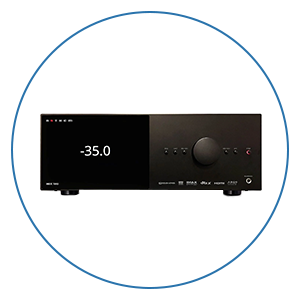
We ran a direct comparison using the final bombing scene from Midway, one of the most demanding sequences in the film, with intense dynamic audio and complex object movement, across three sources: a Roku, an Apple TV 4K, and the UHD Blu-ray disc, feeding a reference-level home theater system with a Trinnov Altitude 32 processor.
The Trinnov has a visualizer that shows you the audio objects moving around the room in real time, with each active speaker lighting up as signals are sent to it. What we saw was genuinely revealing. The disc produced smooth, natural, fluid object movement. The streaming sources showed the object balls on the Trinnov display behaving erratically, shimmering and moving in ways that simply were not there on the disc. You could literally watch the processor working harder to make sense of a compromised signal. We'd love to show it to you but in an ironic catch-22, the compression on YouTube is so severe the differences did not come through.
On the video side, the comparison was not subtle at all. The disc looked dramatically better on our large reference display. More detail, more stability, more of everything the director intended you to see.
One specific observation worth calling out: Apple TV 4K uses something called Dolby MAT, Metadata-Enhanced Audio Transmission, which wraps its audio signal in a way that can appear to a processor as lossless when it is not. Our Trinnov flagged this immediately, displaying red circles with squares around the Apple objects. It was as if the processor was telling us it could see what the signal was trying to do, and was not fooled. To Apple TV's credit, it is still one of the better streaming experiences available, and for casual viewing it is excellent. But on a reference system, the Trinnov does not lie.
The Streaming Bill Is Higher Than You Think
Here is something that does not get talked about enough: the economics of streaming have shifted dramatically, and not in the consumer's favor.
The idea that streaming is the affordable modern option is increasingly a myth. Here is what it actually costs right now to access 4K with Dolby Atmos across the major services as of April, 2026:
- Netflix Premium: $26.99 per month
- HBO Max Ultimate Ad-Free: $22.99 per month
- Disney+ No Ads: $18.99 per month
- Amazon Prime Video Ultra: as of April 2026, an additional $4.99 per month on top of your existing Prime membership. 4K and Dolby Atmos are no longer included with standard Prime.
- Paramount+ Premium: $13.99 per month
- Apple TV+: $12.99 per month. Worth noting, Apple includes 4K and Atmos at this price without requiring a more expensive tier, making it one of the better values in streaming.
Subscribe to all of them and you are approaching $100 a month, over $1,100 a year. For compressed audio and video that still does not come close to what a disc or Kaleidescape delivers.
A Smarter Way to Think About It
Rather than subscribing to every service, consider a different approach. Pick one or two services for the content you watch regularly. Use Fandango at Home when you or your friends just have to see a certain movie that night. You only pay for the rental and they have a huge selection of 4K with Atmos. Then buy or rent a disc, or add it to your Kaleidescape library when you want to experience what you paid for your system to deliver. Good UHD Blu-ray players from Sony and Panasonic start as low as around $200, and that is a one-time investment. Discs themselves run $15-25 new or considerably less used. You are getting the full lossless audio track and all the video data the studio intended, every time. Pretty soon you will have a great collection that you own.
Kaleidescape: The Best of Both Worlds
If you want disc-quality performance without ever touching a disc, Kaleidescape is in a class by itself with a proven 25-year track record. A Kaleidescape system stores a perfect bit-for-bit copy of the movie, lossless audio, full video data on a server in your home, accessible instantly from any seat in the room. The performance and the convenience is simply unmatched. We have written a full article on Kaleidescape if you want to go deeper on how it works and what it costs. If you are building or upgrading a serious home theater, it deserves to be part of the conversation.
The Bottom Line
Your home theater system is only as good as the signal you feed it. You have probably spent real money on great speakers, a quality amplifier or receiver, and a display you are proud of. Feeding that system a heavily compressed streaming signal is not giving it the chance to show you what it can really do.
A physical disc or Kaleidescape remain the gold standard for both audio and video quality in home theater. The bitrate numbers are not close. The audio quality is not close. And on a system built to resolve those differences, the experience of watching a great film the way it was intended to be seen and heard is simply in a different league.
Streaming services are charging you more every year for something that still does not come close. Your system deserves better. Give it what you paid good money for it to deliver.


